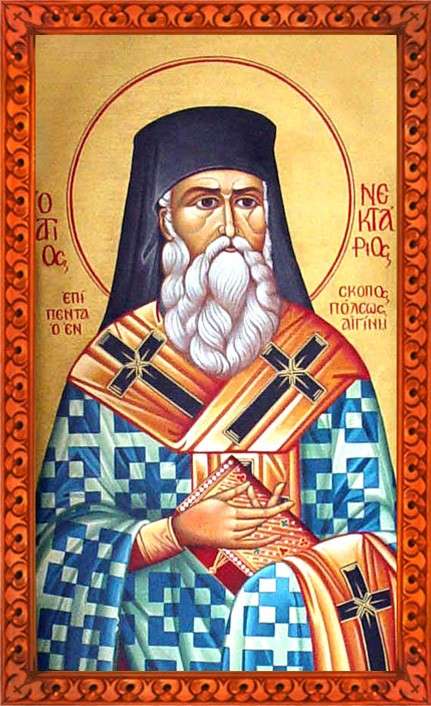
APOLYTIKION. Tone 1. To the melody “A citizen of the desert”.
Let us, the faithful, honour Nektarios, the offspring of Selybria and guardian of Aegina, who in these latter times was revealed as a true lover of virtue and a divinely inspired servant of Christ. For he pours forth healings of every kind for those who devoutly cry: Glory to Christ who glorified you; glory to Him who made you wondrous; glory to Him who works healings for all through you.
SAINT NEKTARIOS
SAINT NEKTARIOS, BISHOP OF PENTAPOLIS
THE LIFE OF THE SAINT:
Prologue:
Saint Nektarios of Pentapolis was born on Tuesday, 1 October 1846, in Selyvria of Turkish-occupied Thrace, to pious and poor parents—Dimos (Dimosthenis) and Balou (Vasiliki) Kephalas. His father was from Ioannina and worked as a sailor, while his mother was from Selyvria. He was the fifth child of the family, and at his baptism he was given the name Anastasios.
Youthful years:
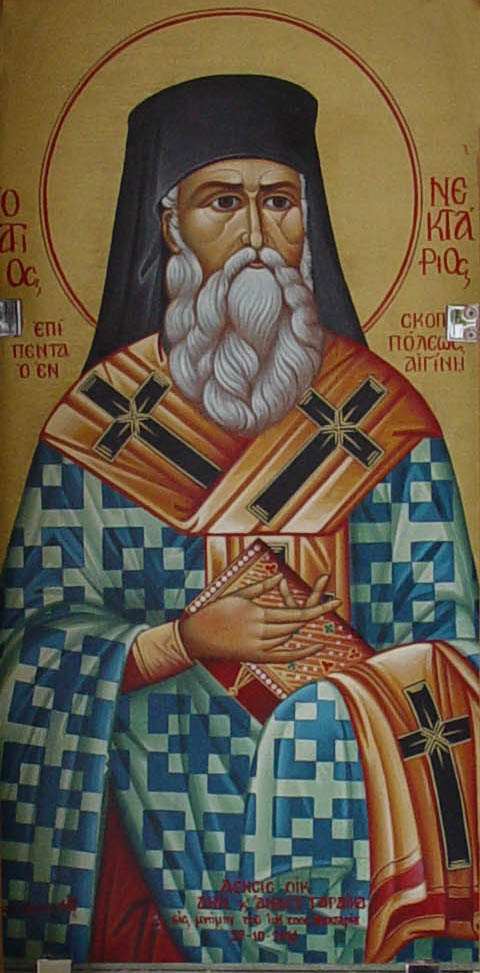 His mother taught him his first letters along with Christian teachings. In Selyvria he completed primary school and the school of letters. He was an exceptionally intelligent child with an excellent memory, and he showed his vocation for teaching and theology from a very early age. A characteristic example is that, at the age of just seven, he stitched sheets of paper together with the aim of making books in which to write the words of God, as he himself told his mother. Afterwards he emigrated to Constantinople, where he initially worked in a tobacco shop, both to help his family financially and to be able to continue his studies. During that time he began to study and collect sayings and maxims of the Holy Fathers and classical philosophers, which formed the two-volume book "Treasury of Sacred and Philosophical Sayings", published in 1895. He gathered them not only for his own use, but also to be able to pass them on to his fellow human beings and benefit them. A characteristic example of this aspect of his character is that he wrote some of these aphorisms on the paper tobacco bags of the shop, so that those who used them might read and benefit from them. This practice also solved the problem of their publication by him, in the absence of financial resources. Before he had even completed his twentieth year, he was employed as a teacher at the school of the Metochion of the Holy Sepulchre in Constantinople (the director of this school was his maternal uncle, Alexandros Triantafyllidis), where he continued his studies while at the same time working as a teacher of the lower classes. During this same period the first miracle of Saint Nektarios took place. While he was on a sailing vessel travelling from Constantinople to his native land to celebrate Christmas with his family, a great storm arose. However, through the exhortations and prayers of the Saint, the ship managed to reach its destination, thus saving the lives of his fellow passengers and, of course, himself.
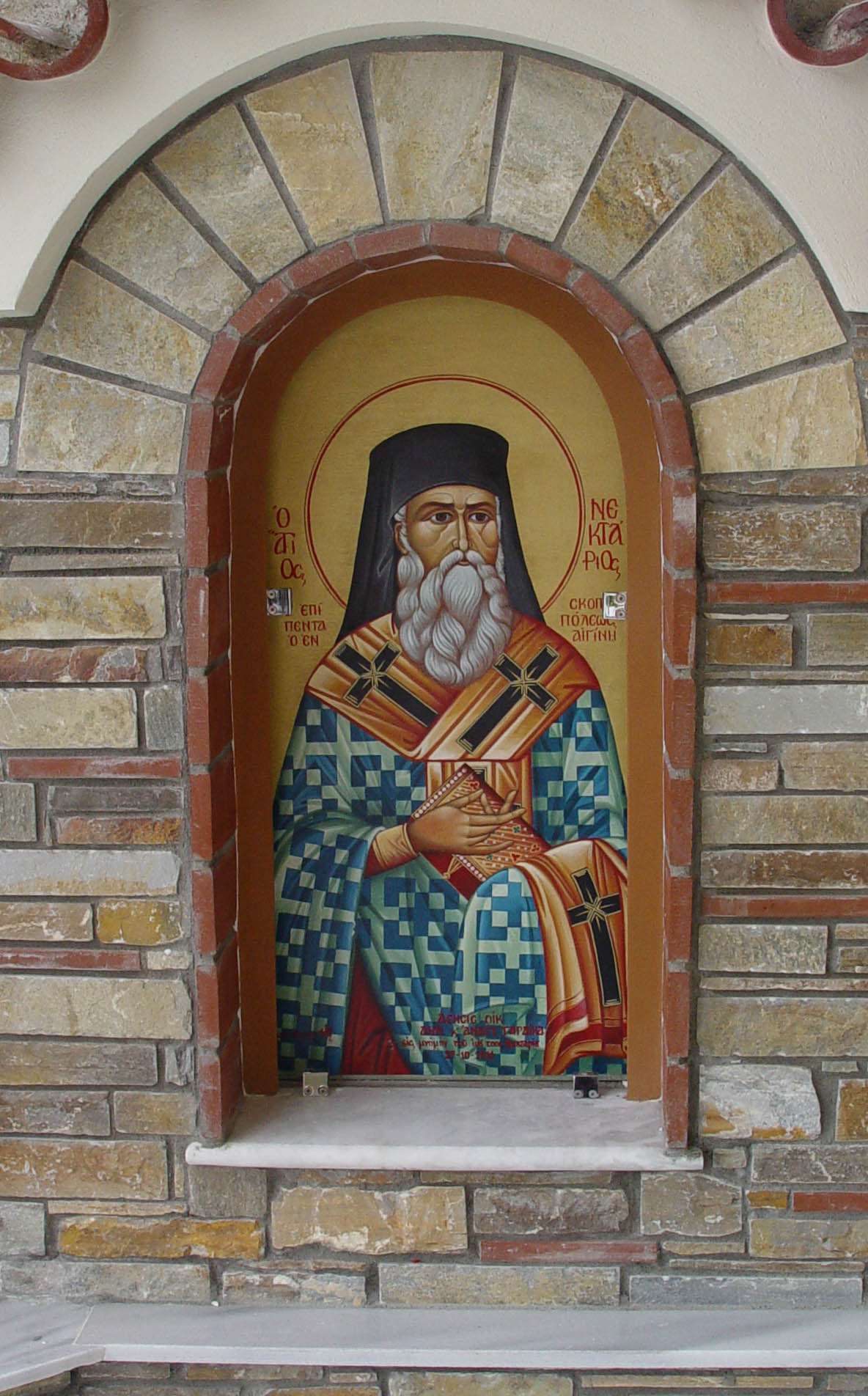 After Constantinople, it was Chios's turn to host the "Saint of the 20th century". Initially he worked as a village schoolmaster in the village of Lithi, while at the same time preaching in the churches of the area. After seven years had passed, he entered as a novice monk at "Nea Moni" on Chios at the age of 27. Three years later he became a monk (on 7 November 1876) and received the name Lazaros, and began working as secretary of the monastery. A few months later (on 15 January 1877) he was ordained hierodeacon by the then Metropolitan of Chios, Gregory. It was at his ordination that he received the name Nektarios. That same year (1877) he left Nea Moni with leave and went to Athens to continue his studies. It is worth mentioning at this point that the expenses of these studies were covered by the Choremis brothers—Ioannis and Dimosthenis Choremis. He returned to the island of Chios after three years, having in his luggage the diploma of the Gymnasium.
In late September 1882 he travelled to Alexandria, where he presented himself to Patriarch Sophronios and expressed his desire to continue his studies, giving him a letter of recommendation from the Hegumen of Nea Moni, Nikiforos. Sophronios indeed helped him (the Patriarchate assuming part of the expenses of his studies, while the rest were covered by the Choremis brothers), setting as a condition that, upon completion of his studies, he would return to Alexandria and work for the Patriarchate.
Thus Saint Nektarios once again set out for Athens, where he enrolled in the Athens School of Theology, graduating three years later. At the School of Theology he studied Dogmatics, Ethics, Old Testament, Hebrew, New Testament, Pastoral Theology, Patrology, Christian Archaeology, Catechetics, Symbolics and History of Dogma. During his studies he served as a deacon at the churches of Saint Irene on Aiolou Street, Pantanassa in Monastiraki, and Saint Nicholas in Pefkakia.
Alexandria:
It was late 1885 or early 1886 when he returned to Alexandria after completing his studies at the Athens School of Theology. On arrival, he immediately took up duties as a preacher. On 23 March 1886 he was ordained a priest in the Church of Saint Sabbas by the Patriarch of Alexandria, and in August of the same year he was elevated to the rank of archimandrite. He worked as secretary to the Patriarchate and later as Patriarchal Vicar in Cairo. In January 1889, Patriarch Sophronios, recognising the Saint's worth and seeing the love with which the faithful surrounded him, ordained him Metropolitan of Pentapolis. The Saint carried out his duties with zeal and in an exemplary manner. This resulted in his flock loving him more and more, while on the other hand some in the Patriarchal environment began to slander him, jealous of the love the Christians had for him and of the greatness of his character.
The slanderers cast their seeds, and they found fertile soil in the aged Patriarch, where they took root. What was the result? Saint Nektarios was stripped of his offices, and he was permitted only to remain in his room, forbidden to move about Cairo or the surrounding towns. Yet the slanderers were not satisfied. They continued their vile work, and so, on 11 July 1890, the Patriarchate of Alexandria issued a “certificate of dismissal,” compelling the Saint to leave Egypt, even though he had fully and uncomplainingly obeyed the orders of Sophronios. It is worth noting that this “certificate of dismissal” was not in accordance with the canons of the Church—no ecclesiastical trial had been held—and furthermore, the wages owed to him by the Patriarchate of Alexandria, from the day he was consecrated Metropolitan of Pentapolis until the day he was forced to depart Egypt, were never paid to him.
Athens:
Thus, Saint Nektarios set out for Athens for the third time. The slanderers had achieved their aim. From the moment he arrived in the Greek capital, he began seeking a position that would allow him once again to serve the people. After a difficult year, owing to his poor financial circumstances, he was appointed by the Church of Greece as Hierodeacon (preacher) of Euboea on 15 February 1891. He remained among the Christians there for two and a half years, until August 1893, when he was transferred to the prefecture of Phthiotis and Phocis. In his new position he stayed for only half a year. His character, his excellent disposition, his piety, and his deeds caused his flock to love him as a father, while his reputation continued to spread. When this reputation reached the “ears” of the authorities in Athens, it was decided that Saint Nektarios should be appointed director of the Rizareios School, a position he assumed in March 1894.
Rizareios School:
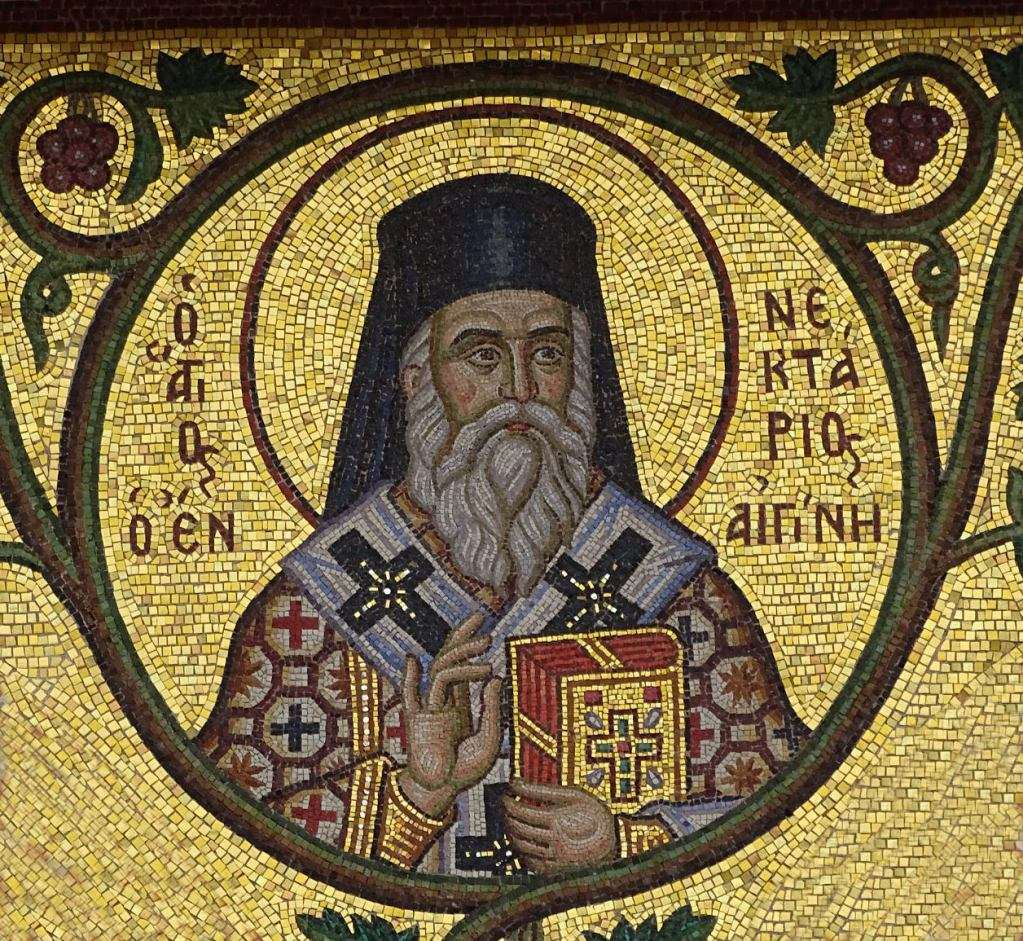 He remained director of the Rizareios School for 14 whole years. During those years he breathed new life into the institution and helped educate and bring forward many clergy and scholars. At the same time he continued his writing with even greater intensity: an activity that had accompanied him since his youth and bequeathed to us spiritual treasures born in the mind and soul of Saint Nektarios. For most of the day he worked for the needs of the school, and he devoted his scant free time to prayer, study, writing, and his beloved pastime: the care of flowers and trees.
During the summer holidays of the school in the summer of 1898, Saint Nektarios visited Mount Athos, where he toured the monasteries there for nearly two months. During this period he studied extensively the manuscripts in the monastic libraries, seeking material for his scholarly works. Alongside his duties as director of the Rizareios, he also undertook charitable work, assisting those in need on both spiritual and material levels. The intense physical and spiritual activity of those years took a toll on his health, and he fell ill with increasing frequency. It was then that the idea of returning to the monastic life took root in his mind, and he requested his “certificate of dismissal” from the New Monastery of Chios, so that he might become a monk wherever he wished. This certificate was sent by the New Monastery to Saint Nektarios on 24 November 1900.
Aegina:
At a certain point, when Saint Nektarios met Chrysanthi Stroggylou (later Abbess Xenia), a blind and pious woman, the first stone was laid for the foundation of a monastery on Aegina. Chrysanthi, together with a few other women, desired to become nuns and were seeking a spiritual guide, whom they found in the person of Saint Nektarios. At his encouragement, they began searching for a site for the establishment of a monastery, and finally settled upon a ruined monastery—dedicated to the Life-giving Spring and dissolved since 1834 by a Bavarian decree—on Aegina. When the Saint himself visited the place, it was decided to restore the old buildings of the monastery and to bring it back into operation. Work for this purpose began in 1904, and the monastery was to be dedicated to the Holy Trinity. From Athens—where he was still director of the Rizareios—Saint Nektarios guided the nuns and, whenever he found time, visited the monastery in which he was destined to spend the final years of his life.
After four years, having now decided to withdraw to the monastery on Aegina and to devote himself to its organisation and the spiritual guidance of the nuns who served there, he submitted his resignation to the administrative board of the Rizareios on 7 February 1908. The board accepted his resignation and, as a minimal recognition of his work, granted him a pension of 250 drachmas per month, a considerable sum for that time. He took up residence in the monastery after Pascha of the same year, since he remained in the post of director of the Rizareios until a successor was found. At his own expense he built a house nearby, but outside the monastery, in which he would live. It is noteworthy that he took an active part in the construction, carrying earth or mud and digging, thereby assisting the craftsmen. Never in his entire life did he consider any work beneath him. He always did whatever lay within his power with special joy, zeal, and humility! One undertaking to which he devoted effort and time was the official recognition of the Monastery by the Church of Greece. This recognition was finally achieved four years after his repose and was announced to the nuns in a letter from Archbishop Chrysostom on 15 May 1924.
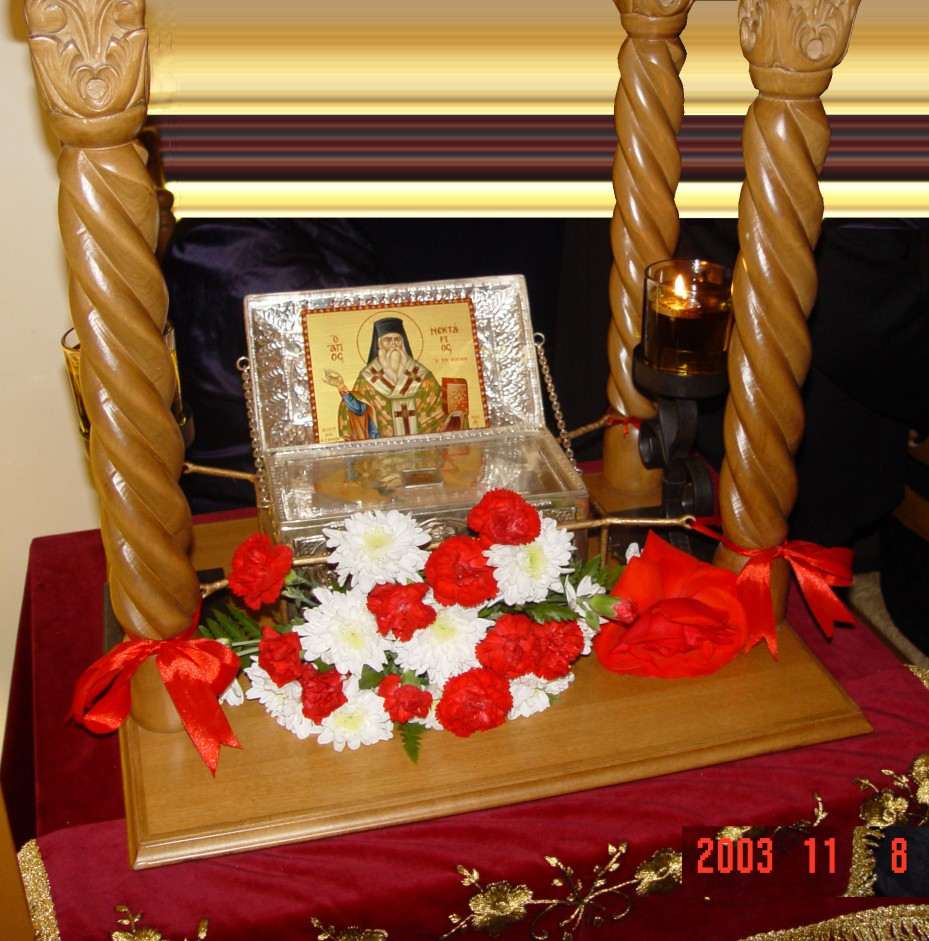 In the final years of his life, Saint Nektarios suffered from chronic prostatitis, which caused him unbearable pain. He eventually agreed to the doctors' recommendations and went to Athens to the Areteio Hospital. There he was hospitalised—in the second ward on the second floor (it was a third-class ward, a cause of wonderment)—for nearly two months. By his side, throughout his entire hospitalisation, were the nuns Euphemia and Agapia, who were constantly present, taking turns in shifts. Finally, around midnight between the 8th and 9th of November 1920, he departed for the Heavens at the age of 74.
The holy body of the Saint was transferred to Aegina, and from the harbour to the monastery the faithful carried it in their arms. The whole island mourned, but most of all the nuns, who had lost their Father and Guide. His holy relics had already begun to emit a sweet fragrance. His burial took place in the monastery courtyard, beside his beloved pine tree.
When, six months later, the tomb was opened to install a gravestone—a donation from the Rizareios School—his holy body was still fragrant, showing not the slightest sign of decay. A year and a half later, the tomb was opened again, and his holy relics continued to remain incorrupt and fragrant. The same occurred three years after his repose. In all, his holy body remained in this state for twenty whole years! Moreover, thirty-two years after his repose, his holy relics were translated on 2 September 1953 by Metropolitan Prokopios.
His official recognition as a Saint of our Orthodox Church took place in 1961 by a Patriarchal Synodal Act of the Ecumenical Patriarchate. Then 9 November was also established as the feast day of Saint Nektarios.
Apolytikion (Download)
Tone 1. To the melody “A citizen of the desert”. Let us, the faithful, honour Nektarios, the offspring of Selybria and guardian of Aegina, who in these latter times was revealed as a true lover of virtue and a divinely inspired servant of Christ. For he pours forth healings of every kind for those who devoutly cry: Glory to Christ who glorified you; glory to Him who made you wondrous; glory to Him who works healings for all through you.
Kontakion
Tone Plagal 4. To the melody “To the Champion Leader”.
(You may download or publish part or all of the material on this website, provided that www.galilea.gr is acknowledged as the source. www.galilea.gr)