
APOLYTIKION. Plagal Tone 1. To the melody “The Word without Beginning.”
Let us honour Luke, physician and shepherd, radiant hierarch of the flock of Simferopol, who bore Christ's divine marks: exiles, hardships, imprisonment, afflictions and reproaches, a new Saint revealed in Russia in these latter times.
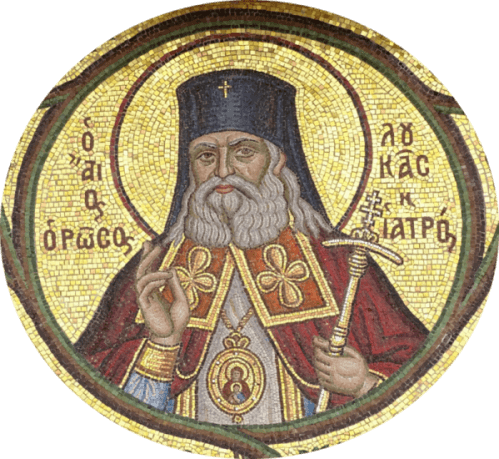
SAINT LUKE THE PHYSICIAN
SAINT LUKE THE RUSSIAN AND PHYSICIAN
THE LIFE OF THE SAINT:
Prologue:
The cross, persecution, affliction and temptation are the lot of the Church and of the true Christian. There is no Orthodox Church that 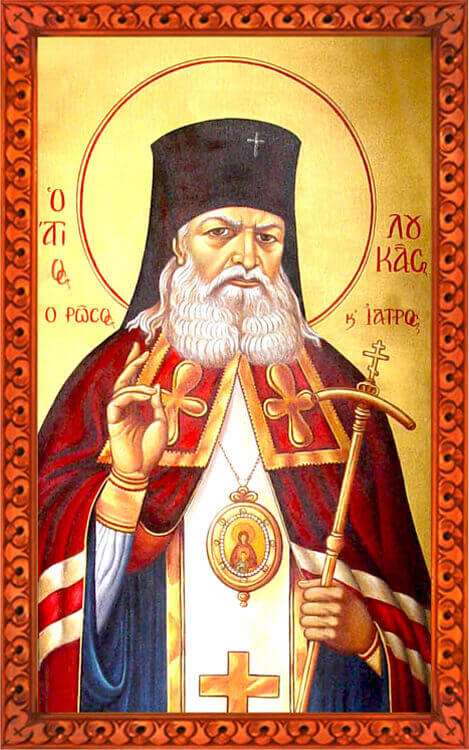 has not lived through its own persecution. Nor was there any saint who did not pass through his own furnace of afflictions, persecutions and temptations. A moving testimony of the cross is also that of this Venerable Saint Luke, Archbishop of Simferopol and Crimea, the physician and professor of topographical anatomy and surgery. A man of rare talents and spiritual gifts, with remarkable scientific training, he served humanity as both shepherd and doctor, with admirable self-denial and love.
The early years:
Saint Luke the Archbishop, known in the world as Valentin, son of Felix, Voyno-Yasenetsky, was born on 14/27 April 1877 in Kerch on the Crimean peninsula. The family environment in which he grew up was unusual: his father was Roman Catholic, while his mother, though Orthodox, confined herself to good deeds without taking an active part in the Church's worship. The family moved to Kyiv when he was very young. In Kyiv, Valentin decided to study Medicine. He obtained his degree in 1903 and pursued studies in ophthalmology.
Medical practice – family:
In 1904, with the outbreak of the Russo-Japanese War, he found himself in the Far East, where he worked as a surgeon with great success. There he met Anna Vasilievna Lanskaya, his future wife, with whom he had four children. After the war ended, he worked in various provincial hospitals. His successes were so numerous that his fame spread quickly, and patients arrived from everywhere. At the same time, he studied local anaesthesia and wrote scientific articles. He excelled in eye surgery and decided to devote himself to the treatment of pyogenic infections.
In 1917, Valentin was elected professor at the University of Tashkent. The Russian Revolution had already begun, and the Church found itself in the sights of the Bolsheviks. The situation had spiralled out of control. At that time, Valentin was arrested for the first time. The cause was the slander of a nurse. With God's help, the truth was revealed and the doctor was set free. This ordeal, however, despite its happy ending, deeply disturbed Anna, who was already suffering from tuberculosis, and her health deteriorated to the point that she passed away a few days later. After her death, the doctor entrusted his children to Sofia Sergeevna, a faithful nurse, who stood to them as a second mother for many years.
Valentin was deeply faithful, and this was evident in the way he worked. The result was that the first reactions arose from representatives of the atheistic regime. Meanwhile, to the persecutions was added the wound of the "Living Church", which aimed to serve the interests of the State by dividing the clergy and the faithful and leading them away from the true Faith.
Ordination as Priest-Bishop:
In this time of trials for the Church, the doctor participated actively in its life. When Archbishop Innokenty of Tashkent and Turkestan was accused by the schismatics, the doctor vigorously defended canonical order. Archbishop Innokenty, impressed by Valentin's boldness, proposed that he become a priest. Indeed, his ordination as deacon took place on 26 January 1921, and a week later he was ordained presbyter.
In the summer of 1923, the "Living Church" launched its offensive and exiled Bishop Innokenty. The clergy and people of Tashkent, left at the mercy of the schismatics, elected Father Valentin Voyno-Yasenetsky as their bishop. His monastic tonsure took place secretly in the home of the priest-professor. The name deemed most suitable for the new bishop was that of the Apostle, Evangelist, icon painter and physician Luke.
Imprisonment – exile:
This did not go unnoticed, and very soon Bishop Luke was arrested. He was accused of treason and imprisoned. 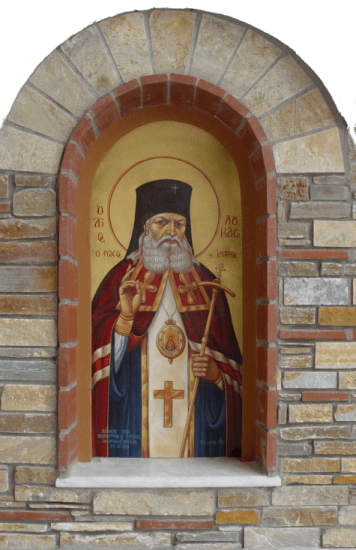 In prison he had the opportunity to complete his work, Essays on the Surgery of Pyogenic Infections. Despite its importance for medical science, it remained unpublished for many years because its author insisted that his episcopal title appear on the cover.
During his absence, representatives of the "Living Church" seized the churches, but the people, faithful to their shepherd's counsel, stayed away from the temples. Due to his great influence, the authorities of the G.P.U. ("State Political Directorate") decided to remove Bishop Luke from Tashkent. At the moment of his departure, a large crowd gathered at the railway lines in an attempt to prevent his departure. The people were dispersed by the police forces, and Bishop Luke set out on the long and painful road of exile.
He was imprisoned under wretched conditions in Moscow. There he began to experience the first symptoms of heart failure, which would accompany him throughout his life. Despite all the hardships, the Bishop's conduct towards all the prisoners evoked respect even from the most hostile.
First transplant surgery:
 Although doctors assured him that his health condition did not permit it, Bishop Luke departed as an exile for Siberia. The regime settled him in the town of Yeniseysk. At the hospital in Yeniseysk, he attempted a pioneering and extremely difficult operation. They brought him a young man suffering from severe kidney failure. His condition was desperate. The doctor-Bishop, having no other solution, decided to perform a "heroic" operation and attempted a kidney transplant from a calf to the young patient, despite the meagre resources at his disposal. The doctor who recounted this event described the operation as successful, though he provided no further details regarding how long the patient lived, post-operative complications, and so forth. Although this was the first transplant surgery, it did not become widely known, evidently for political reasons. It was not fitting to promote an "enemy of the people"! For this reason, the first such operation officially recognised is that of Professor I. I. Vorony in 1934 (a decade later), when he performed a pig kidney transplant on a woman suffering from uraemia.
New exile:
Subsequently, the G.P.U. sent him a further 2,000 km away, to the town of Turukhansk. Even in this new place of exile, he did not refuse to offer his services to those in need, despite the adverse conditions. The people of Turukhansk surrounded him with great love and respect. This was sufficient for the atheists, who planned a new exile for the doctor-Bishop; this time they sent him beyond the Arctic Circle, to the village of Plakhino, where the sun does not rise during the winter solstice. The Bishop's health had deteriorated, and such an exile was extremely dangerous for his life. This was precisely the aim of his persecutors. There, in Plakhino, he suffered terribly, both due to the weather conditions and due to the treatment he received from the local inhabitants. Fortunately, two months later, prompted by the death of a peasant, the people of Turukhansk rose up and demanded the Bishop's return. The authorities had no choice but to yield. Thus, Bishop Luke, who had been warned by a vision that his trial was over, returned to Turukhansk and continued his labours undisturbed for another eight months, that is, until the end of his exile. Despite all the difficulties he faced, he never forgot his children and communicated with them as often as he could.
Resignation as Bishop – Exile in Siberia:
In Krasnoyarsk, he appeared before the G.P.U. for interrogation. There, the assistant to the commander informed the Bishop that he could go wherever he wished; he was free. Naturally, the Bishop set out for Tashkent. Unfortunately, there he encountered slander even from his collaborators, a situation which led him to resign from his episcopal see.
In Tashkent, he continued his charitable works, but his adversaries never ceased seeking opportunities to drive him away. The pretext was not long in coming, and the Bishop once again found himself accountable before the Party officials. This time, the aim was to force him to resign from his sacred office. After exhaustive interrogations and hunger strikes, and having spent a whole year in prison, the Bishop was exiled once more to Northern Russia. His activities there disturbed not only the authorities but also the inhabitants. Soon, a serious health problem compelled him to travel to Leningrad.
After his recovery, he underwent a long period of trials and wandering. Party representatives pressured the Bishop to abandon the priesthood. During this period of spiritual trial, he began to lose sight in his left eye due to retinal detachment. His Essays on the Surgery of Pyogenic Infections were also published without mentioning his ecclesiastical office. In time, he regained the inner peace he had lost, and spent two years of tranquillity and peace close to his children.
New arrest – New exile:
Bishop Luke was 60 years old when he was arrested for the fourth time. The file kept on him by the security authorities enables us to learn about his activities. Not only did he never take money from his patients, but he also gave his salary to charitable causes, helping whatever poor, destitute and exiled people he happened to know. His charitable work once again displeased the regime, which arrested him anew and sent him to Siberia.
Service in the First World War – Honours and awards:
 When on 21 June 1941 the Hitlerite forces entered Russia, the doctor-Bishop, although an exile, volunteered to work for the treatment of the wounded. The Party recognised his value as a physician and appointed him chief physician of the military hospital and adviser to all the hospitals in the region. Nevertheless, the conditions were wretched, and at the same time he was denied any political rights.
In the Spring of 1942, the attitude of the State towards him, and towards the Church, changed. Throughout the territory of Russia, churches were opened, and the people found refuge in the temples from the madness of war. To meet the existing needs, Bishop Luke was promoted to Archbishop of Krasnoyarsk. As the Germans retreated, the Archbishop was transferred further west, to Tambov. At that time, he was responsible for 150 military hospitals. To facilitate his work, the Church transferred him to the Archbishopric of Tambov and Michurinsk. In 1946, Archbishop Luke was awarded the Stalin Prize for his heroic work during the Second World War and for his great contribution to the medical sciences.
Archbishop of Simferopol and Crimea – Preaching:
At the age of seventy, he became Archbishop of Simferopol and Crimea. There, his work was arduous. Poverty had reached such dimensions that he was compelled to feed the indigent of the region daily in his own home. Excluded from every scientific congress, he turned his attention to ecclesiastical life. He made superhuman efforts to reopen churches. At the same time, he strove to curb the negligence and indifference of the priests, emphasising that they themselves must serve as examples for the faithful to imitate. Meanwhile, he continued his work as a physician, offering his services selflessly to the suffering. Following the example of the God-Man throughout his life, he “went about doing good and healing all”.
As relations between Church and State improved, the Archbishop found the opportunity to return to his beloved activity, namely preaching. “I consider it a fundamental episcopal duty to preach Christ everywhere and always,” he himself notes. About 750 of his sermons were recorded, forming 12 volumes (4,500 pages), and have been described as “an exceptional phenomenon in contemporary ecclesiastical life and theology”.
In the Spring of 1952, his eyesight deteriorated, and by early 1956 he was completely blind. In 1953, Nikita Khrushchev succeeded Stalin and launched a new wave of persecutions against the Church, which reached their peak in 1959. The Archbishop cared for his flock and sought to strengthen their courage. At that time, he wrote to his eldest son, Mikhail: “It is becoming increasingly difficult to manage the affairs of the Church. Churches are closing one after another; there are no priests, and their number keeps dwindling. In some places opposition goes as far as rebellion against my episcopal authority. At eighty years of age I cannot bear it. Yet with the Lord's help I continue my difficult work.” Yet the love of the people for Archbishop Luke was evident. Even those of other faiths or without faith regarded him with reverence.
Repose and Canonisation:
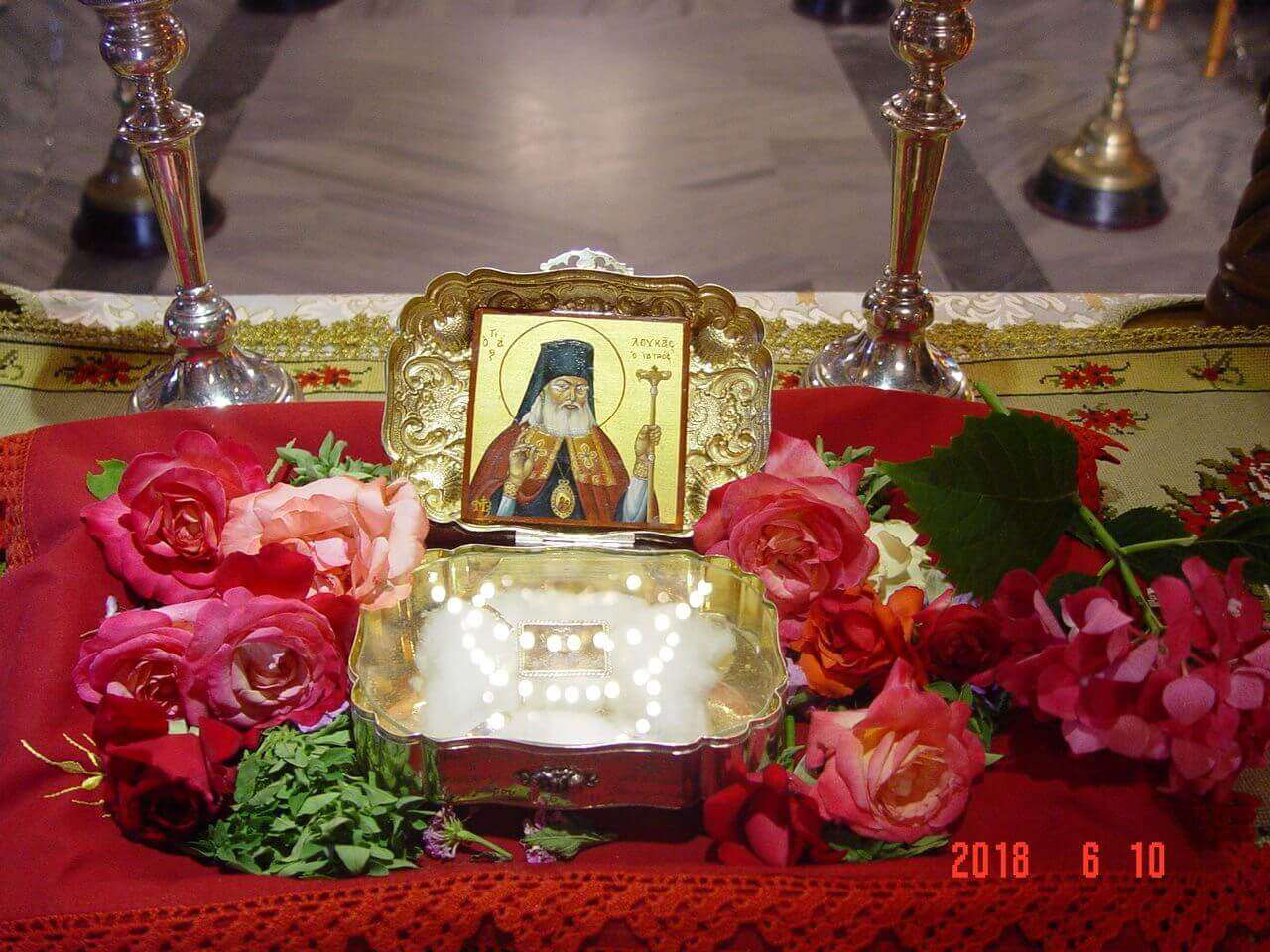 The Archbishop was already 84 years old. He sensed that his end was drawing near. At the Nativity of Christ in 1960, he celebrated the Divine Liturgy for the last time; for the time remaining, he confined himself to preaching. Finally, on Sunday, 11 June 1961, the day on which the All Saints of Holy Russia are commemorated, Archbishop Luke Voino-Yasenetsky fell asleep in the Lord. Despite the fierce opposition of the Communist authorities, his funeral was transformed into a popular uprising. E. P. Leikfeld describes: "The streets were flooded with women wearing white headscarves. They moved slowly forward before the bier of the Bishop. Even the Gerontissa did not lag behind. Three rows of outstretched arms seemed to guide the hearse. The road all the way to the cemetery was strewn with roses. And as far as the cemetery gate, above the heads with their white scarves, the hymn could be heard: 'Holy God, Holy Mighty, Holy Immortal, have mercy on us.' Whatever was said to this crowd, however hard they tried to silence them, the answer was one: 'We are burying our Archbishop.'"
In November 1995, he was proclaimed a Saint by the Ukrainian Orthodox Church. On 17 March 1996, his holy relics were solemnly exhumed and placed for public veneration in the cemetery church, dedicated to the memory of the All Saints. His holy relics emitted an indescribable fragrance, and many sick people were miraculously healed. Three days later, on 20 March 1996, his holy relics were transferred to the Church of the Holy Trinity. On 24–25 May 1996, his official canonisation by the Patriarchate of Russia took place.
Saint Archbishop Luke Voino-Yasenetsky, by his life, proved that there is essentially no chasm between religion and science. He succeeded in combining them in the best possible way, motivated by selfless service to his neighbour, in perfect harmony with the word of God. His self-renunciation in pursuit of this goal is the reason he was so deeply loved by the Ukrainian people and Orthodox Christians throughout the world, while at the same time winning the respect of his enemies.
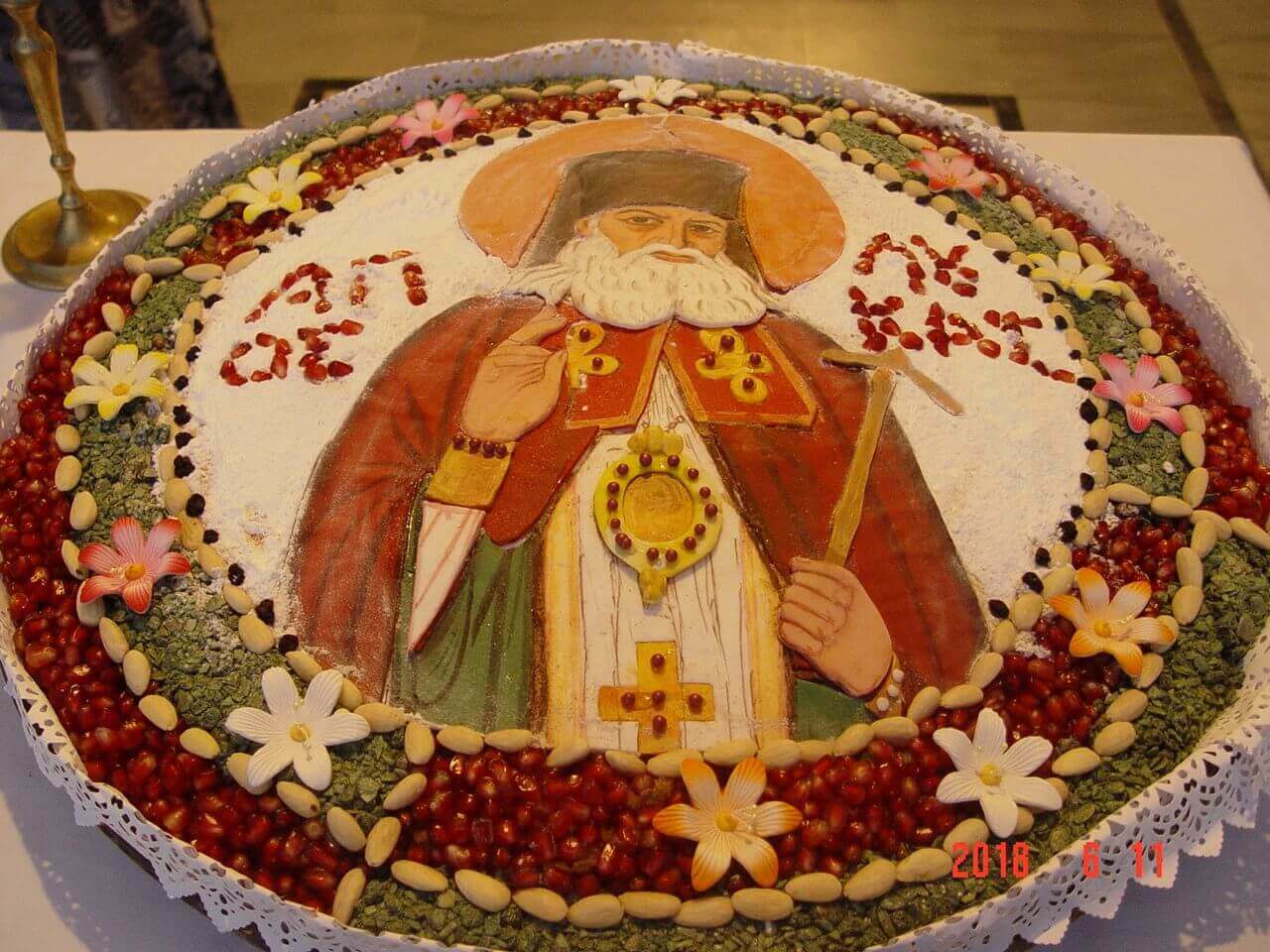
His commemoration was appointed for 11 June, the anniversary of his repose.
Apolytikion. Plagal Tone 1. To the melody “The Word, coeternal.”
Let us honour Luke, physician and shepherd, the radiant hierarch of the flock of Simferopol, who bore the divine marks of Christ: exile, hardships, confinement in prisons, afflictions and reproaches; the new saint who appeared in Russia in these latter times.
Kontakion. Plagal Tone 4. To the melody “To you, the Champion.”
Let us who love the saints wholeheartedly praise Luke, chief shepherd of Simferopol and most excellent physician and scientist. For, living like an angel in Russia, he confessed Christ's divine name. Therefore we cry: Rejoice, O father of blessed memory.
(You may download or publish part or all of the material on this website, provided that www.galilea.gr is acknowledged as the source. www.galilea.gr)
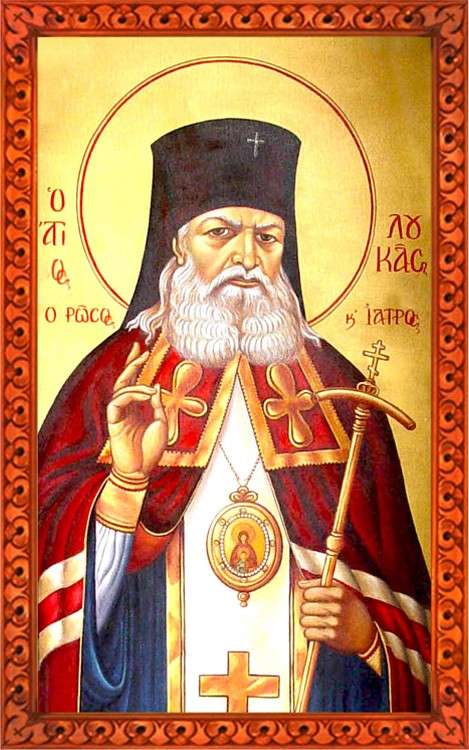
ONE OF SAINT LUKE'S MIRACLES
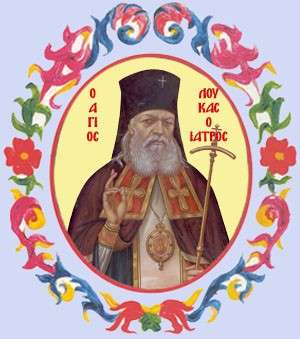
Our own miracle. (19/ 03/19)
It is difficult to express an experience in words… Especially when a little time has passed since then… We already had two little children, and in the summer of 2015 I became pregnant with our 3rd. Great joy, especially at a time when everything seemed difficult. It was when capital controls made us queue at ATMs to withdraw up to 40 euros a day—if the machine had money!—and buy milk for the children and long-life foods, fearing the worst… Everything was going well with the pregnancy… Until it was time for the “big ultrasound scan”…
…………………………………………………..
Because… as we also wrote on the card accompanying the icon of Saint Luke that we gave to our gynaecologist,
“There was another Physician on the team during this pregnancy…”
Holy fellow physician,
We thank you, Fotis—Elena
(Papageorgiou, physicians)
SAINT LUKE THE PHYSICIAN AS A FAMILY MAN
“SAINT LUKE THE PHYSICIAN AS A FAMILY MAN”
A talk by Fr Nikiforos Kontogiannis on “Saint Luke the Physician as a Family Man”. The talk was given on Saturday 17 August 2019, at the invitation of Fr Dionysios Golias, rector of the Church of Saint Anna in Katerini, to young people and young families staying at the “Saint George” camp of the Holy Metropolis of Katerini in Ritini, Pieria. It took place in beautiful natural surroundings, with the blessings of our Metropolitan, His Eminence Ieronymos of Larissa and Tyrnavos, and the good wishes of His Eminence Metropolitan Georgios of Kitros, Katerini and Platamonas, who blessed and honoured the event with his presence, addressing warm, familiar words full of love.