THE VENERABLE JOHN THE RUSSIAN
THE LIFE OF THE SAINT:
Prologue:
The Venerable John was born around 1690 AD, in a village of the so-called Little Russia (present-day Ukraine), from pious and  virtuous parents. During the reign of the Great Peter in Russia, the Venerable one enlisted and took part in the Russo-Turkish War (1710–1711), where he was captured as a prisoner of war by the Tatars.
His Captivity:
The Tatars sold him to an Ottoman cavalry officer (Hipparchos) who hailed from Prokopi in Asia Minor, located near Caesarea of Cappadocia. The Aga took him to his village and, as was customary at the time, tried to persuade him to renounce his faith. Many of his fellow-countrymen, who were also captives, denied the faith of Christ and became Muslims, either because they were overcome by threats or because they were tempted by promises and offers of material goods. The Saint, however, had been raised from childhood with the instruction and admonition of the Lord; he loved God and the faith of his fathers very much. He endured all the tortures with patience and admirable courage. His adamant Christian character shone forth. Like the sun, his wonderful inner world shone, a world entirely devoted to Christ from his childhood years. In the face of beatings, insults and kicks from the Turks, he replied with the words of Paul: “Who shall separate me from the love of Christ? Shall tribulation, or distress, or persecution, or nakedness, or peril, or sword?” I have confidence, faith and love in my Lord Jesus Christ, the Only-Begotten Son of my God, and nothing of all these evils shall separate me from His love. Thus, the blessed John, having the wisdom which God gives to those who love Him, endured slavery, the ill-treatment of his master, and the insults and taunts of the Ottomans, who called him “kafir”, that is, unbeliever, showing him their contempt and hatred. To his master and to all who urged him to renounce his faith, he replied with firm conviction that he preferred to die rather than fall into such a terrible sin. He said to the Aga: “If you leave me free in my faith, I shall be very willing to obey your commands. If you force me to renounce my faith, know that I surrender my head rather than my faith. I was born a Christian and a Christian I shall die.” Thus, seeing the great faith and humility which adorned John, his gentleness and his daily confession, God softened the hard heart of the Aga, who in time began to feel affection for him.
His Way of Life:
Gradually, then, John became calm in the face of the promises and threats of his Ottoman master, who had appointed him to the  stable to care for his animals. The Saint’s living conditions were very harsh. In a corner of the stable he would lie down his weary body and rest, yet giving thanks to God, for he was deemed worthy to have as his bed the manger in which our Lord Jesus Christ was laid at His birth. He was devoted to his work, caring tenderly for his master’s animals, which sensed the Saint’s love for them so keenly that they would seek him when he was absent, gaze upon him with affection, and neigh with joy when he stroked them, as if they were conversing with him. He ate very little, his clothes were poor, and he was forced to walk barefoot. In this stable the Saint prayed, and often at night he would visit a nearby church dedicated to Saint George. As time passed, however, both his master and his wife came to love him and offered him a small cell near the barn as a dwelling. John, however, refused and continued to sleep in the stable, so as to mortify his body through hardship and asceticism amidst the stench of the animals. That stable was filled every night with the Saint’s prayers, and the foul smell became a fragrance of spiritual sweetness. The Venerable John had that stable as his place of ascetic struggle, and there he followed the rules of the Fathers, praying on his knees for hours, sleeping very little upon the straw, with no other covering than an old cloak. He fasted on most days, having as his meal often only a little bread and water. Besides prayer and fasting, which he practised like another Job, he would go at night and keep all-night Vigils standing in the narthex of the church of Saint George, which was built within a rock and situated near the house of his Turkish master. He went there secretly at night, and every Saturday he received the Holy Mysteries. And the Lord, “who searches hearts and reins”, looked upon His faithful servant and caused his fellow-slaves to cease mocking and insulting him; the brutality of the Turks was tamed, and in amazement they called him “veli”, that is, saint.
The Miracle at Mecca:
In time, the master of our Venerable One grew wealthy and became one of the most powerful men in Prokopi. At a certain point, the Turkish officer decided to make a pilgrimage to Mecca, the holy city of the Muslims. After a considerable period had passed since his departure, his wife invited the man's relatives and friends and hosted a feast so that they might rejoice together and pray for his safe return from the pilgrimage. During the feast, at which John also served, they set before the lady a dish that the master greatly favoured, known as pilaf, which is much enjoyed in the East. The hostess then remembered her husband and said to John: "How delighted your master would be if he were here, eating this pilaf with us!" Addressing his mistress, John asked for a plate full of pilaf, saying that he would send it to his master in Mecca. Immediately, the hostess, unmoved by the laughter of the guests, instructed the cook to give a dish of food to John. She thought either that he himself was hungry and wished to eat it, or that he would offer it as alms to some poor Christian family, as he was accustomed to doing by giving away his own food. Taking the food, the Saint withdrew to the stable, where, kneeling in prayer, he beseeched God from the depths of his heart to send the food to his master in whatever way He, in His omnipotence, might arrange. With the simplicity that marked him and the humble heart he possessed, John believed that the Lord would hear his prayer and that the food would miraculously reach Mecca. He believed, "without doubting", in the words of the Lord, having no hesitation that what he asked for would come to pass. And, as Saint Isaac the Syrian says, "these supernatural signs happen to those who are simpler in mind and warmer in hope"; that is to say, these supernatural miracles occur in those who have a simpler mind and are warmer in the hope they place in God. And indeed, the dish of food vanished from the sight of the Venerable One. The blessed John, returning to the house, told the hostess that he had sent the food to Mecca, once again provoking the laughter of the guests.
However, when a few days later his master returned from Mecca carrying with him the copper dish, all were amazed. All, that is, except our Saint. The master's household listened with wonder to the account of how, upon returning from the great mosque to the house where he was staying, the master found a steaming plate of pilaf upon the table. He himself could not explain how this food had come to be in his locked room. He said, "Not knowing how to explain this strange thing, I was examining the dish in which the pilaf was steaming, and I saw with wonder that my name was engraved upon the copper, just as on all the copper vessels of our house. Despite the disturbance I felt from this unexplainable event, I sat and ate the pilaf with great appetite; and here is the dish which I brought with me, and it is truly ours." Hearing this account, his wife immediately told the master that John had asked her for the dish of food and said that he had sent it to Mecca, and that the guests had laughed when they heard him.
This miracle of the Saint was immediately known throughout the whole village and the surrounding region. All now regarded John as a righteous man beloved of God; they looked upon him with awe and reverence, and no one dared to trouble him. Although his master and his wife again begged him to leave the stable and dwell in a house, he continued to live his life in the same manner, as an ascetic, working as before in the care of the animals and willingly carrying out the master's wishes.
His Repose:
Working by day and praying by night, Saint John lived out the remainder of his life until 27 May 1730, when 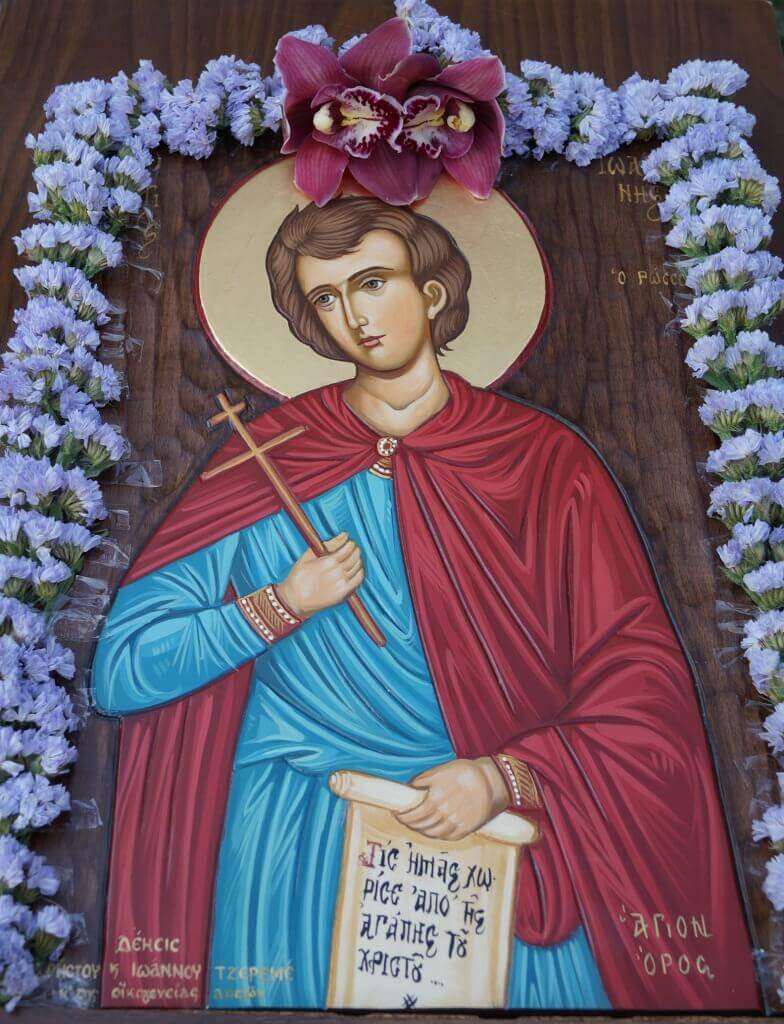 he fell asleep in the Lord at the age of 40. He had found a support in all his struggles and a comfort in his life full of hardship. He took refuge in prayers, prostrations, all-night Vigils, and secretly received the Holy Mysteries from the Turks. Holy Communion was his great rest and refreshment. As he approached the end of his life, he fell ill and remained lying on the straw in the stable, which he had sanctified with his supplications for the name and love of Christ. The Venerable One, sensing his end, asked to receive Holy Communion. A priest was sent and summoned for this purpose. Fearing to carry the Holy Mysteries openly to the stable because of the Turks' fanaticism, the priest, by divine illumination, devised a plan: he placed the Holy Communion inside an apple, which he hollowed out for this very purpose. Thus he went to the stable and gave Holy Communion to the blessed John, who, as soon as he received the Holy Body and the Precious Blood of the Lord, surrendered his holy soul into the hands of God, whom he so loved. It was 27 May 1730 AD.
His Burial:
The priest who had given Holy Communion to the Saint saw the Venerable John in a dream in November 1733. The Venerable One told him that his body, by the grace of God, had remained in the tomb intact, whole and incorrupt, just as it had been placed there 3 1/2 years earlier. He said, "Take it out, and it will be with you as a blessing from God for all ages." Despite the priest's hesitations, by divine permission, a heavenly light shone upon the Venerable One's tomb like a pillar of fire. When the Christians opened the tomb, they found the Venerable One's body intact, incorrupt and fragrant with that divine sweetness which it continues to have to this day. In 1733 AD, the priests and leading Christians of Prokopi, with the Turk's permission, took the intact and fragrant holy relics of the Venerable John and, with emotion and tears, in deep compunction, with censers and candles, with reverence and care, carried them to the rock-hewn church of Saint George, in whom the Saint prayed while he was alive. Later, the holy relics of the Saint were transferred to the newly built church of Saint Basil and, finally, to the church built in his honour. They were placed in a reliquary on the right side of the Church, and there countless pilgrims and sufferers from various illnesses came and found their healing.
Osman Burns the Holy Relics:
In 1832 AD, Ibrahim Pasha, the Viceroy of Egypt, revolted against Sultan Mahmud II, who sent Hazneta Oglou Osman Pasha with 1,800 soldiers against 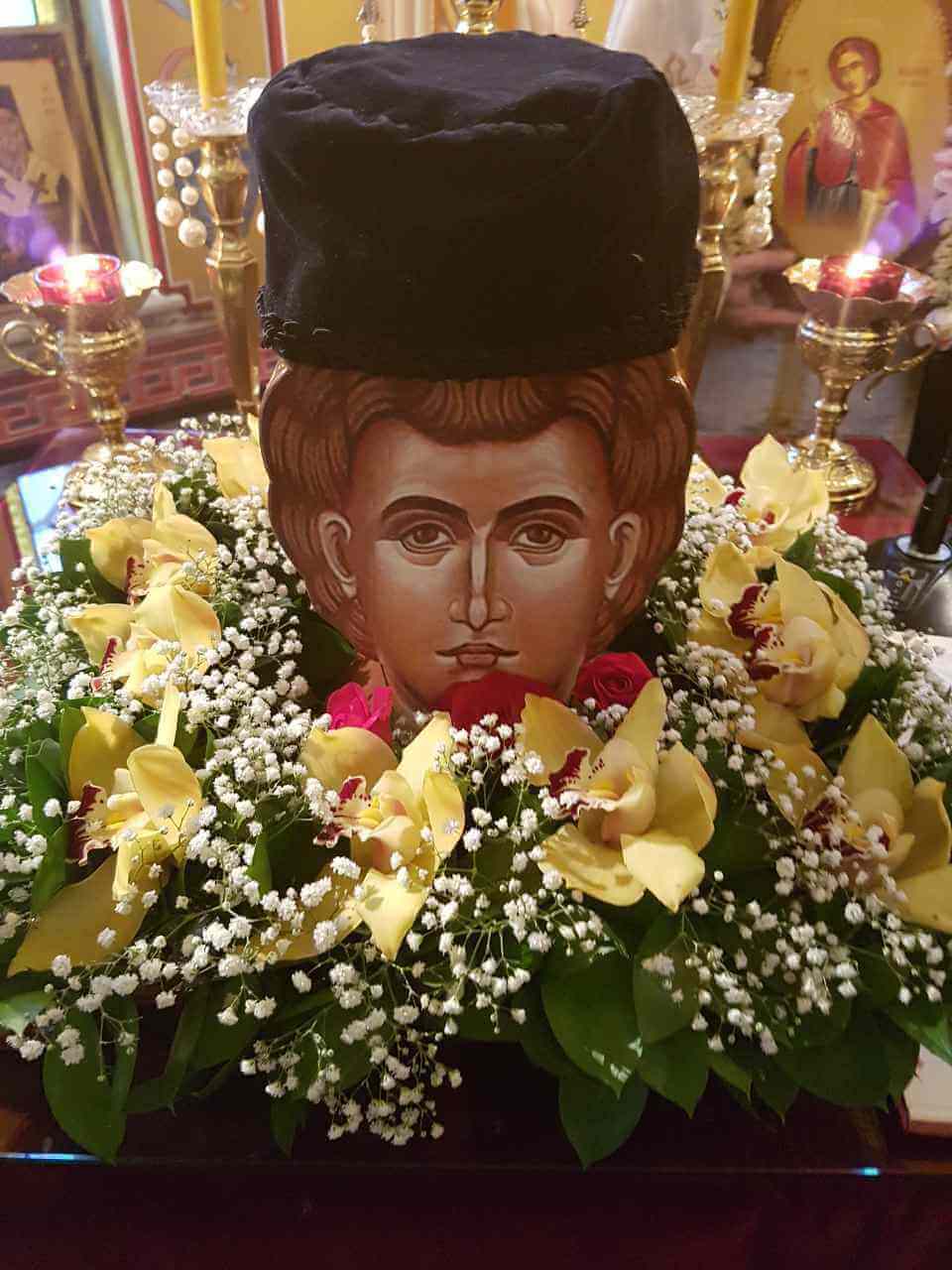 him. After passing through Caesarea of Cappadocia, Osman Pasha arrived near Prokopi, where he intended to rest and depart the following day. However, since most of the Muslims of Prokopi, being like Janissaries, hated the Sultan, they all agreed not to admit Osman Pasha into Prokopi or even at the borders. The Christians, who were loyal to the Sultan, tried to persuade their fellow citizens to obey the Sultan and accept the army coming from him, even telling them that Osman Pasha might become enraged and destroy the village. But they would not change their minds. Then the Christians took the women and children and fled to the surrounding villages and caves, so as not to fall victim to the Janissaries' reaction. Indeed, the next day, when Osman Pasha entered Prokopi, he plundered and destroyed it. Some of the soldiers even entered the church of Saint George. They seized the sacred vessels and opened the reliquary of the Venerable One, hoping to find gold and silver there as well. They found nothing. In their spite, having been mocked, and to ridicule the Christian faith, they decided to burn the holy relics. They placed them in the courtyard, gathered much brushwood, set fire to it, and cast the holy body into the flames with impiety. The holy relics of the Venerable John not only remained unburnt, but the unbelievers saw that he was alive; he terrified them and drove them from the church precincts. The next day, elderly Christians found the silver items that the Turkish soldiers had left behind in their terror, reverently took up the holy relics, and placed them once again inside the reliquary.
Transfer of the holy relics to Prokopi, Evia:
A great church dedicated to Basil the Great was built in Prokopi of Asia Minor, and the holy relics of the saint were transferred there. However, on three occasions the holy relics of the saint returned each night to the old church, even though the faithful carried them by day to the new church. After many all-night vigils, the relics were finally transferred permanently to the new church, where they remained until 1924.
With the exchange of Greek and Ottoman populations that took place at that time, the holy relics of Saint John the Russian were also transferred to Prokopi of Evia, where the Greeks who had lived in Prokopi of Asia Minor settled. The transfer was made possible through the efforts of Panagiotis Papadopoulos, who chartered at his own expense the ship "Vasileios Destounis", with which, in addition to the saint's holy body, 800 fellow countrymen were brought to Greece. The ship first sailed from Asia Minor to Rhodes, where it remained immobilised for an unknown reason, circling in the same spot. At that point, Panagiotis Papadopoulos reminded the captain of the presence of the holy body in the hold. Immediately, an order was given to bring the holy relics up to the main deck, and thus the journey to Chalkida continued without hindrance. There it remained for a year, until 1925, before finally being taken to Prokopi of Evia.
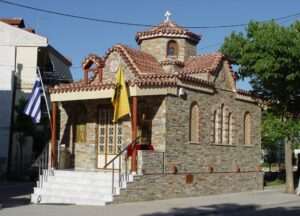
In 1930, construction began in Prokopi of a church in honour of the saint, which was completed in 1951 after much labour by the faithful. At that time, the saint was transferred (from the Church of Saints Constantine and Helen of the village) to the new church, where he remains to this day.
His feast day is celebrated on 27 May.

Apolytikion (Apolytikion).
Tone 4. To the melody “Come quickly.”
He who called you from earth to the heavenly dwellings preserves your body unharmed even after death, O venerable one. For you were taken captive to Asia, where you became united with Christ, O John. Therefore entreat Him that our souls may be saved. (Download.)
Tone 4. To the melody “You who were lifted up upon the Cross.”
Let us, the faithful, in distress and misfortune, now hasten to John and fall before him, crying devoutly from the depths of our souls: O venerable one, help us who implore you; come quickly and deliver us from our present need. Do not overlook the pitiful prayer of those who flee to your protection, O saint.