
APOLYTIKION. Tone 4.
You free the captives, defend the poor, heal the sick, and stand as champion of kings. O victorious Great Martyr George, intercede before Christ our God, that our souls may be saved.
SAINT GEORGE THE GREAT MARTYR
SAINT GEORGE THE GREAT MARTYR
THE VICTORY-BEARER
A. THE LIFE OF THE SAINT:
Prologue:
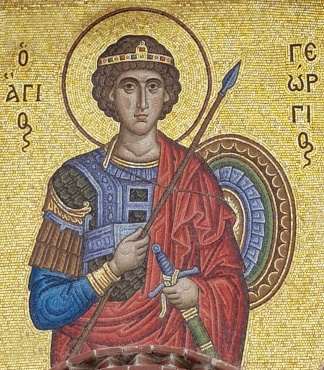
The Great Martyr George the Victory-Bearer belongs to the choir of the Great Martyrs and is among the most beloved saints of our Church. He lived at the end of the third century AD and the beginning of the fourth, when Diocletian was emperor. His era was one of harsh and exterminating persecutions against the Christian Faith. George held a high office. He bore the title of Count and was distinguished in all military campaigns for his courage and bravery. Yet, despite his glory and honours, he did not refuse to sacrifice earthly pleasures and to confess with boldness before the emperor and many rulers his Christian faith. He endured many and terrible tortures which ultimately made him a Great Martyr.
Confession:
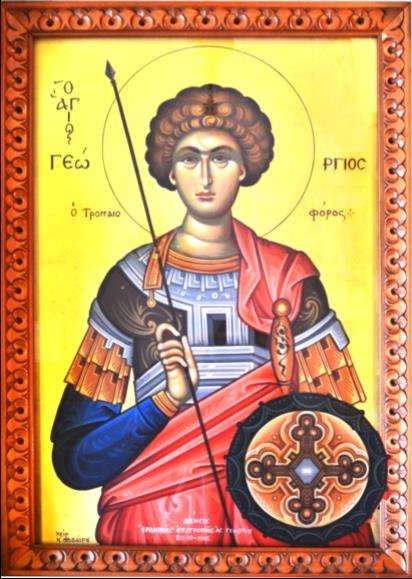 The Great Martyr George was born in Cappadocia to devout parents. He lost his father at the age of ten. His mother brought him with her to Palestine, where she was from and where she also owned estates. Although young, George enlisted in the army, where he was promoted to high office, even taking part in the assemblies of the state's highest officials. Diocletian held him in great esteem. From the time of Emperor Decius until Diocletian ascended the throne in AD 284, the Christian Church grew greatly because peace prevailed. Christians had taken many public offices, built many large churches, established schools, and organised both the administration and management of the churches and charitable work. When Diocletian assumed office, he initially worked to organise his vast empire. He appointed generals as his assistants, naming them emperors and Caesars, and after succeeding in subduing the empire's enemies and stabilising its borders, he turned to internal matters. Unfortunately, he also turned against the Christian religion in order to restore paganism and the idea of the emperor.
For this reason, therefore, he summoned his assistants, the Caesars and generals, to the capital of the Eastern Roman Empire for three general assemblies. Among them was George, who had been distinguished many times in wars. They all gathered to make decisions regarding the extermination and annihilation of the Christian faith. Diocletian spoke first and imposed upon all the duty to undertake the exterminating struggle against Christianity. All promised that they would make every effort to eradicate the Christian religion from the Roman Empire. Then the brave George stood in the midst of the assembly and said: Why, O king and rulers, do you wish to shed righteous and holy blood and to compel Christians to bow down and worship idols? And he proclaimed the truth of the Christian religion and the divinity of Christ. As soon as he finished, all were confounded by this confession and tried to persuade him to repent for what he had said, so that Diocletian might be appeased. But George remained steadfast and with courage proclaimed his Christian faith.
Imprisonment – Tortures:
Enraged, Diocletian ordered him to be thrown into prison, to have his feet tightly bound in the stocks and to have a large, heavy stone placed upon his chest after he was laid on his back. The next morning, Diocletian ordered George to be brought before him for interrogation. Once again, George remained unshaken in his confession; despite all the flattery and promises the emperor Diocletian offered him, he proclaimed his faith and spoke of heavenly treasures. Then Diocletian grew angry and ordered the executioners to bind the Saint to a great wheel so that his body might be torn apart. Indeed, he mocked the Saint's courage and called upon him to bow down to the idols. Saint George thanked God for deeming him worthy to be tested and gladly accepted to undergo this terrible martyrdom, by which his entire body would be torn into small and fine pieces, for sharp iron blades, resembling knives, were fixed all around the wheel. Indeed, as soon as the wheel began to turn, the sharp blades began to cut his body. Then a voice was heard from heaven saying: "Be not afraid, George, for I am with you," and immediately an angel freed the Saint, unbinding him from the wheel and healing his entire wounded body.
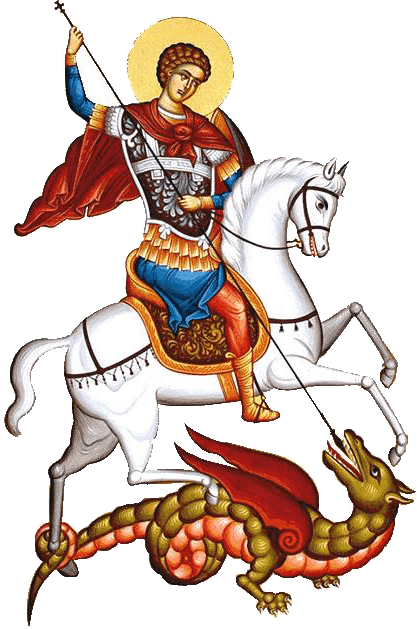 Having attained a wondrous presence and an angelic countenance, George appeared before Diocletian, who had gone with others to offer sacrifice. Upon seeing him, all were struck with awe and wonder. Indeed, some claimed he was merely someone who resembled the Saint, while others insisted he was a ghost. As they discussed this marvel, two of the Emperor's officers, Proleontios and Anatolios, appeared before the king with a thousand soldiers and confessed their faith in Christ. Diocletian became so enraged that he flew into a frenzy and ordered them to be put to death, which was done. He then commanded that a pit be immediately filled with lime and water, and that George be cast into it and left there for three days and three nights, so that even his bones might be dissolved. The executioners indeed cast the Saint into the scalding lime and sealed the mouth of the pit. After three days, Diocletian sent soldiers to open the pit, whereupon they found Saint George standing upright within the lime, praying. This event impressed the people, provoking wonder and enthusiasm, and they cried out, "The God of George is Great!" Diocletian believed that George was using magic and demanded an explanation. George replied that all these events were the result of Divine Grace and not the works of sorcery or enchantment. Enraged, Diocletian ordered that he be made to wear red-hot shoes studded with iron nails and be forced to walk. The Saint prayed as he walked, suffering no harm. Once again, Diocletian ordered him imprisoned and considered convening the rulers to deliberate on what should be done to George. After they scourged him so severely that they wounded his entire body, they presented him to Diocletian, who remained amazed, seeing George shine like an Angel. The Emperor insisted that such a phenomenon could only be the work of magic. For this reason, he summoned the renowned sorcerer Athanasios to undo George's enchantments.
Unharmed by the poison:
Indeed, the sorcerer Athanasios came, holding two earthenware vessels containing poison. In the first was poison that would drive anyone who drank it mad; in the second was poison so potent that drinking it would cause death. They led the Saint to Diocletian and the sorcerer Athanasios. The Emperor ordered that he be given the first poison to drink. Without hesitation, the Saint drank the poison from the first vessel, having first prayed, saying, "Lord Jesus Christ our God, who said, 'Even if they drink anything deadly, it will not harm them,' now make Your mercies wondrous." And he suffered absolutely no harm. As soon as they saw that he was unharmed, the Emperor ordered the sorcerer to give him the second, deadly poison. He drank this too without suffering the slightest harm. All were amazed when they witnessed this miracle. Diocletian continued to insist that George possessed his own magic to avoid death. Athanasios, who knew how potent the poisons were that he had given to Saint George, knelt before the martyr and confessed his faith in the True God. Then Diocletian ordered that Athanasios be put to death immediately. At that very moment, Diocletian's wife, Alexandra, arrived. Seeing the wonders that were taking place, she too confessed her faith in the True God. The cruel and hard-hearted Diocletian ordered that she be imprisoned and beheaded the following day. While praying in prison, Alexandra delivered her soul into the hands of God.
Martyrdom of the Great Martyr:
Saint George was imprisoned, and during the night he saw Christ in a dream, who announced that he would receive the crown of martyrdom and be deemed worthy of eternal life. At dawn, the soldiers were ordered to bring the Saint before Diocletian. Indeed, Saint George walked joyfully toward the king, for he foresaw that his end had come. As soon as Diocletian beheld him, he proposed that they go to the temple of Apollo so that George might sacrifice to the idol. Upon entering the temple, George raised his hand, made the sign of the Cross, and commanded the idol to fall. Immediately, the idol fell and was shattered. The priests of the idols and the people became so enraged that they cried out to the King to put George to death. Diocletian then gave the order, and the executioner beheaded him.
B. THE MIRACLES OF THE SAINT AFTER HIS MARTYRDOM:
1) The miracle of the transport of the column
A woman purchased a column but was unable to send it to Rome, where a church of Saint George was being built. She saw the Saint in a dream, who together with her lifted the column and cast it into the sea. The column was found in Rome with an inscription, to be placed on the right side of the church.
2) The deliverance of the captive soldier
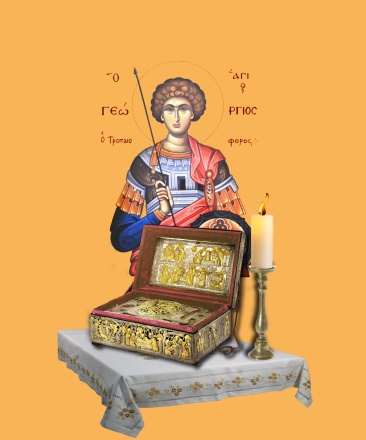 In Paphlagonia of Pontus, Saint George was held in great honour, and indeed many churches had been built in his honour. The people honoured the Saint so greatly that every family would name one of their male children George. This also happened in a good and pious family. Their child grew up; he was prudent, virtuous and wise. When he reached the age of twenty years, he was called up for military service. In the battles fought against the barbarians, many Christians fell into a barbarian ambush, among them the young George. Some were slaughtered, others were kept as servants, and others were sold as slaves. George became the servant of a certain officer, who held him in high esteem. For a whole year, George's parents mourned and wept inconsolably for their lost child. Every day they went to church and, kneeling, implored God with fervent faith to reveal what had become of their beloved son. And George, from his place of exile, prayed to God to free him from slavery and grant him the blessing of meeting his beloved parents. A year had passed since his disappearance. The feast of Saint George had arrived, and his parents, who always hoped their son was alive, invited their relatives to dinner. The officer, George's master, requested before the meal that George wash his feet; for this purpose, George was heating water. All day long, George wept and prayed to Saint George, whose feast it was, to set him free and bring him to his parents. As soon as the water boiled and he placed it in the jug, preparing it for his master, Saint George appeared before him, mounted on a white horse. He lifted the youth onto the horse and immediately brought him to his home at the very hour when all the guests were seated at the table. Everyone remained stunned, and when they recovered their senses, they asked George how he had come to be there. He then recounted the miracle to them in every detail. And all, filled with joy, glorified God and the Great Martyr George. There is also a Byzantine depiction of this miracle, showing the Saint on horseback and a youth holding the silver jug with the hot water.
3) The miracle of the widow's son's return
A miracle similar to the preceding one is that of the widow's son. Pirates from Crete came to Mytilene to steal, plunder and capture as many people as they could. They decided to launch their raid on the feast day of the Great Martyr Saint George, when everyone would be gathered in church. Indeed, the corsairs made their attack, and among those captured was a most handsome young man, the son of a wealthy widow. The corsairs gave him to Amoun of Crete, who made him a servant at his table. From the moment her son disappeared, his mother wept and implored God and Saint George to reveal to her her lost child. The Great Martyr George did not delay in fulfilling the longing of that suffering mother. And while the young man was preparing to offer wine to the emir, Saint George seized him and transported him to his mother. Both could not believe their eyes at what had happened; and when they recovered their senses, they glorified God and the Saint for the strange manner of their deliverance.
4) The miracle of the Great Martyr concerning the Saracen
 A certain Saracen traveller (the nephew of the king of Syria), upon seeing the wonderful church of Saint George, commanded his servants to carry their luggage into the narthex of the church, for they intended to stay there to rest and then continue on their journey. However, he demanded that his 9 camels also be brought inside the church. The priests of the church begged him not to desecrate their church. But he insisted and climbed to a high place in the temple to watch and observe them. When they led the camels into the church, therefore, they all died immediately. Then the miracle spread and was attributed to Saint George. The Saracen was impressed and asked for them to be taken out and buried. He remained in the church until the priest came in the morning to celebrate the Divine Liturgy. The Saracen then observed the priest's actions and, at the hour of the consecration of the Holy Gifts, saw that the priest, after taking a small child into his hands, slaughtered him, and his blood was poured into the Holy Chalice; and his body, after being cut into small pieces, was placed upon the holy diskos. When the Communion service ended and the Saracen saw the priest distributing the flesh and blood of the child to the people, he became very angry. Following this vision, the Saracen asked to learn details and receive explanations for what had occurred. The priest then explained to him concerning the Holy Eucharist and further told him that he had been granted to see a vision which only the Great Fathers have seen. "I," said the priest to him, "have never been granted to behold this dreadful Mystery, and I see only bread and wine." He then explained to the Saracen ruler the wondrous Mystery. At that, the Saracen wished to be baptised, for he now believed that the Christian faith was the most correct and true. The priest then told him to go to Jerusalem to be baptised, for when his uncle the Saracen, who was king of Syria, learned of it, he would kill him and begin a terrible persecution against the Christians. Thus the Saracen went to Jerusalem, where there was another ruler, and was baptised by the Patriarch. Indeed, after a few days, he consulted the Patriarch on what he ought to do to be saved. Then the Patriarch advised him to become a monk on Mount Sinai. Indeed, he went to Sinai and became a monk. After 3 years, he received permission from his Hegumen and departed to meet the priest of Saint George who had advised him to be baptised. When he arrived there, the priest did not recognise him. After revealing who he was, he expressed his desire and longing to see our Lord Jesus Christ. The priest then glorified God and said to him: "Go, my child, to your uncle the emir and confess your faith both to him and to all the Saracens." When the monk heard the words of the God-fearing priest, he was moved and immediately set out to go to the city where his uncle was ruler. When he arrived there, he waited until nightfall, climbed the minaret of the mosque and began to shout: "Come here, Saracens, for I have a word to tell you." Then the Saracens ran with torches, and when they saw the monk, they asked what he had to tell them. The monk said to them: "You ask me what I have to tell you? Then I ask you: Where is the emir's nephew who departed secretly?" They replied to him: "If you tell us where he is, we will give you as much money as you wish." The monk said to them: "Take me to the emir so that I may tell you." So, seizing the monk with great joy, they led him to the emir, saying: "This monk knows where your nephew is." The emir then asked if he truly knew where he was. And he replied to him: "Yes, I know him. I myself am he. But now I am a Christian and I believe in the Father, the Son and the Holy Spirit, the one Godhead, and I confess that the Son of God was incarnate of the Ever-Virgin Mary, and performed great and wondrous deeds in the world, and was crucified, and on the third day rose again and ascended into the heavens and sat at the right hand of God the Father, and is coming to judge the living and the dead." As soon as his uncle the emir heard this, he was amazed and said to him: "What has befallen you, my poor one, that you have abandoned your home, your wealth, your glory and walk thus despised like a beggar? Return, therefore, to your religion and accept Muhammad as your prophet so that you may return again to your former state." Then the monk said to him: "All the good things I had when I was a Saracen were
 the portion of the devil. This haircloth garment which I now wear is my boast and my wealth, and above all the pledge of the glory which I am about to enjoy for the true faith of my Christ. I anathematise and utterly reject Muhammad, who has deceived you, as well as his religion." When the emir heard these things, he said to the Saracens present that his nephew had lost his reason and that they should drive him away. He certainly did this to save him from the law which prescribed the death penalty for those who blasphemed the religion. As soon as they heard the emir, they said: "Do you set free him who has blasphemed our prophet and our religion? Let us then also renounce our religion and become Christians." The emir, fearing that the crowd might become even more enraged, gave permission for them to do with him as they wished. They seized him while he gnashed his teeth with fury, and after leading him outside the city, they stoned him while he prayed and gave thanks to God, for He had granted him to martyrise for the name of our Lord Jesus Christ. This was the end of the courageous confessor monk, who was crowned with the crown of martyrdom. Every night a bright star appeared above the heap of stones and lit up that place. The Saracens even marvelled at what was happening. After quite some time, the emir gave the Christians permission to take the martyr's holy relics out from beneath the stones and bury them. When they removed the stones, they found his body whole and unharmed, giving off a sweet fragrance. After venerating it reverently, they buried it with hymns and psalmody, glorifying the Lord.
5) The Miracle of the Dragon
In the eastern province of Attaleia, in the city of Alagia, there reigned a certain Selvius who was a fierce persecutor of Christians. He had tortured many Christians to force them to renounce their faith and then put them to death. Near the city there was a terrible dragon which seized people or animals every day and devoured them. The inhabitants were terrified and avoided passing that way. Once the king assembled his army and they went to kill the savage beast. But they achieved nothing and returned empty-handed. When the people saw that the king had failed to kill the dragon, they went to question him as to why he had been unable to find ways to destroy the terrible beast. Then the king, following advice given to him by the priests of the idols, said to the crowd: "You know that we have attempted several times to slay the beast, but we have not succeeded, for this was the will of the gods. Now therefore, by their command, each of us must send his child to be devoured by the dragon. Even I shall send my only daughter when her turn comes." Thus the people obeyed the king's command, for they could do otherwise. They sent their children with tears and lamentations to be swallowed up by the beast. When the turn came for the king's daughter, tragic scenes unfolded. The king beat his breast and his face, tore at his beard and, weeping aloud, said: "Woe is me, the wretched one! What should I weep for first, my sweetest child? Our separation or your sudden death which I am about to witness shortly? What should I mourn first, my beloved child, your beauty or the terror you are about to feel as the savage beast tears you apart? Woe is me, my daughter, who shone like a many-lamped candle in my palace, and I awaited the hour when I would celebrate your joyful wedding. Where shall I find comfort now, and how shall I live apart from you? What use is life and palaces without you?" These were the words of the inconsolable king. Then he turned to the crowd and said: "My dear friends and rulers, I beg you to have mercy on me and to pity me. I offer you as much wealth as you desire, and even my kingdom, but grant me one favour. Spare my beloved and only child; otherwise, let me go with her." Yet no one was moved by the king's words, for he was the one who had issued the decree that led their children to such a pitiful end. Thus, with one voice, they all told him that his decree must be applied to his child as well.
 Unable to do otherwise, the king accompanied her to the city gate. After embracing her and kissing her fervently as he wept, he handed her over to the people to take her to the lake. Indeed, they left her there and departed. From within the walls the people watched the maiden sitting by the lake, waiting for the beast to come and devour her. At that time the Great George, who had not yet confessed his Christian faith, was a count and commander of a military unit in the army of Diocletian. He was in fact returning to Cappadocia from a war in which he had fought alongside Diocletian. By God's providence he passed by the lake, and when he saw the water he wished to water his horse and rest himself. When he saw the maiden weeping incessantly and overcome with anguish and terror, he approached her and asked why she was weeping and what was the reason the people were watching her from within the walls. The maiden told him that she was unable to recount all that had happened and all that was about to happen, and she begged him to mount his horse and depart as quickly as possible, for he was in danger of losing his life, and he was so young and handsome. And the saint said to her: "Tell me the truth why you are sitting here, and I swear by the God in whom I believe that I will not leave you alone, but I will deliver you from death; otherwise I shall die with you."
Then the maiden sighed bitterly and recounted to the Saint all that had befallen her. When the Saint heard these events, he asked the girl: "In which God do your father, your mother and the people believe?" She replied: "They believe in Hercules and in the great goddess Artemis." The Saint then said to her: "From this day forth, fear not and weep no more. Only believe in the Christ in whom I believe, and you shall see the power of my God." The princess answered the Saint: "I believe, my Lord, with all my soul and with all my heart." The Saint continued: "Have confidence in the God who created heaven and earth and the sea, for Christ is about to destroy the power of the beast, and you shall be delivered; indeed, all the inhabitants of this land shall drive away the fear of the beast. Remain here, therefore, and as soon as you see the beast approaching, call upon me."
Then the Saint bowed his knees to the ground and, lifting his hands toward heaven, prayed, saying: "O great and mighty God, seated upon the Cherubim and beholding the abysses, O blessed One who endures for ever, You know that the hearts of men are vain. O Man-loving Master, O God of wondrous deeds from before all ages, whom neither thought can comprehend nor speech interpret, look upon me now, the humble one, and reveal to me Your mercies. Subdue under my feet this evil beast, that all may know that You are with me and that You alone are God, and that there is no other besides You." Then a voice was heard from heaven saying: "Your petition has been heard, George; do as you will, for I shall always be with you." As soon as the Saint finished his prayer, the fierce beast appeared. When the maiden saw it, she cried out: "Woe is me, my lord! The beast comes to devour me." Then the Saint ran to meet the beast. The beast was terrible; it breathed fire from its eyes and was so savage and hideous that it presented a dreadful sight. Immediately the Saint made the sign of the Holy Cross and said: "O Lord my God, tame this beast for my sake, who am Your servant, that the people may believe in Your Holy Name." And so it was done. The terrible dragon with its great teeth fell at the feet of the Saint's horse and, while writhing, roared. When the princess saw this sight, she felt great joy. The Saint said to her: "Take off your girdle and bind the dragon by the neck with it." Immediately, the maiden, without fear, removed her girdle and bound the dragon, and she thanked the Saint for delivering her from certain death. When the Saint had mounted his horse, he said to the princess: "Lead the dragon by the girdle to the city."
When the inhabitants saw the strange event—that a maiden was leading the bound dragon—they fled in terror. Saint George called out to them: "Fear not; stand still, and you shall see the glory of God and your salvation." Then they all stopped, amazed, and waited to see what he would show them. He therefore exhorted them to believe in the True God, and they accepted with joy. Raising his hand, he struck the dragon with his spear, and the terrible monster was slain. Then, taking the princess by the hand, he delivered her to the king. All felt great and inexpressible joy; kneeling down, they kissed the feet of the Saint and thanked the All-good God, for He had delivered them from the beast, and thus the sacrifice of their children ceased. Saint George summoned Bishop Alexandros from a city in Antioch, and baptised the king, the officials and the entire people. Within fifteen days, forty-five thousand were baptised. After they had all been baptised and there was great joy on earth and in heaven, they built a large church in the name of the God who is three in Persons. The Saint went to see it. As soon as he entered the Holy Altar and prayed, a spring of holy water appeared, and fragrance filled the church. This spring survives to this day.
The Devil Sets an Ambush for Him
After bidding farewell to the king and the people, the Saint departed for his homeland, Cappadocia. On his journey, the Devil, transformed into the form of a man, met him. He held two staffs upon which he leaned like an old man; indeed, he appeared as a defeated and despised soldier. With humility he said to the Saint: "Hail, George." The Saint immediately perceived that he was the Devil and said to him: "Who are you, and how do you know me? If you were not an evil devil, you could not know me, since you have never seen me before." The Devil said: "How dare you insult the Angels of God and ask who I am? Learn to speak properly." The Saint then replied: "If it is as you say and you are an Angel, follow me. But if you are an evil spirit, do not move from your place." As soon as the Saint finished these words, the Devil found himself bound and cried out loudly: "Woe is me! What an evil hour was this when I met you! What evil befell me, wretch that I am, to fall into your hands!"
The Saint assured himself that it was an evil spirit and said to it: «I adjure you by God to tell me what you intended to do to me.» And the demon said: «I, George, am from the second rank of Satan. When God made the heavens and separated the earth from the waters, I was present. I caused terrible thunder and lightning; I bound heads, and now, because of my pride, I have been cast down into Hades and have become a demon. Woe is me, George, for I envied the grace given to you and came to deceive you into worshipping me. But I was deceived and led astray. Woe is me! What evil did I seek to suffer, and now I cannot be loosed! I beg you, George, remember my former happiness and do not let me return to the abyss, for I have told you all.» Then the Saint, raising his hands to heaven, said: «I thank You, my Lord, for having delivered into my hands the evil demon, who is to be sent to a dark place to be punished eternally.» As soon as he spoke these words, the Saint rebuked and dismissed the evil spirit. From that time the Saint knew by prophecy that it was the will of God that he should bear witness to the love of Christ. Thus he went to Diocletian, where with courage he proclaimed his faith and was martyred, giving his blood for the love of Christ.
G. ON THE WONDERWORKING ICONS OF SAINT GEORGE KEPT AT THE HOLY MONASTERY OF ZOGRAFOU ON MOUNT ATHOS
a) Concerning the one miraculously transferred from the Monastery of Phanouel
During the reign of Leo the Wise (886–912), there were three true brothers, Moses, Aaron and Basil, whose origin was from the great city of Lykhida, which was later renamed Ochrida. These men therefore decided to leave the world, wealth and glory and to receive the Angelic Schema. They came to the Holy Mountain and, having found a quiet place, built three huts where they remained for a considerable time, meeting only on Sundays. Thus the fame of their virtue spread, and many drew near to them and did not depart.
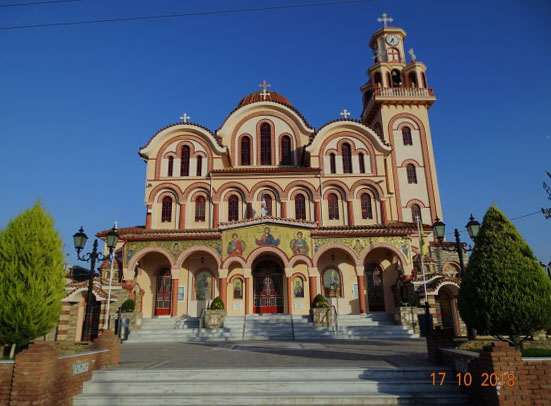 They also found a site where they built a monastery. After constructing the church, they pondered how to name it. Some said it should be dedicated to Saint Nicholas, others to Saint Clement, Archbishop of Ochrida, who was also their fellow-countryman; each wished to give the church the name of the saint in whom he held the greater devotion. Since they could not agree, they decided to turn to God in prayer, beseeching Him to decide and command to which of His saints they should dedicate the church and what icon they should paint on the panel they had prepared. So the three prayed, each in his own cell. While they were praying, an unusual light, brighter than the rays of the sun, shone forth from the newly built church around the monks' cells. The monks were seized with fear and wonder and remained in prayer throughout the night.
The following morning, when the monks went down to the church, they saw with wonder that on the panel they had prepared to paint, an icon of Saint George the Great Martyr and Trophy-bearer had appeared. From it came the radiance that illuminated their humble hermitages. Thus the church was dedicated to Saint George, and the monastery was named Zographou, “of the painter.”
The wonderworking icon was kept at the Monastery of Phanouel, which is situated in Syria near Lydda. According to the testimony of the Abbot of the Monastery of Phanouel, Eustratios, when God at one time willed, and justly, to punish Syria and deliver it into the hands of the Saracens, the painted image of the icon suddenly separated from the panel and, having been lifted up, hid itself in an unknown place. The monks, fearing and grieved by this miracle, knelt down and prayed fervently to God with tears, beseeching Him to reveal where the face of Saint George the Great Martyr and Trophy-bearer had hidden. The All-good God heard the prayer of the monks; therefore Saint George appeared to the Abbot Eustratios and said to him: «Do not grieve for me. I have found for myself a monastery of the Theotokos on Athos. If you wish, hasten there yourselves, for the wrath of the Lord is ready to fall upon the corrupted Palestine and almost upon the whole inhabited world because of the sins of Christians.»
After gathering all the monks, the Abbot announced to them what had occurred. He then summoned the leading citizens of the city of Lydda, informed them of what had taken place concerning the holy icon, and gave them the following instructions: “We are departing for the Holy City of Jerusalem to venerate the Holy Sepulchre of the Lord; let His will be done. You are to take up residence in the monastery to safeguard it.”
With tears and sorrow, they then set out. Upon reaching Joppa, they found a ship and departed for Mount Athos. After several days, they arrived and went to the Monastery of Zographou. When they entered the church, to their wonder and astonishment, they saw the painting of Saint George, which had been at the Monastery of Phanouel, attached without any alteration to a new panel. Then, with emotion and tears, they knelt before the icon and said: “Why have you caused us so much sorrow, Great Martyr George?” The monks of Zographou were perplexed, wondering how all these strange things could happen. However, those monks recounted the events, and all praised wholeheartedly the Lord and Saint George. They made the Abbot Eustratios their Hegumen.
From that time, many miracles began to occur through the holy icon; for this reason, people went to the Monastery of Zographou to venerate the Trophy-bearer George. The fame of these miracles reached even King Leo the Wise, who was very pious. Indeed, he decided to go in person to Mount Athos to venerate and to be spiritually gladdened by the soul-edifying conversations he would have with the ascetics Moses, Aaron, and Basil, who had become renowned for their virtue. After Leo, the King of the Bulgarians, John of Tarnovo, also visited the monastery. With the abundant aid of these rulers, the magnificent Monastery of Zographou began to be built. Later, the Holy Monastery was destroyed by barbarians and pirates. The existing monastery was built by Stephen, the Prince of Moldavia.
 The holy icon still bears to this day the tip of the finger of a Bishop who was known for his lack of faith in the miraculous power of the icon. According to tradition, this Bishop was from Vodena (Edessa), and when he heard of the miracles of the icon, he wished, together with his retinue, to go and verify whether the reports were truly genuine or merely inventions of the Monks for the sake of greed. Upon arriving at Mount Athos, he went to the Monastery of Zographou, where the Monks received him with due honour. They then led him to the Church to venerate Saint George. However, instead of showing humility and reverence, especially given his ecclesiastical rank, the Bishop appeared proud and faithless. After viewing the Church with indifference, he stood before the icon of Saint George and, with a haughty air, said to the Monks: “So this is the miraculous icon of Saint George?” He then touched the Saint’s cheek with his finger. Immediately, however, his finger became stuck to the icon, and he vainly tried to pull it away. His anguish and fear grew as he struggled and attempted to free it. Each time he tried to detach it from the icon, he felt pain, for his finger had adhered with great force. In the end, the unfortunate Bishop, against his will, consented to have his finger amputated following a surgical intervention, and thus he learned by personal experience the authenticity, the truth, and the power of the miracles of the glorious Trophy-bearer George.
The icon of Saint George is adorned with a silver covering which was made in Petroúpoli, with the blessing of Metropolitan Seraphim, as is also inscribed on the lower edge of the covering. The iconography of the icon is Byzantine, but due to the passage of time it has become dark.
b) Concerning the icon which came by sea from Arabia
There exists near the pillar of the left choir, where the icon of Saint George is located, the following handwritten account. The holy icon came from Arabia and was found at the harbour of the Vatopedi Monastery. The unexpected arrival of the icon caused disturbance and uproar on Mount Athos. For the fame spread quickly, and monks from all the Monasteries converged to venerate the holy icon which was miraculously revealed at the harbour. Indeed, every Monastery sought to acquire this treasure, and the Elders refused to hand it over to the Vatopedi Monastery. Finally, they decided to cast lots and to accept the decision of the holy icon. Indeed, all the Elders unanimously decided to load the icon onto a strange, wild young mule that knew neither the roads nor the Monasteries, and then to let it go free, following it from a distance. Wherever it stopped, the sacred icon was to remain. Thus it came to pass. After they led the mule onto the road from Thessaloniki to Mount Athos, they left it to its own will. And the mule, with a slow and steady gait as if sensing that it carried a sacred burden, passed through difficult places, forests and heights, and arrived at the Zographou Monastery, where it stood still on a most beautiful hill.
In this way, all came to know that it was the will of the Great Martyr Saint George that His holy icon should remain at Zografou Monastery. All the Monks received the holy icon into the monastery with joy and a spiritual feast, placing it upon the pillar of the left choir. The mule that carried the holy icon, as soon as it was unloaded, breathed its last and was buried in that very place. In remembrance of the arrival of the holy icon of Saint George, they built upon the hill a cell and a small church in the name of the Great Martyr George.
c) Concerning the holy icon dedicated by Stephen, the Prince of Moldavia
Upon the north-western pillar, which also supports the dome, is hung another icon of Saint George, concerning which there is the following handwritten account preserved at Zografou Monastery. As is known, Stephen, the Prince of Moldavia, was continually engaged in wars against the Turks. On one occasion, innumerable Turkish armies gathered, determined to annihilate him. When Stephen saw the multitude of the enemy, he was afraid. Yet immediately he recovered his spirits and, with fervent prayer, took refuge in the Lord God, calling upon His aid with tears. 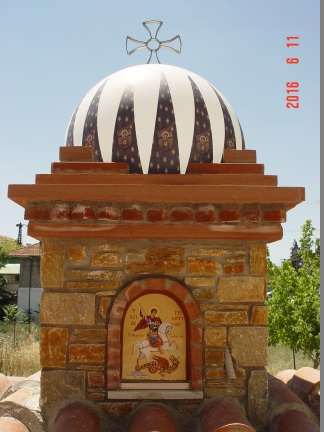 Through his prayer from the depths of his heart, he fell asleep. No sooner had light sleep taken him than the Great Martyr George appeared, bathed in a radiant and wondrous light; his eyes shone, and heavenly glory surrounded him. Though he was asleep, Stephen was filled with fear and dread. Then the Saint said to him: "Take courage in your Lord and do not fear this multitude. Tomorrow, gather your entire army and lead it against the enemies of Christ with festive shouts and trumpets, and you shall see the power of our God, who always aids you. For this reason I have appeared here, to reveal to you who shall be victorious and to tell you that the power of God is with you, and that even I shall aid you in this battle. For all these things, restore Zografou Monastery, which is dedicated to My name and has become deserted. Indeed, send also My own icon which you always keep with you." Stephen took courage from the appearance of the Saint and from the promise that he would be aided by divine grace. Indeed, bringing the holy icon with him, and with the sound of trumpets, he suddenly fell upon the mass of the Ottomans like a mighty whirlwind, crushing them without delay and scattering them. After a short time, he sent the holy icon to Mount Athos and restored Zografou Monastery according to the will of the Saint, having dedicated to it many offerings.
A certain Russian writer, referring to the holy icon of Saint George, writes as follows: "In the fifteenth century, another benefactor of Zografou Monastery appeared, Stephen, who was the official Prince of Moldavia, and who fought many times against the Ottomans, always bearing the trophy of victory. On one occasion, when innumerable hordes of enemies surrounded him, he pondered how he might save the ramparts of his fortress. Then the Mother of God appeared above the wall and said to him: 'I shall never permit your enemies to open the gates of your fortress. If you do not gain the victory and cannot withstand them on the battlefield, little hope shall remain for your ramparts.' That very night, Saint George appeared to the troubled Prince Stephen and promised him victory. He also commanded him to send the holy icon that Stephen always kept with him to Zografou Monastery, and to restore it, for it was already deserted. Victory crowned the arms of the Prince, who routed the enemy. Stephen fulfilled the command of the Great Martyr George: he sent the icon and magnificently restored the monastery. All three icons of Saint George are adorned with most beautiful silver coverings, embellished with precious stones. Indeed, all their decoration was crafted in Russia."
d. Concerning the wondrous icon of Saint George found at the Holy Monastery of Xenophontos.
On Mount Athos, the ancient oral tradition is also preserved concerning the holy icon that existed during the time of the ungodly and heterodox iconoclasts, when holy and venerable icons were burned by imperial decree. In those days, therefore, the servants of the lawless king searched and sought to find the holy icons in order to shatter them and cast them into the fire. They found, indeed, this holy icon and cast it into the fire to be consumed. But in vain did the foolish ones labour, for the holy icon remained unburned until the fire was completely extinguished. When the iconoclasts saw that the fire had scarcely harmed the coverings of the Saint and that his face had suffered no injury, they were amazed. One, moreover, who was more impious, thrust a knife into the chin of the Saint, and immediately pure blood flowed forth. Then all who witnessed this miracle departed, each to his own home. A pious Christian, having taken up the holy icon and come to the shore, prayed fervently to the Lord that the terrible storm of iconoclasm might cease. Then, turning to the holy icon, he said: "Great Martyr of Christ, Victor-bearing George, You who wrought so many miracles both in life and after death, and who have just now kept Your holy icon unburned, preserve this icon now also from the sea, and convey it wherever You know and desire for the glory of our God." And no sooner had he finished than he cast the icon into the sea.
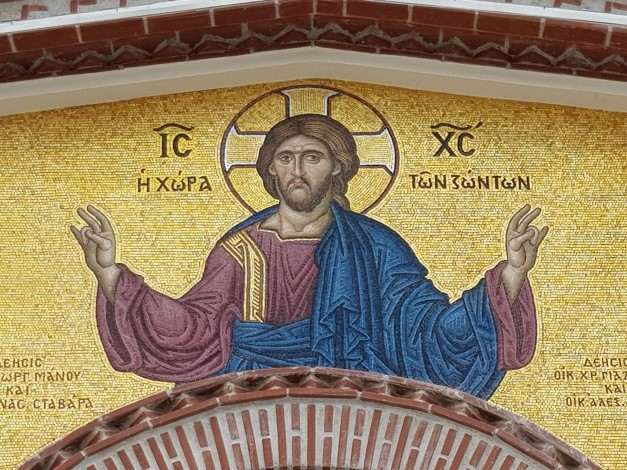 That Christian departed. The Great Martyr George ensured that his holy icon reached Mount Athos, where Divine Providence had guided other icons as well. The icon was placed near the Monastery of Xenophontos, where the healing acidic waters flowed. Indeed, there was a small monastery dedicated to the Great Martyr Demetrios. This little church still stands; when the monks saw the icon of Saint George, they joyfully and reverently transferred it there. Later, they built a church near this small chapel. As the number of monks increased and the monastery grew, it came to be named after Saint George. The monks celebrate daily together with Saint George and the Great Martyr Demetrios, commemorating them in the dismissals of the services.
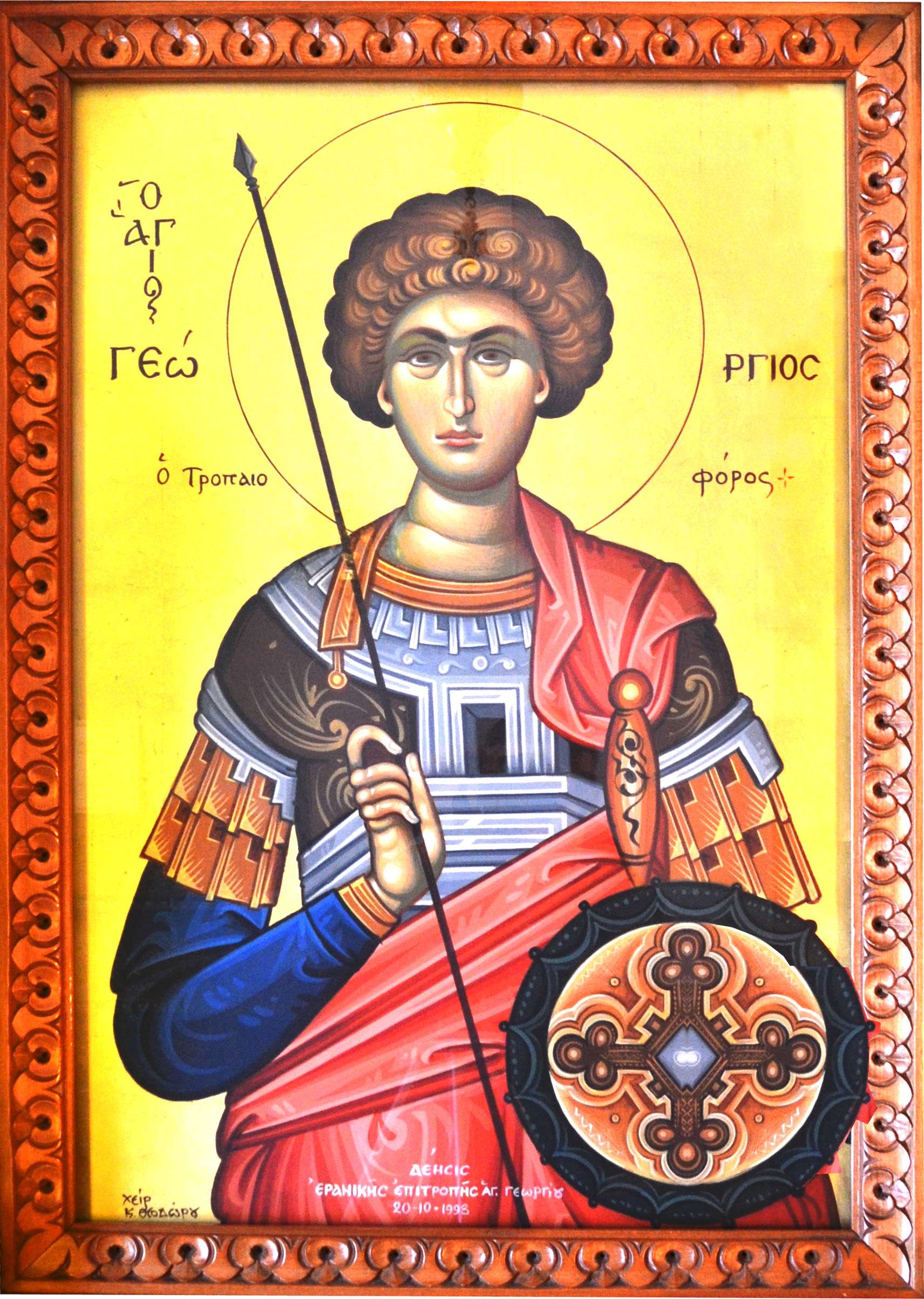
The holy icon is located in the large, new katholikon, the main church of Saint George, on the eastern column of the right choir. It depicts the Great Martyr full-length and, as a sign of the miracle, also bears the wound on his chin, with his blood clotted upon it. To this day, this wondrous phenomenon plainly proclaims the innumerable miracles worked, and still being worked, by the holy Great Martyr and Trophy-bearer George.
His memory is celebrated on 23 April. However, if Pascha falls after 23 April, then the feast of the Saint is observed on the following (second) day of Pascha (Monday of the Bright Week).
APOLYTIKION. Tone 4.
You free the captives, defend the poor, heal the sick, and stand as champion of kings. O victorious Great Martyr George, intercede before Christ our God, that our souls may be saved.
Kontakion. Tone 4. To the melody “You Who Were Lifted Up on the Cross”.
Tended by God, you became a most honoured cultivator of true devotion, gathering within yourself the sheaves of virtue. For you sowed in tears and now reap in gladness. Through your struggle and the shedding of your blood, you received Christ as your reward. Through your intercessions, O saint, you obtain forgiveness of transgressions for all.
(You may download or publish part or all of the material on this website, provided that www.galilea.gr is acknowledged as the source. www.galilea.gr)
Life of Saint George
Saint George's miracles are many: not only those recounted in this small booklet, but many others which he performs at all times, including today, for those who turn in faith to his intercessions. Many churches are dedicated to Saint George, another sign of the people's love for him, and many people bear his name. A sign of our honour for the saint, dear reader, is certainly the celebration of his memory and the patronal feasts. But a greater sign of honour is imitating his holy life, for “honouring a martyr” means “imitating a martyr”: imitating his confession of faith, his life of martyrdom, his holy life.
4) The miracle of the saint’s kindness to the devout child and the punishment of the ungodly
In Paphlagonia there was a large church dedicated to Saint George, and children played various games in the church square. One of these children could not win any of the many contests, so the others mocked and laughed at him. Then he turned towards Saint George's icon and asked him to help him win, promising to offer him a sfoungato, a dish of eggs fried with onions and herbs.
As soon as he made the vow, he began wrestling with other boys and defeated them. He immediately went home, prepared the sfoungato, an egg dish, himself and placed it before the saint's icon. A little later, three young men arrived to venerate it. Seeing the sfoungato, they thought of eating it and said to one another, “What does the saint want with this? Is he going to eat it?” So they sat down and ate the sfoungato on the church steps. When they tried to leave, they could not stand up, for they were stuck to the marble steps. They made inexpensive vows to the saint to be released, but nothing happened. Only when they made an expensive vow, each promising to give a gold coin, could they become unstuck and free themselves. As soon as they left the church and regained courage, they said to the saint, “Saint George, you sell your sfoungata dearly. That is why we will buy nothing more from you.”