
Αναζητήστε σελίδες, άρθρα και βιβλία (ράφια AnyFlip και δανειστική βιβλιοθήκη) σε όλο το galilea.gr.
LIVEΕδώ παρακολουθείτε ζωντανά το 24ωρο πρόγραμμα του Galilea WebTV, καθώς και τις ζωντανές μεταδόσεις της Galilea.gr — που περιλαμβάνουν και τις μεταδόσεις της Φιλαρμονικής.
ΑΓΙΟΙ

SAINT PHILOTHEI

09.ΑΓΙΑ ΦΙΛΟΘΕΗ

APOLYTIKION. Tone 4. To the melody “Come quickly.”

Having received the illumination of the venerable saints, O honoured one, you made the city of Athens radiant through your ascetic life and grace. For, shining in good works, O Mother, you contended devoutly out of love for your neighbour. Therefore Christ has glorified you, O Philothei.
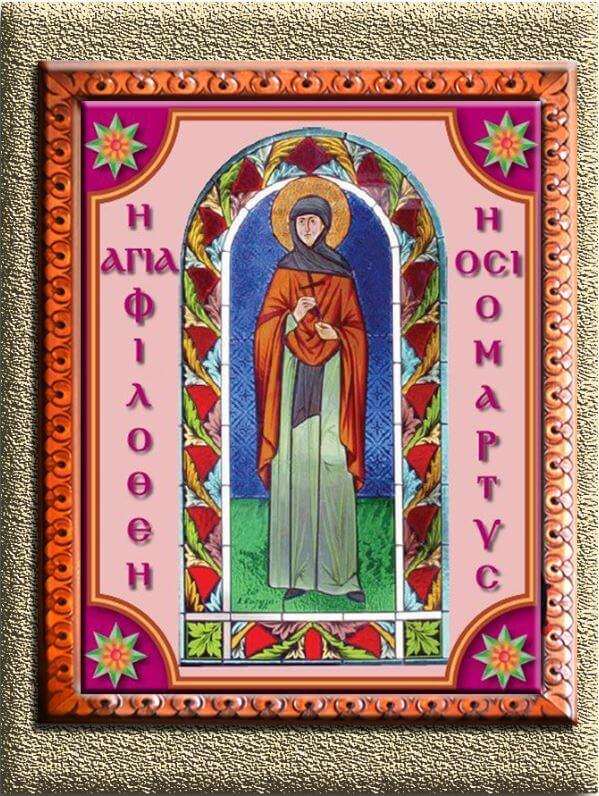
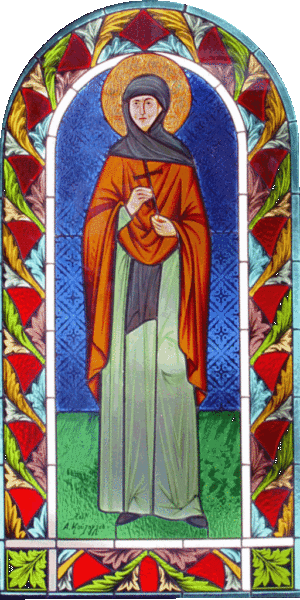
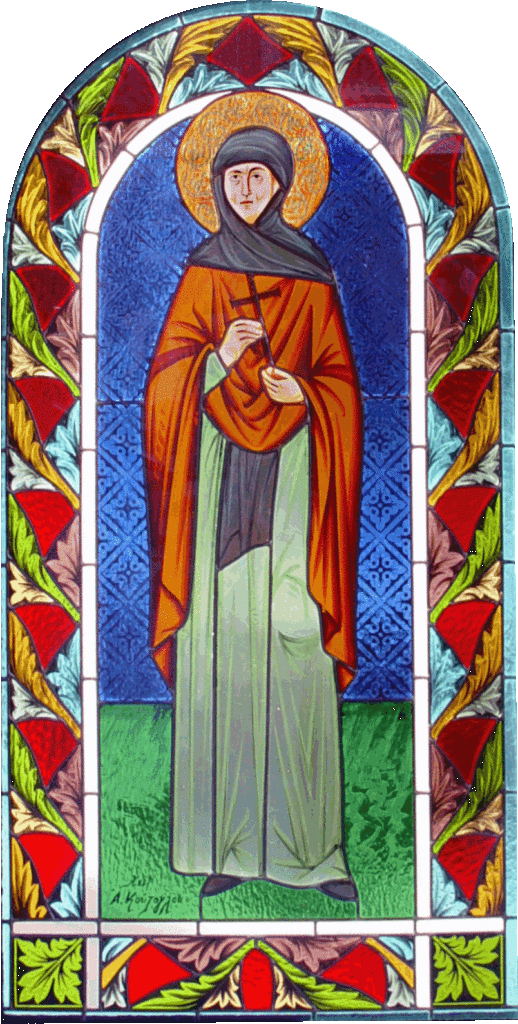
SAINT PHILOTHEI OF ATHENS

THE LIFE OF THE SAINT:
Her youthful years:
Saint Philothei was born in the year 1522 AD in Athens, which was then under Turkish rule. She was the daughter of an Athenian noble family of landowners, Angelos Benizelos and Siriggi Palaiologina, and her secular name was Rigoula or Revoula (Paraskevoula) Benizelou. Her ΑΓΙΑ ΦΙΛΟΘΕΗmother was barren and conceived the Saint only after fervent and continuous prayer. As Rigoula grew, she was distinguished for her character and intelligence. She received an excellent education, something rare for a girl of her time.
At the age of 14, her parents married her, against her will, to Andreas Cheilas, one of the nobles of Athens, who was much older than she. The marriage lasted only three years. At 17, Revoula became a widow. Her beauty, wealth, noble lineage and education made her a highly sought-after bride, claimed by the most prominent families of Athens and beyond. Her parents pressed her strongly to enter a second marriage, but this time Revoula did not heed their wish. She devoted herself to significant charitable and social work, and ten years after the death of her parents, she became a nun under the name Philothei.
Her work:
In 1571 she began the restoration of the small church of Saint Andrew, which stood within the grounds of her family mansion, transforming it into a cenobitic monastery. Following the command of Saint Andrew the First-Called, whom she saw in a vision, she built a convent with many cells, which she named after the Saint in his honour. To the monastery she added other necessary buildings and lands, and endowed it with metochia and estates that were more than sufficient for the sustenance and upkeep of the nuns. There she lived as the abbess of the sisterhood alongside daughters of wealthy families, as well as Christianised Muslims and persecuted Cypriots. Even the women who served her family followed her example, striving in asceticism and virtue. In a short time, the monastery came to have two hundred sisters. The monastery of the Venerable Philothei became a true harbour, where those worn by slavery found protection, the sick found healing, the hungry found food, the elderly found support, and orphans found affection.
In her charitable, social, educational and national work, Saint Philothei devoted her entire paternal and personal inheritance. Despite Turkish opposition, the Venerable one founded schools, craft and handicraft workshops, hospitals, hostels, orphanages, and «schools for the children of the Athenians, to open their eyes to the tradition and glory of their ancestors». The abbess Philothei led all these endeavours. She taught both by her words and by her life. She gave large sums for the liberation of captives, and took special care to smuggle women to the islands, causing havoc in the Turkish harems. The masters of the women whom Philothei had smuggled out did not hesitate to storm her cell and bring her before the city governor, who imprisoned her and persistently demanded to know where the women were hidden. Saint Philothei refused to betray them and did not flinch before the threat of death. The governor pressed her to renounce her faith, but seeing her steadfast belief, he signed her death sentence. Christian officials, however, hurried to the rescue and saved the Saint, enabling her to return to the monastery and her work.
She established branches in Chalandri, Patissia, Psychiko and Kalogreza. In the area of Psychiko she opened a well so that exhausted farmers working for hours under the hot sun might rest, since water was scarce in the Attic soil. It is said that the area took its name, Psychiko, from this «psychiko» (cooling place) of the nun Philothei. The area of Kalogreza also owes its name to the monastery founded there by Philothei, the Monastery of Kalogreia, as the Athenians called it (and from a corruption of the word, Monastery of Kalogreza; according to another etymology, «kalogreza» means «nun» in the Arvanitic dialect).
The fundamental aim of Saint Philothei was the strengthening of the Orthodox ideal and the preservation of Greek consciousness. Her work, essentially national and religious, transcended the boundaries of Athens and became known throughout Greece. Undeniable historical confirmation of this work is provided by Saint Philothei's correspondence with the Senate of Venice (1583), from which she requested financial aid.
Yet the entire activity of Saint Philothei enraged the Turks. At one point she was arrested, and with spiritual courage she confessed: «I thirst to endure various kinds of tortures for the name of Christ, whom I worship and adore with all my soul and heart as the true God and perfect man, and I shall owe you great gratitude if you can send me to Him a little sooner with the crown of martyrdom». After this heroic reply to the conquerors, all believed that the most blessed and namesake Philothei would shortly be perfected through martyrdom. However, by divine will, at the very last moment some Christians intervened and calmed the ruler by various means, thus succeeding in freeing the Saint.
Once again free, Saint Philothei returned to her monastery, caring not only for the salvation of her own soul but also for that of others, for she strengthened the virtuous in virtue, improved the sinners morally and led them to repentance. For this purpose she went to the island of Tzia (Kea), where she had long ago built a metochion, in order to send there those nuns who, for various reasons, feared to remain in Athens. She stayed in Tzia for a considerable time and catechised the ascetic sisters with great zeal in the exact observance of the rules of monastic life. As soon as she completed her work there, she returned once more to Athens.
Thus, Saint Philothei, having attained perfection in both practice and contemplation, was granted by God to perform miracles, of which, as proof of her thaumaturgic grace, we shall commemorate but one: In her time there lived a young shepherd of sheep who, from very early on, had become accustomed to theft and deceit. This young man, by divine permission, was seized by Satan. Because of this, he wandered naked and on all fours through the mountains and caves, a truly pitiable sight. Many times, when he recovered from the madness into which Satan had driven him, he frequented the nearby monasteries seeking healing for his affliction, but he could achieve nothing. Some who took pity on him brought him to Saint Philothei, who, after much and prolonged prayer, delivered him from that diabolical scourge. Then, after admonishing him greatly, she admitted him into the order of monks. And so that young man, having been tonsured a monk, spent the rest of his life in repentance and asceticism.
Her Venerable repose:
The Turks, however, sought by every means to halt her work. Thus, one night, on 2 October 1588, they went ΑΓΙΑ ΦΙΛΟΘΕΗto the small monastery she had built in Patissia, at the hour when the Saint, together with her sister nuns, was in the Church performing an all-night Vigil, commemorating the memory of Saint Hieromartyr Dionysios the Areopagite. Five of them climbed the outer wall and leapt into the courtyard. They then burst into the church, seized the Saint, and scourged her with fury and brutality, leaving her half-dead outside her monastery.
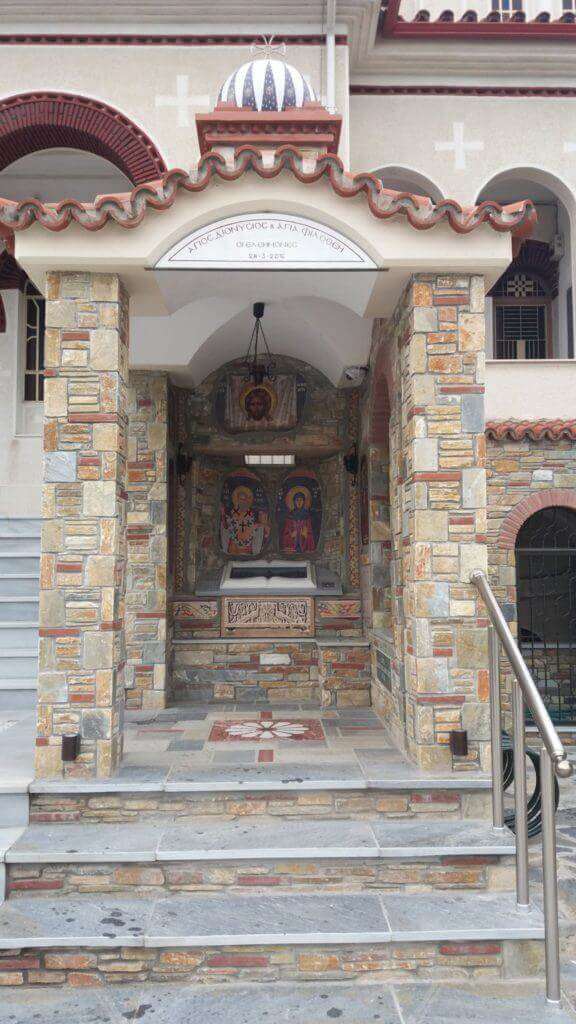
Outside the church, to the right of its entrance, stands the pillar to which Saint Philothei was bound and scourged. The nuns carried her to the crypt in Kalogreza. There, Philothei succumbed to her wounds on 19 February 1589. She was buried on the right side of the sanctuary of Saint Andrew; centuries later, her body was transferred to the Metropolitan Church of Athens, where it is kept in a silver reliquary to this day. At the place where she gave up her spirit, in the area of Kalogreza, the Church of Saint Philothei now stands, and her name is borne by the entire well-known suburb of Athens, Filothei.
Twenty days after the Saint's repose, her tomb emitted a fragrant aroma. Moreover, when her relics were translated one year later, her holy relics were found intact. They were also filled with fragrant myrrh, a clear and radiant proof of her God-pleasing and virtuous life, to the glory and praise of God and the boast of our faith. Her holy relics are today kept in the Metropolitan Church of Athens. Upon her tomb the following words were inscribed: "Beneath this sign lies the body of the pure Philothei; the Most High has placed her soul among the blessed."
Holy Canonisation:
Saint Philothei was proclaimed a saint during the reign of Ecumenical Patriarch Matthew II (1595–1600). Neophytos, Metropolitan of Athens, after examining and investigating the life and martyrdom of the Venerable one, composed a report to the Patriarchate together with the Bishops of Corinth and Thebes and the leading citizens of Athens, so as to enrol Saint Philothei among the ranks of the saints. In this synodal document the following is written: "Since it has been reliably attested that the most holy body of the most venerable Philothei is filled with fragrance and continually pours forth myrrh, and that it grants healing to those who approach, both the sick and those in need of cure… for this reason it has seemed good to us and to the entire Holy Synod of the hierarchs present here to compose this and to enrol her among the ranks of the Venerable and holy women, so that she may be honoured and celebrated each year." The Service in her honour was composed by a wise and devout man named Ierax. Among the beautiful Lamentations (Enkomia) is this one: "For you possessed the meekness of David and, reverend one, the wisdom of Solomon; the courage of Samson and the hospitality of Abraham; the patience of Job and the divine asceticism of the Forerunner…."
The house of Saint Philothei, the old mansion of the Benizelos family at the intersection of Palaiologos Benizelos and Adrianou streets, is the oldest building in Christian Athens and one of the few architectural remains from the period of Turkish rule. In this very place an olive press and part of a late-Roman wall have been discovered. In the basement there is a portico with elegant cylindrical columns supporting simple arches, while a stone staircase leads from the courtyard to the upper floor. The Benizelos mansion, an ancient monument according to Law 3028/2002 "For the Protection of Antiquities and Cultural Heritage", has been arranged as a visitable monument, a museum of itself.
The Katholikon of Saint Andrew and the monastery well have, by the grace of God, survived to this day within the precincts of the Archbishopric of Athens, many years after the repose of Saint Philothei.
Her memory is celebrated on 19 February.

Apolytikion. Tone 4. To the melody “Come quickly.”
O venerable one, having received the radiance of the saints, you made the city of Athens radiant. For, shining in good works, O Mother, you contended devoutly out of love for your neighbour. Therefore Christ has glorified you, O Philothei.

(You may download or publish part or all of the material on this website, provided that www.galilea.gr is acknowledged as the source. www.galilea.gr)