
APOLYTIKION
Tone 4. To the melody “Come quickly to our aid”
“A heavenly hymn of praise is splendidly celebrated on earth, while the community of Angels now joyfully celebrates an earthly festival. From above, with hymns they acclaim your struggles; below, the Church acclaims the heavenly glory
you attained through your labours and contests, O glorious Phanourios.”
SAINT PHANOURIOS
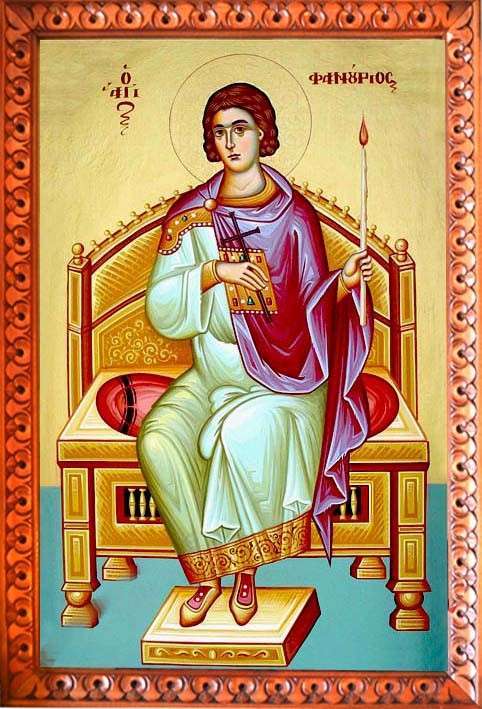
SAINT PHANOURIOS
2019 FEAST OF THE SAINT
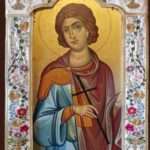
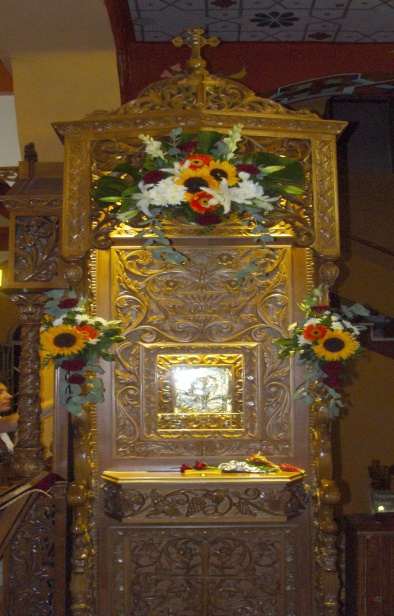
PATRONAL HOLY ICON
APOLYTIKION
Tone 4. To the melody “A Royal Diadem”
Our parish possesses you as guardian and protector, a gift offered by the faithful for our souls. Your venerable icon from Makri in Asia has found a new home, this church. And now, O Phanourios, champion, intercede that we may be saved.
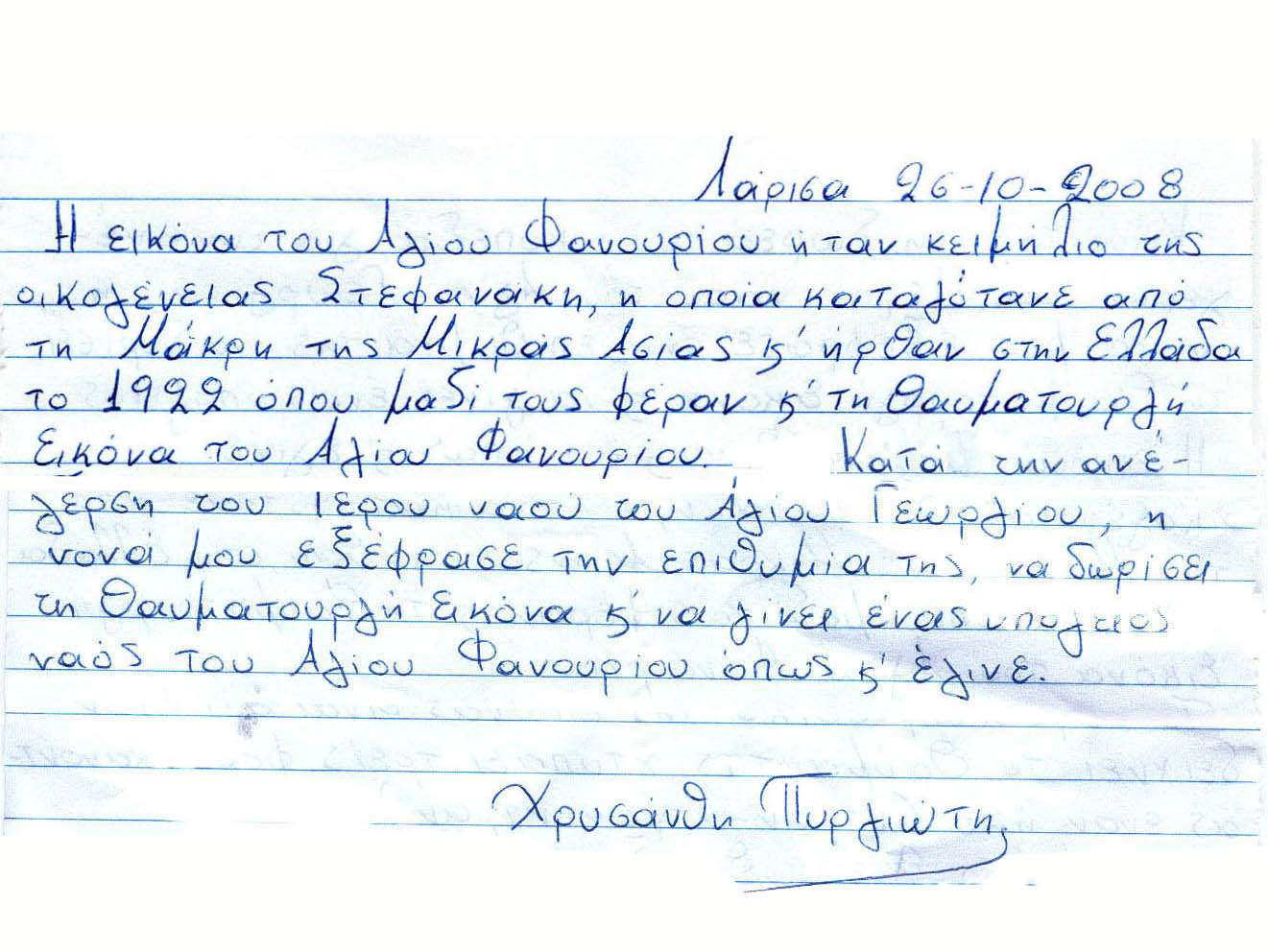
TEXT OF THE DONATION
THE GREAT MARTYR SAINT PHANOURIOS
THE LIFE OF THE SAINT:
Prologue:
Saint Phanourios is among the most beloved saints of the entire Greek people and can without doubt be described as a gift from God, for he remained unknown for many centuries.
The discovery of the icon:
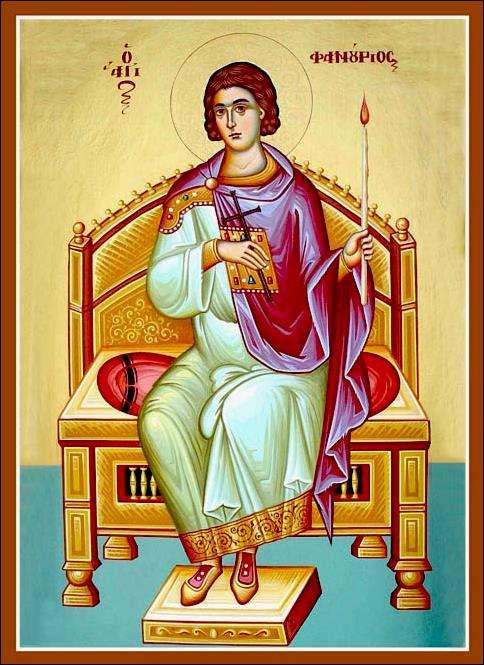 Unfortunately, no written accounts of the life of Saint Phanourios have survived. All that we know consists of inferences drawn from an icon of his, discovered in Rhodes during the 14th or 15th century AD, when the island was under Hagarene rule. The Hagarenes decided to rebuild the city walls they had savagely destroyed and demolished in the war a few years earlier. So they began sending workers outside the southern part of the fortress to collect stones from the inhabitants' half-ruined houses, to rebuild their city's strong new walls. During the restoration work on the city walls, a half-destroyed church filled with ancient icons was found among the ruins of the southern section of the fortress. Most of these were so decayed that neither the faces of the Saints nor the inscriptions upon them could be distinguished.
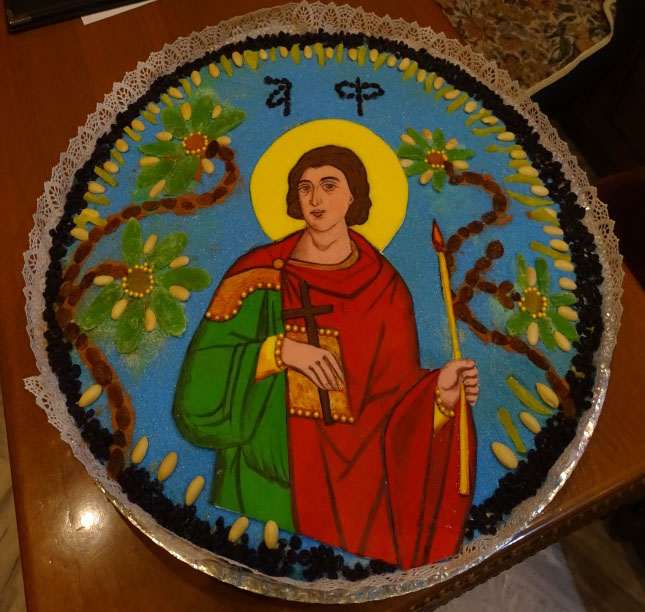
Only one remarkable icon stood out from the rest, untouched by time, depicting a young man clad in Roman military attire, holding a cross in his left hand and a candle in his right. Besides the figure of the Saint, the icon also contained twelve scenes portraying the martyrdoms he endured 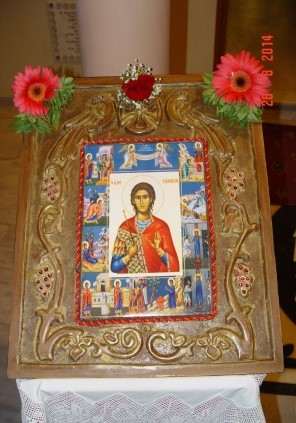 at the hands of the Romans. Thus we learned that the Saint suffered martyrdom at a young age. From the severity of the martyrdoms he endured, as depicted in the twelve scenes, we infer that he must have lived and suffered martyrdom around the 2nd or 3rd century AD, during a period when the persecution of Christians was relentless. Furthermore, from the scenes on the Holy Icon, we conclude that the Saint is a Great Martyr, having endured many cruel and inhuman tortures. Another conclusion arises from the Saint's attire, which appears to be Roman military uniform. This indicates that he was educated enough to hold such a position. Moreover, Saint Phanourios must have been of Greek origin, as evidenced by his name. The then Metropolitan of Rhodes, Neilos, since the Saint's name on the Holy Icon was worn away, gave this unknown Saint the name Phanourios. Bishop Neilos eventually restored the church in which the icon was found and placed it there.
The building of the church.
Metropolitan Neilos of Rhodes immediately sent a delegation to the ruler of the island, pleading for permission to restore the church. When the ruler refused, the Metropolitan personally travelled to Constantinople and succeeded in obtaining the requested permission from the Sultan. He soon returned to Rhodes and restored the church precisely to its original location outside the walls. The church has survived to this day and has since become a holy shrine for all Christians.
The miracle of the three priests:
 Saint Phanourios performs many miracles for the faithful who invoke his name, and one of these is the following:
During the historical period when the Latins held Crete under their dominion (1204–1669 AD), they had established their own Archbishop and were attempting by every means to lure the island's inhabitants into Catholicism (Papism).
Among the oppressive measures against Orthodoxy, the Latins had forbidden the ordination of priests in Crete; thus, the Cretans were compelled to travel to the island of Tsigiro (Kythera) to be ordained by the Orthodox Archbishop residing there.
At one time, therefore, three deacons set out from Crete for Tsigiro and, having been ordained priests there, returned in great joy to their island, then much afflicted by slavery. However, on their return journey, they were captured by Hagarene pirates, who took them to Rhodes and sold them to three different Hagarene masters.
While the plight of the three priests was pitiable, a sweet hope came to sweeten their bitter lament. They learned that in Rhodes Saint Phanourios worked miracles, and upon him they placed their hopes, continually praying and invoking him, each one separately, to deliver them from the harsh captivity of the Hagarenes. Thus, each of them, without having consulted the others, asked his master for permission to visit the church to venerate the icon of Saint Phanourios. Having obtained permission with relative ease, all three hastened to the Saint and venerated his icon with deep devotion. Kneeling in prayer with all the strength of their souls and wetting the ground with their tears, they implored Saint Phanourios to intercede so that they might finally be freed from the hands of the Hagarenes.
After the priests departed, relieved of their anguish, Saint Phanourios appeared during the night to all three of their masters and commanded them to set their slave priests free. However, the Hagarene rulers regarded the Saint's intervention as some form of sorcery; therefore, they chained their slaves and began to torture them even more severely. The following night, Saint Phanourios intervened effectively, loosing the three priests from their bonds and promising that he would free them from the Hagarenes the next day. Thereafter, he appeared once more to the Hagarenes and threatened them this time, saying that if they did not release the priests in the morning, they would meet with great disaster.
 The following morning, the Hagarenes, disobeying the saint's command, lost their sight and their bodies were left paralysed. They were then forced to consult their relatives to discuss the calamity that had befallen them. All the rulers, in turn, decided to summon the three priests, hoping they might be able to help. The priests replied that they would pray and implore God, and He would decide.
On the third night, Saint Phanourios appeared once more to the three Hagarene rulers and announced that unless they sent written consent to his church for the release of the priests, they would never regain their health. The Hagarenes then submitted in writing what Saint Phanourios had requested, declaring unequivocally that they granted the three priests their freedom. Even before the Hagarene delegation returned from the church, the blind and paralysed unbelievers were completely healed according to the will of the Saint. The wealthy Hagarenes provided the three priests with all their travelling expenses, and before departing, they went to the church; after thanking the Saint for their liberation, they made a faithful copy of the icon of Saint Phanourios and took it to Crete, where they honoured it every year with services of thanksgiving and processions.
The Saint is one of our greatest wonderworking Saints and is honoured as a Great Martyr. When Christians wish to ask the Saint for something, they customarily make a special cake, phanouropita, and take it to church for the priest to bless.
The Saint's memory is celebrated on 27 August.
APOLYTIKION. Tone 4. To the melody “Come quickly to our aid”
A heavenly hymn of praise is splendidly celebrated on earth, while the community of Angels now joyfully celebrates an earthly festival. From above, with hymns they acclaim your struggles; below, the Church acclaims the heavenly glory you attained through your labours and contests, O glorious Phanourios.
KONTAKION. Tone 3. To the melody “Today the Virgin”
You rescued priests from godless captivity and shattered their bonds by divine power, O godly-minded one. Courageously you shamed the tyrants' insolence and gladdened the ranks of Angels, O Great Martyr. Therefore we honour you, divine warrior, glorious Phanourios.
(You may download or publish part or all of the material on this website, provided that www.galilea.gr is acknowledged as the source. www.galilea.gr)
Life of Saint Phanourios
Saint Phanourios the Great Martyr
PREFACESaint Phanourios is undoubtedly a holy and important youthful figure, who stands out in his own way among the other saints of Christendom. He is not honoured on just one date; the faith of Christians leads them often to make the well-known fanouropita cake.
Saint Phanourios, who lived in Roman times, courageously confronted the pagan world, because the Christian spirit of the God-man did not allow him to renounce his unquestionably virtuous principles. Thus the 12 tortures the saint endured provide us with a powerful incentive to persevere and adhere to Christianity's moral values, so that we may emerge victorious from an unceasing struggle against the unbelief and injustice of our time. Through his actual sacrifice, the saint taught us that today we are not, of course, fighting Roman military rulers and dreadful Hagarenes, but must confront the most cunningly laid traps of materialism and atheism, which seek to sweep through the ranks of Christians en masse.
Saint Phanourios also taught us that the crown of a virtuous life is not won easily, but only through continual trials, with courage, patience and endurance. Therefore, as true strugglers in the faith, let us imitate the Saint’s exemplary and blameless life, so that one day we too may be found worthy to honour the Christian name we bear, just as he honoured it worthily.
Saint Phanourios1. General information about his life
Nothing definite is known about Saint Phanourios's origins and life, because all the details of his life were lost in times of turmoil.
The only information we have about the saint concerns the discovery of his icon, around AD 1500 according to the synaxaria, or around AD 1355–1369 according to others. Some maintain that the saint's icon was found on Rhodes, others on Cyprus.
2. The Discovery of the Icon
We return to the past, when the Hagarenes ruled Rhodes and decided to rebuild the city walls they had savagely destroyed and demolished in the war a few years earlier.
So they began sending workers outside the southern part of the fortress to collect stones from the inhabitants' half-ruined houses, to rebuild their city's strong new walls. Suddenly, amid the ruins, they found a beautiful church, though one side was half-destroyed. Inside it they found a heap of icons on which, because of their great age, neither the Saints' faces nor the inscriptions could be distinguished.
One remarkable icon alone stood out from all the others, untouched by time, depicting a young man dressed as a soldier. Neilos, Metropolitan of Rhodes, hurried to the site and clearly read the saint's name: Phanourios. Moved by the saint's revelation, His Eminence observed that he was dressed as a Roman soldier, holding a cross in his left hand and a burning candle in his right. Around the icon, the icon painter had also depicted in twelve scenes the torments the saint endured, plainly recounting his whole life.
These depictions are as follows:
I. The Saint is depicted standing before his Roman interrogator, apparently defending himself courageously and upholding his Christian faith.
II. Here the soldiers intervene and strike Phanourios's head and mouth with stones to force him to yield and deny the Lord.
III. The soldiers, now enraged by Phanourios’s steadfastness, threw him down and beat him savagely with sticks and clubs, to break his strong spirit.
IV. Phanourios is in prison, where he is tortured in a horrifying manner. He appears completely naked, with soldiers around him tearing his flesh with sharp iron instruments. The saint endures this terrible martyrdom without complaint.
E. Phanourios is once again in prison and prays to God to strengthen him to endure the tortures to the end.
VI. The saint appears again before the Roman examiner to account for his stance. His untroubled expression shows that neither the tortures he has suffered nor the tyrant's threats of what is to come have shaken his faith. Undaunted, he awaits still worse torments.
VII. With fury and cruelty, Phanourios’s executioners burn his naked body with flaming torches, revealing his surpassing sacrifice for the Crucified One. Once again the Saint prevails through his indomitable resolve and endurance in the Lord.
VIII. Here his savage torturers also use mechanical means to bring his martyrdom to its height. They have bound the saint to a rack which, as it turns, crushes his bones. He suffers without complaint, yet his beautiful face shows inexpressible exultation, because he suffers for the Lord's sake.
IX. Phanourios is thrown into a pit to become food for wild beasts, while his executioners watch from above to see his end. But the beasts have been completely tamed by God’s grace, so they surround him peacefully like little lambs and delight in his company.
X. His executioners are not satisfied with the previous result, so they take him out of the pit and crush him beneath a great stone, certain that this will finish him off. Yet once again they achieve nothing.
XI. The scene shows the saint before an altar, where his executioners urge him to sacrifice, placing burning coals in his palms. Phanourios emerges victorious from this trial too, as is shown by a devil in the form of a dragon flying in the air and weeping over his failure.
XII. The last scene depicts the end of his martyrdom. Phanourios has been thrown into a great furnace and stands upright on a stool, surrounded by flames and smoke. The saint is shown praying unceasingly to God, expressing neither complaint nor grumbling. Thus, steadfast and unyielding, he flew to heaven, full of contentment for all the torments he had endured for the Lord's sake.
3. Building the church
The island's Metropolitan at the time, Neilos, carefully studied the icon that had been found and concluded that Phanourios was one of the greatest Great Martyrs of our Faith. He immediately sent a delegation to the island's ruler, asking permission to restore the church. When the ruler refused, however, the Metropolitan travelled personally to Constantinople and succeeded in obtaining the permission he sought from the Sultan. He soon returned to Rhodes and rebuilt the church on its original site, outside its walls. The church survives to this day and has been a sacred place of pilgrimage for all Christians ever since.
4. Details about the discovery of the icon
Looking at the icon of Saint Phanourios found on Rhodes, we can draw many noteworthy details, which are as follows:
- 1. When we read the Saint's name on the icon, we immediately conclude that he is of Greek origin.
- 2. We also conclude that his parents were very devout, to have given him such a Christian name.
- 3. This young man must also have been very well educated to have become a soldier.
- 4. We also estimate that Saint Phanourios’s martyrdom took place in the second and third centuries, when the persecutions of Christians were at their height.
- 5. The many terrible torments Phanourios suffered plainly demonstrate that he was a Great Martyr.
- 6. We are also assured that faithful Christians honoured him in Christian churches from the time of his martyrdom, since such a church was even found in Rhodes.
- 7. From the Saint's depiction, it appears that Phanourios suffered martyrdom at a young
age.
5. The Saint's miracles
Saint Phanourios performed many miracles for the faithful who call upon his name. The following is one of them.
During one period of its history, Crete was subject to the Latins (1204–1669 AD). They had their own archbishop and therefore tried in every way to draw the island's inhabitants into Catholicism (Papism).
As an oppressive measure against Orthodoxy, the Latins prohibited the ordination of priests in Crete. Cretans were consequently compelled to travel to the island of Tsirigo (Kythera) to be ordained priests by the Orthodox bishop who resided there.
At one time, three deacons set out from Crete for Tsirigo. After being ordained priests there, they were returning, overjoyed, to their island, which was then suffering greatly under foreign domination. Unfortunately, Hagarenes—Muslim pirates—captured them at sea, took them to Rhodes and sold them to three different Hagarene masters.
The three priests were in a pitiable plight. Yet a sweet expectation came to soften their bitter sorrow. They learned that Saint Phanourios was working miracles in Rhodes, and placed their hopes in him. Each separately prayed continually and called upon him to deliver them from their harsh captivity under the impure Hagarenes.
Without consulting one another, each priest asked his master for permission to go to church and venerate the icon of Saint Phanourios. All three obtained permission easily. They reverently venerated the saint's icon, kneeling in prayer and watering the ground with their tears. With all the strength of their souls, they begged Saint Phanourios to intercede so that they might at last escape from the hands of the Hagarenes.
After the priests departed, relieved of their pain, Saint Phanourios appeared that night to all three masters and ordered them to free the enslaved priests, or else He would punish them severely. The Hagarene masters, however, regarded the saint's intervention as a form of sorcery. They therefore chained their slaves and began to torture them even more cruelly.
The following night, however, Saint Phanourios intervened more effectively. He loosed the three priests from their bonds and promised that He would free them from the Hagarenes the next day. He appeared to the Hagarenes again, this time warning that, if they did not release the priests in the morning, He would take severe measures against them.
The next morning the Hagarenes felt the punishment: they all lost their sight, and their bodies became paralysed. They were thus compelled to consult their relatives about the calamity that had befallen them. All the rulers decided to summon the three priests in case they could help. The priests' only answer was that they would pray to their God, and He would decide.
On the third night, Saint Phanourios appeared to the Hagarenes again and told them that unless the three rulers sent written consent to the priests' release to His church, they would never recover their health. Willingly or unwillingly, the Hagarenes wrote the letter Saint Phanourios requested, declaring unequivocally that they granted the three priests their freedom. Their declarations were deposited in the saint's holy church.
Even before the delegation of Hagarenes returned from the church, the blind and paralysed unbelievers had been completely healed through the saint's will. The wealthy Hagarenes gave the three priests all their travelling expenses. Before departing, the priests went to the church, and after thanking the saint for their liberation, they made a faithful copy of the icon of Saint Phanourios and took it to Crete, where they honoured it every year with services of thanksgiving and processions.
6. Saint Phanourios' cake
The great honour Christians show Saint Phanourios gave rise to the popular traditional custom of the saint's cake, better known as phanouropita.
The cake is usually small and round, made with pure flour, sugar, cinnamon and oil. These ingredients are mixed and kneaded, placed in a round tin, and the cake is baked in a moderate oven.
The cake is made so that the saint may reveal a lost object to someone, a job to someone out of work, a way forward in a lost cause, health to someone who is ill, and other such things.
Our Church celebrates his memory on 27 August.
PUBLICATIONS: ORTHODOX FOUNDATION "THE APOSTLE BARNABAS"