PROGRAMME FOR THE PATRONAL FEAST OF SAINT PHANOURIOS, THE GREAT MARTYR AND WONDERWORKER, 26–27 AUGUST 2021
21 Αυγούστου 2021 · ΓΕΝΙΚΕΣ ΕΚΔΗΛΩΣΕΙΣ
THE GREAT MARTYR SAINT PHANOURIOS
THE LIFE OF THE SAINT:
Prologue:
Saint Phanourios is among the most beloved saints of the entire Greek people and may without doubt be described as a gift from God, for he remained unknown for many centuries.
The discovery of the icon:
Unfortunately, no written accounts of the life of Saint Phanourios have survived. All that we know consists of inferences drawn from an icon of his which was discovered in the fourteenth or fifteenth century AD in Rhodes, when the island was under the dominion of the Hagarenes. The Hagarenes decided to rebuild the city walls that they had savagely destroyed and demolished in the war a few years earlier. They therefore began to send workers outside the southern part of the fortress to collect stones from the inhabitants' half-ruined houses, in order to reconstruct the new and strong walls of their city. During the restoration works on the city walls, a half-ruined church filled with ancient icons was found among the ruins of the southern section of the fortress. Most of these were so decayed that neither the figures of the Saints nor the inscriptions upon them could be distinguished.
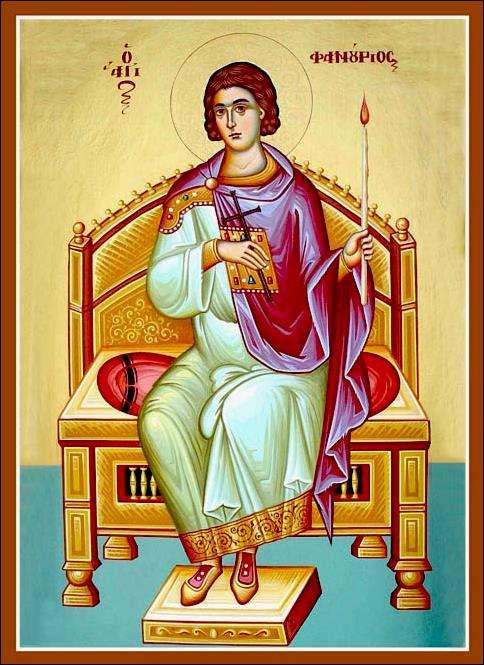
Only one remarkable icon stood out from the rest, untouched by time, depicting a youth clad in Roman military attire, holding a cross in his left hand and a candle in his right. Besides the figure of the Saint, the icon also contained twelve scenes illustrating the martyrdoms he endured at the hands of the Romans. Thus we learned that the Saint suffered martyrdom at a young age. From the severity of the martyrdoms he endured, as depicted in the twelve scenes, we infer that he must have lived and suffered martyrdom around the second or third century AD, during a period when the persecution of Christians was relentless. Furthermore, from the scenes on the Holy Icon, we conclude that the Saint is a Great Martyr, having endured many inhuman tortures. Another conclusion arises from the Saint's attire, which appears to be a Roman military uniform. This indicates that he was educated to hold such a position. Moreover, Saint Phanourios must have been of Greek origin, as is evident from his name. The then Metropolitan of Rhodes, Neilos, since the Saint's name on the Holy Icon was worn away, gave this unknown Saint the name Phanourios. Bishop Neilos ultimately restored the church in which the icon was found and placed it there.
The building of the church.
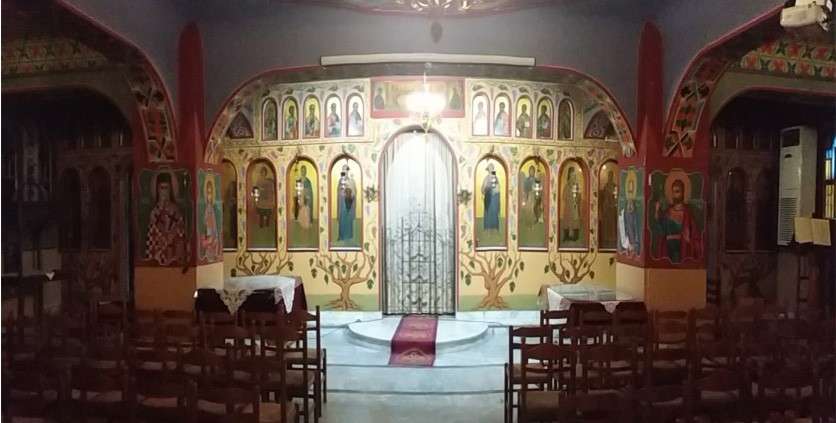
The Metropolitan of Rhodes, Neilos, immediately sent a delegation to the ruler of the island and begged him to grant permission to restore the church. When, however, the ruler refused, the Metropolitan himself travelled personally to Constantinople and succeeded in obtaining from the Sultan the permission he sought. He soon returned to Rhodes and restored the church precisely in its original location, outside the walls. The church has survived to this day and has since become a sacred shrine for all Christians.
The miracle of the three priests:
Saint Phanourios performs many miracles for the faithful who invoke his name, and one of these is the following:
During the historical period when the Latins held Crete under their dominion (1204–1669 AD), they had established their own Archbishop and were striving by every means to lure the inhabitants of the island into Catholicism (Papism).
Among the oppressive measures against Orthodoxy, the Latins had forbidden the ordination of priests in Crete; thus the Cretans were compelled to travel to the island of Tsigiro (Kythera) to be ordained priests by an Orthodox Hierarch who resided there.
At a certain time, therefore, three deacons set out from Crete for Tsigiro and, having been ordained there as priests, returned in great joy to their island, which at that time was sorely afflicted by slavery. On their return journey, however, they were captured by Hagarene pirates, who took them to Rhodes and sold them to three different Hagarene masters.
And while the plight of the three priests was pitiable, a sweet hope came to sweeten their bitter lament. They learned that in Rhodes Saint Phanourios was working miracles, and in him they placed their hopes, continually praying and invoking him, each one separately, that he might deliver them from the harsh captivity of the Hagarenes. Each of them, without having consulted one another, therefore asked his master for permission to go to the church to venerate the icon of Saint Phanourios. Having obtained permission with relative ease, all three hastened to the Saint and venerated his icon with devotion. Kneeling in prayer with all the strength of their souls and wetting the ground with their tears, they besought Saint Phanourios to intercede that they might be delivered from the hands of the Hagarenes.
After the priests departed, relieved of their pain, Saint Phanourios appeared during the night to all three of their masters and commanded them to set their slave priests free. The Hagarene rulers, however, regarded the Saint's intervention as some form of sorcery; therefore they bound their slaves with chains and began to torture them even more severely. The following night, however, Saint Phanourios, intervening effectively, loosed the three priests from their bonds and promised that he would deliver them from the Hagarenes the next day. Thereupon he appeared once more to the Hagarenes and threatened them this time, saying that if they did not release the priests in the morning, they would meet with great harm.
The next morning, the Hagarenes, disobeying the saint's command, lost their sight and their bodies remained paralysed. They were then forced to consult their relatives to discuss the affliction that had befallen them. All the rulers decided to summon the three priests, hoping they might be able to help. The priests replied that they would pray and beseech God, and He would decide.
On the third night, Saint Phanourios appeared once more to the three Hagarene rulers and announced that unless they sent written consent to his church for the liberation of the priests, they would never regain their health. The Hagarenes then submitted in writing what Saint Phanourios had requested, declaring unequivocally that they granted the three priests their freedom. Even before the delegation of Hagarenes returned from the church, the blind and paralysed unbelievers were completely healed according to the will of the Saint. The wealthy Hagarenes gave the three priests all their travelling expenses, and before departing, they went to the church and, after thanking the Saint for their liberation, made a faithful copy of the icon of Saint Phanourios and took it to Crete, where they honoured it every year with services of thanksgiving and processions.
The Saint is one of our greatest wonderworking Saints and is honoured as a Great Martyr. When Christians wish to ask the Saint for something, they customarily make a special cake, the phanouropita, which they take to church for the priest to bless.
The Saint's memory is celebrated on 27 August.
APOLYTIKION. Tone 4. To the melody “Come quickly to our aid”.
A heavenly hymn of praise is splendidly celebrated on earth, while the community of Angels now joyfully celebrates an earthly festival. From above, with hymns they acclaim your struggles; below, the Church acclaims the heavenly glory you attained through your labours and contests, O glorious Phanourios.
LISTEN TO APOLYTIKIA No. 2 & No. 3 HERE:
KONTAKION. Tone 3. To the melody “Today the Virgin”.
You rescued priests from godless captivity and shattered their bonds by divine power, O godly-minded one. Courageously you shamed the tyrants' insolence and gladdened the ranks of Angels, O Great Martyr. Therefore we honour you, divine warrior, glorious Phanourios.
=