WITH PAIN AND LOVE – Let us become resilient people –
22 Οκτωβρίου 2020 · ΧΡΗΣΤΟΗΘΕΙΑ
Βίντεο
CHURCH OF SAINT GEORGE THE GREAT MARTYR, LARISSA.
EVENING TALKS: "UPRIGHT CONDUCT, PART II—WITH PAIN AND LOVE."
2020 22 Oct. WITH PAIN AND LOVE — Let us become resilient people — Fr Nikiforos.
On Thursday, 22 October 2020, an evening talk in the second series of talks by our spiritual father, Fr Nikiforos Kontogiannis, was held in our Church of Saint George the Great Martyr in Larissa. Entitled “UPRIGHT CONDUCT (Part II) – WITH PAIN AND LOVE”, it took as its starting point Saint Paisios the Athonite's book “With Pain and Love for Contemporary Man”, from which various conclusions are drawn concerning spiritual life, coexistence, cooperation and, in general, drawing near to God with a view to salvation, sanctification, the imitation of Holy Christ and, ultimately, the deification of man through the incarnate Holy Christ. The talks take place every Thursday at 7:00 p.m., immediately after the Services of Vespers and Supplication, which begin at 6:00 p.m. They are also streamed live through our website: galilea.gr/new/webtv/live/ .
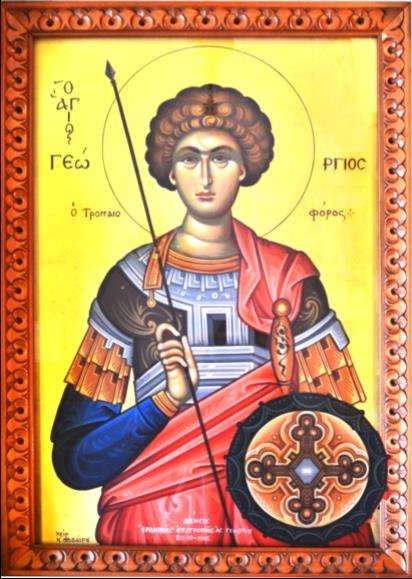
The supplication was offered in honour of the Great Martyr Saint George the Trophy-bearer. During it, the holy relics of Saint Luke the Physician and Saint Nektarios, Bishop of Pentapolis, were set out for the faithful to venerate and receive their blessing, as well as two handcrafted items made by Saint Paisios the Athonite containing wood of the Precious Cross.
APOLYTIKION. Tone 4. As liberator of captives, defender of the poor, physician of the sick and champion of kings, O Trophy-bearing Great Martyr George, intercede with Christ our God that our souls may be saved.
THEME OF THE 31ST TALK:
“Let us become people hardened by trials ”
Excerpts from the book by Saint Paisios the Athonite:
SPIRITUAL COUNSELS, VOLUME 1, “With Pain and Love for Contemporary Man,” Part 3, chapter 3
The spirit of sacrifice has vanished
Most people today have not tasted the joy of sacrifice and do not love labour. Laziness, comfort and excessive ease have entered. The sense of honour and sacrifice is missing. They regard it as an achievement when they manage to accomplish something without labour, when they find comfort. They do not rejoice when they are not comfortable. Yet, if they approached things spiritually, they ought then to rejoice, for they are given the opportunity for struggle.
Now everyone, young and old, seeks ease. Spiritual people look for how to be sanctified with less labour. Secular people seek how to earn more money without working. Young people seek how to pass their examinations without studying, how to obtain a degree without leaving the café. And if possible, to telephone from the café to have the results given to them! Yes, they have reached that point! Many children come to the cell and say to me: “Pray that I may pass.” They do not study and say: “God can help me.” “Study, I tell them, and pray as well.” “Why, they say, cannot God help me?” That is to say, should God bless their laziness? That cannot be. If the child studies but does not succeed, then God will help him. There are some children who do not remember or do not understand, yet they make an effort. These God will help to become versatile.
Thank God there are exceptions. A young man from Chalkidiki sat for examinations at three faculties and passed all of them125, coming first in one and second in another. Yet he found greater comfort in securing a job to relieve his father, who worked in the mines. Thus, he did not proceed with his studies but immediately took up employment. Such a soul is a remedy for me. For such children, I would willingly die and become compost. Most young people, however, have been influenced by the worldly spirit and have suffered harm. They have learned to care only for themselves, thinking nothing of their neighbour but only of their own self. And the more you help them, the more indolent they become.
I see some children today who are like overcooked, lifeless things. They criticise one another, they grow bored with one another, yet the heart never grows weary nor ages. They become monks and grow bored; they marry and are afraid. Great young men come, they return to Mount Athos… “Alas, being a monk is difficult,” they say. “To have to rise at midnight every day! It is not just for one or two days!…” They return to the world. “What shall I do in this society? With whom shall I become involved if I marry? It is all trouble,” they say, and they come back to the Holy Mountain. They stay a little while and tell you, “It is difficult…”
Young people today are like new machines whose oil is frozen. The oil must be warmed for the engines to start; otherwise, it cannot be done. Wretched children come to the hermitage—not just one or two—and ask me, “What shall I do, Father? How shall I pass the time? I am overcome by boredom.” “Find a job, my child,” I reply. “I have money,” he says to me. “What need have I of work?” “But the Apostle Paul says, ‘If anyone will not work, neither let him eat’126. You must work in order to eat, even if you have money. Work helps a person to thaw the frozen oil of his machine. It is creative. It brings joy and removes anxiety and boredom. Thus, my young friend, find a job that you like, even a little, and begin. Just try and see!”
And you see, some young people become weary, and they find rest in their weariness. New young people come to the skete and sit down, yet they grow tired simply from sitting. But with great sense of honour, they keep asking me: “What shall we do for you? What shall we bring you?” I never ask for anything. In the evening, by torchlight, I do the work: carrying wood, lighting two stoves in winter, and tidying up. Many visitors leave everything in disarray—mud, wet socks. I give them the fine socks sent to me, and they throw the others away. I give them tissues to wrap things in, yet they do not tidy up. Three times in my life have I asked for something. Once I told a young man: “I would like two boxes of matches from Karyes”—though I had four lighters, but I did so to give him joy. He ran happily, panting to bring them, yet the labour wearied him, for he tasted the joy of sacrifice. Another sat down and grew weary simply from sitting. People seek to feel joy, but man must make a sacrifice for joy to come. Joy is born from sacrifice. True joy springs from a sense of honour. Thus, when a sense of honour is cultivated, it becomes a feast. Man’s suffering lies in egoism and self-love. That is where one gets stuck.
Two young officers once came to Mount Athos and said to me: “We wish to become monks.” “Why,” I asked, “do you wish to become monks? Since when has this occupied your thoughts?” “Now,” they replied, “we have visited Mount Athos and are considering staying, in case some war breaks out.” “My dear friends,” I said, “are you not ashamed? ‘In case some war breaks out’! And how will you leave the army?” “We shall find some excuse,” they said. What excuse could they find? Either they will pretend to be mad, or… they will find something. “If you set out to become monks with such reasoning, you are failures from the start,” I told them. Others, though ready for some time to marry and build a family, come and say to me: “What should I marry? Is it right to have a family and children in these difficult times?” “Well,” I said, “when persecutions occurred, did life come to a halt? Did people neither work nor marry? Or are you simply bored?” “I wish to become a monk,” he says. “You are bored! What kind of monk will you become?” Do you understand? If a woman sets out to become a nun thinking: “Why should I remain in the world, have a family, children, worries and noise? I shall go to a monastery, where I shall simply obey; I shall bear no responsibility, and if anyone says something to me, I shall bow my head. Where would I build a house? There I shall have my own cell, food, and so on,” let her know that she is a failure from the start. Does this seem strange to you? Such people do exist. Know this: a capable head of a household would also succeed in monastic life, and a capable monk, if he had a family, would also succeed.
Someone had entered a monastery as a postulant but did not wish to become a monk. “Why, my child, do you remain thus?” I asked him. “Because the monk’s cap reminds me of a helmet,” he replied. Do you hear such words? He did not wish to become a monk so as not to wear the monk’s cap. It reminded him of a helmet! And when had he ever worn a helmet? It is doubtful he wore it only a few times during some training exercise. Where would he have gone to war! It reminded him of a helmet! Do you hear? What does this person seek in monastic life? When one begins thus, what sort of monk will he become? Can you tell me? In the end, the poor man became a monk somewhere and did not wear the heavy cap.
Once, two young men came to the skete with long hair reaching down. I went to cut their hair; they resisted, and I was in a hurry, so I merely offered them refreshments. I also had a kitten there. “Shall I take it?” one asked. “Take it,” I said. They went from there to Iviron, an hour’s journey, one carrying the kitten in his arms—and it was raining. He asked to stay in the guesthouse with the kitten. “That cannot be done,” they told him, and he remained outside in the rain all night. If you had asked him to stand guard for one hour, he would have said, “No, I cannot,” yet he could remain outside all night with the kitten.
Another went as a soldier and then left. He later came to the skete and said to me, “I wish to become a monk.” “Go and complete your military service!” I told him. “The army is not like my home,” he replied. “How fortunate you tell me this, my brave lad; I did not know, so I can tell others!” Meanwhile, his family was searching for him. A few days later, he passed by again early in the morning. It was Thomas Sunday. “I want you,” he said. “What do you want?” I asked. “Did you attend church?” “Nowhere,” he replied. “Today, Thomas Sunday, the monasteries hold a Vigil, and you did not go? And you wish to become a monk? Where were you?” “I stayed at a hotel. It was quiet; monasteries are noisy!” “And what will you do now?” “I am thinking of going to Sinai, because I desire a harsh life.” “Have a little patience,” I said. I went inside, took a sweet bread that had been brought to me, and gave it to him. “Take this soft bread,” I said, “so that you may live a harsh life, and go!” These are the young people today. They do not know what they seek. They cannot endure any constraint at all. How then could they sacrifice themselves later?
I remember in the army how often a need would arise and you would hear: “Sir Commander, let me go in his place; he is married and has children; let not his children be left on the streets.” They would implore the Commander to let them take his place, to go to the front line! They rejoiced at the thought of being killed themselves so that the other might live and not leave his children destitute! Who now would make such a sacrifice? It is a rare thing indeed! Once we found ourselves without water at a certain location. The Commander saw on the map that there was water at a specific point. However, insurgents were stationed there. He said to us: “There is water nearby, but it is extremely dangerous. Who will go to fill a few canteens? They must not even light a lamp.” One man sprang up: “I will go, Sir Commander,” another said “I,” another “I”! Everyone was asking to go! And in the night, without light, the terror is great. “You cannot all go,” said the Commander. I mean, no one thought of themselves. No one shrank back to say: “Sir Commander, my foot hurts,” or another: “My head aches,” or “I am tired.” We all wanted to go, even though our lives were in danger.
Today there is a spirit of lukewarmness, no courage whatsoever, no sacrifice. Everything has been transformed by today’s misguided reasoning. And you see, whereas in the past men went as volunteers to the army, now they obtain a medical certificate to avoid service. They look for ways not to become soldiers. But before? We had a captain who was twenty-three years old, yet he was a true hero! Once his father, a retired officer, called him on the telephone and said he was thinking of arranging for him to leave the front line and go to the rear. The captain raised his voice in protest. “Shame on you, father, to speak such things! The drones are the ones who sit back.” He possessed sincerity, honesty, and great courage that went beyond all limits; he ran ahead. His cloak was pierced like a sieve by bullets, yet he was not killed. When he was discharged, he took the cloak with him as a keepsake.