Come, believers, let us see where Christ was born,
27 Δεκεμβρίου 2019 · ΑΝΑΚΟΙΝΩΣΕΙΣ
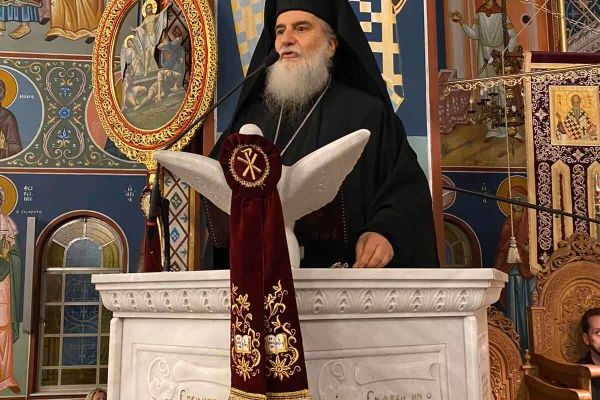
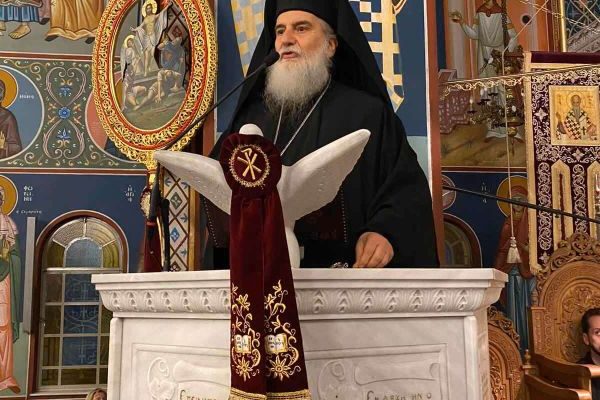
A talk during Festal Vespers for the Feast of Christmas at Saint Achillios (Monokklisia)
https://imlarisis.gr/%CE%BF%CE%BC%CE%B9%CE%BB%CE%AF%CE%B1-%CE%BA%CE%B1%CF%84%CE%AC-%CF%84%CE%B7-%CE%B4%CE%B9%CE%AC%CF%81%CE%BA%CE%B5%CE%B9%CE%B1-%CF%84%CE%BF%CF%85-%CF%80%CE%B1%CE%BD%CE%B7%CE%B3%CF%85%CF%81%CE%B9%CE%BA/Come, Let Us See
CHRISTMAS 2019
Kathisma, Tone 4—Joseph Was Amazed
Come, faithful, let us see where Christ was born. Let us therefore follow where the star leads, with the Magi, the kings of the East. Angels sing praises unceasingly there. Shepherds keeping watch in the fields sing a worthy song, saying, “Glory in the highest” to Him who today was born in a Cave of the Virgin and Theotokos, in Bethlehem of Judea.
“Come, faithful, let us see where Christ was born,” our Church sings on Christmas Day, filling us with awe and challenging us to set out on the road to reach the place where our Christ was born.
But let us take a look at ourselves.
This Christmas too, the hymn invites us: “Come, faithful, let us see where Christ was born.” And what are we doing? Have we decided to obey this call, or have we still not set out? Are we perhaps attached to our work? Like Martha, are we “anxious and troubled about many things” (Luke 1:42)? Do our anxiety, tension, irritability and concern to fit everything in mean that we have still not begun our journey?
Yet there are other excuses too that prevent us from setting out to meet the Lord, as the parable of the Great Supper recounts: “I have bought a field and must go out and see it; I ask you, have me excused.” And another said, “I have bought five yoke of oxen and am going to test them; I ask you, have me excused.” And another said, “I have married a wife, and therefore I cannot come” (Luke 14:8).
Of course, the Apostle Paul urges us to avoid life's many cares: “Brothers and sisters, the time is short. From now on, let those who have wives be as though they had none; those who weep, as though not weeping; those who rejoice, as though not rejoicing; those who buy, as though not possessing; and those who use this world, as though not engrossed in it. For the form of this world is passing away. I want you to be free from anxiety” (1 Cor. 7:29–31). He also emphasises contentment and simplicity in material goods, writing to the Apostle Timothy: “Having food and coverings, with these we shall be content. But those who wish to become rich fall into temptation and a snare, and into many foolish and harmful desires that plunge people into ruin and destruction” (1 Tim. 6:8–9).
“Come, faithful, let us see,” the hymn calls, yet we are still trapped by the temptation of laziness. But how beautifully the Word of God urges us: “How long, sluggard, will you lie there? When will you rise from sleep? A little sleep, a little sitting, a little drowsing, a little folding your arms upon your chest” (Proverbs 6:9–10).
So what are we doing? Are we still asleep? Are we still undecided? Why do we not set out? Why do we not follow “where the star leads”?
With what longing the Apostle Paul journeyed towards martyrdom! “And now, behold, bound in the spirit, I go to Jerusalem” (Acts 20:22).
Bound by the bonds of obedience to God's call, he goes on his way. But have we considered by what bonds we are bound, what spirit drags us along and where it is taking us? Many are the bonds of our age: material things, pleasures, electronics, harmful company, fashion, majority opinion and so much else.
Yet this year too the hymn calls, “Come, let us see, O faithful,” and something seems to stir within us. Something challenges us. It is “the voice of my beloved, knocking at the door: Open to me, my sister” (Song of Songs 5:2), but we are not ready yet. The call has found us at a time when we need to rest, relax and recover from all our work. “How can we follow at such an hour?” And at once we find an excuse: “I have taken off my tunic; how shall I put it on again? I have washed my feet; how shall I soil them?” (Song of Songs 5:3). “Did you have to choose this hour to call us? Why is that bell ringing at such an hour? We are sleeping; please do not disturb us.” But God's love does not stop. He stands outside the door and calls us, stressing that whoever stands firm and overcomes temptation will be honoured by being seated beside him on the throne of divine glory: “Behold, I stand at the door and knock. If anyone hears my voice and opens the door… To the one who overcomes I will grant to sit with me on my throne” (Revelation 3:20–21).
So let us hasten to respond today without delay, for we never know where postponement may lead us. The Apostle Paul emphasises, “Today, if you hear His voice, do not harden your hearts” (Hebrews 3:7).
And the divine hymn continues to call us, “Come, faithful, let us see where Christ was born,” and at last we set out. We took the road, but did not hear the Lord calling, “Enter through the narrow gate; for wide is the gate and broad is the road that leads to destruction” (Matt. 7:13). We chose the wide gate. We chose the comfortable Christian life. We chose the road of comforts, conveniences, our own ease, our desires and our feelings, and settled comfortably like the rich man in the parable: “Soul, you have many good things laid up for many years; rest, eat, drink and be merry” (Luke 21:19).
Finally, when we awaken from the deception of comfort and complacency and decide to set out, we realise that it is impossible to take the road leading to Jesus Christ, because we have become bogged down in the mire. We are stuck in the mud of our desires. Then we realise that we took the wrong road and therefore do not arrive, because we lost ourselves amid the calls of so many worldly enticements. Yet even in this fallen state, we again hear the hymn calling us: “Come, faithful, let us see where Christ was born.” But how? In what way, since we are stuck in the mire of our desires?
Once again the love of our newborn Christ gives us the answer through the Prophet Joel: “Return to Me with all your heart, with fasting, with weeping and with lamentation. Rend your hearts and not your garments, and return to the Lord your God, for He is merciful and compassionate, patient and abundant in mercy, and relents concerning calamities” (Joel 2:12–13).
And after so many calls, we decided to set out. We decided to become good people, free of all those systems and constraints, taboos and outdated ways—the human systems that bring no progress and do not let us go freely through life. They do not let us proceed without prohibitions, without commandments, without saviours, without interference in our lives. Yes, then, we decided to go to the newborn Christ on our own, as good people, as humanitarians, especially since we feel we know the road that will bring us close to Christ and can walk it by ourselves. Of course, the good God calls out, “Take heed to yourself and guard your soul diligently” (Deuteronomy 4:9), and we reply so casually, “All right, we are grown-ups; we know how to make our way through life.” Thus we drew courage from ourselves and set out. We wanted to break free from everyone and everything. We became good people, in our own opinion, although the word of God says, “The fool, trusting in himself, associates with the lawless” (Proverbs 14:32). We became kites, soaring high in the sky; and up there, where we had risen, we felt that certain strings were holding us and making us do whatever they wanted. “But we want to leave, free of constraints, commandments and laws that constantly ring in our ears: ‘Fast, go to church, go to confession, do not have a civil marriage, do not dress like that…’ and so many other things.” And we wonder: “Why must there be so many DON'Ts and just as many NOs in our lives? We are not bad people. We are not hypocrites. We do not make a great show of crossing ourselves, or do so many other things.” While these questions whirl around in our minds, we decide to cut all those strings that bind our lives. Then we felt free: free to fly and reach our God. But at that moment came the great surprise. By cutting away our roots, our traditions, the ways and customs of our faith and our homeland, we found ourselves free, indeed, but among the dead, as the Psalmist also says: “I have become like a man without help, free among the dead” (Psalm 87:5–6).
At this point let us consider what S. KONDOS of Corfu writes in his book “Ancient History”: “If we are ignorant of what has passed, we are always infants; for what is human life unless knowledge of ancient things is joined with knowledge of our own times?” (Computer folder: BOOKS–HISTORICAL, “Ancient History,” S. KONDOS of Corfu, vol. A, Prolegomena 2,4).
Of course, after so many adventures, one would hardly set out to reach the newborn Christ alone, and we said:
“Let us follow, then, where the star leads.” But we have no clothes, for amid the many follies of our lives we have ruined our garment. We have no suitable clothing, as the hymnographer of the Great Canon chants: “I have torn my first garment; I have lost my original beauty and comeliness” (Great Canon). Moreover, looking at all the others walking towards the manger where Christ was born, we realise that they all have something to offer the newborn Child: “The angels offer the hymn, the heavens the star, the shepherds the wonder, the earth the cave, the wilderness the manger, the Magi the gifts.” But we, idly wandering along life's roads, have not found time to acquire gifts.
Someone said that we should offer Him our sins.
But everyone brings precious Gifts, and we bring our sins? The Word of God became man for us, and shall we stain Him with our sins? Besides, the good God cleansed us of our sins through baptism and confession, since He was baptised in the Jordan not to be cleansed Himself, but to cleanse us, like another kind of soap.
Thus the great love of God’s mercy washed away our sins through the sacrament of Holy Confession.
Then what shall we offer Him?
Our virtues. Love for our neighbour. Humility, submission as servants of Christ. Our uncomplaining journey with our cross, joy, peace and all the wealth of our virtues, which we forget because we concern ourselves more with our passions than with our virtues.
“Let us follow, then, where the star is going,” where the star leads us. Let us follow the Magi with their gifts, or keep watch with the shepherds abiding in the fields, so that we may hear the angels' “fitting song.” And Saint Gregory the Theologian says, “For many are the paths of salvation, all leading to communion with God; these you must travel” (Gregory the Theologian, Poem 11, 1225, EPE, vol. 10, p. 130).
Of course, on this journey towards Christ there are also those who mislead the people. They shout, “Christ is here,” “Christ is there,” like traders at fairs, and confuse us. But the Lord warns us: “For false christs and false prophets will arise… Behold, I have told you beforehand. Therefore, if they say to you, ‘Look, He is in the wilderness,’ do not go out; ‘Look, He is in the inner rooms,’ do not believe it” (Matt. 24:24–26).
Saint Gregory the Theologian explains: “The saving paths all lead to communion with God” (Poem 11:1225, EPE, vol. 10, p. 130). There are many paths we think lead us to salvation, but only those leading us to unity with our Christ are right. The many voices and calls, says Saint Cyril of Jerusalem, create envy, hatred and divisions. He stresses: “Hatred of one's brothers gives room to the Antichrist, for the devil prepares divisions among peoples so that, when he comes, he may be readily welcomed. May none of Christ's servants here or elsewhere run to the enemy” (Saint Cyril of Jerusalem, Catechetical Lecture to Those Being Enlightened 15:9, EPE, vol. 2, p. 132).
Yet as we celebrate Christmas again this year, once more the beautiful hymn calls us: “Come, faithful, let us see where Christ was born.” Let us therefore resolve to set out to meet our newborn Christ. Let us all go together, united in love, following the Star with the Magi and the shepherds. All together, united with our bishop, our priests, our spiritual brothers and sisters, and all Christians who love virtue, let us reach the Manger, where “Angels sing hymns without ceasing” and where Jesus Christ calls us to hear Him say: Come, “that you may know that there is none like Me in all the earth”; Gen. 9:14.
24 December 2019
Festal Vespers of Christmas.
Metropolitan Cathedral of Saint Achillios, Larissa
Archimandrite Nikiforos Kontogiannis