CHRISTIAN CONDUCT—The worldly spirit in our times—Fr Nikiforos.
12 Δεκεμβρίου 2019 · ΧΡΗΣΤΟΗΘΕΙΑ
Βίντεο
CHURCH OF SAINT GEORGE THE GREAT MARTYR, LARISSA
2019 12 Dec. UPRIGHT CONDUCT — The worldly spirit in our time.
A talk by Archimandrite Nikiforos Kontogiannis on “UPRIGHT CONDUCT,” guided by Saint Paisios the Athonite's book “With Pain and Love for Contemporary Man,” p. 69 ff., and Saint Nikodemos the Athonite's “Upright Conduct” (E.P.E., vol. 1, p. 16).
The talks take place at the Church of Saint George the Great Martyr in Larissa every Thursday at a quarter to seven in the evening, immediately after the Service of Supplication.
On Thursday 12 December 2019, our spiritual father, Fr Nikiforos Kontogiannis, gave the evening talk entitled “VIRTUOUS CONDUCT” at our Church of Saint George the Great Martyr in Larissa. Drawing on Saint Paisios the Athonite's book “With Pain and Love for Contemporary Man”, the talks explore lessons concerning spiritual life, living together, cooperation and, more generally, drawing near to God, with the aim of salvation, sanctification, imitation of Jesus Christ and, ultimately, the deification of the human person through Jesus Christ, who became man. The talks take place every Thursday at 6:45 p.m., immediately after the Service of Supplication, which is celebrated at 6:00 p.m. They are also broadcast live on our website: galilea.gr/new/webtv/live/ .
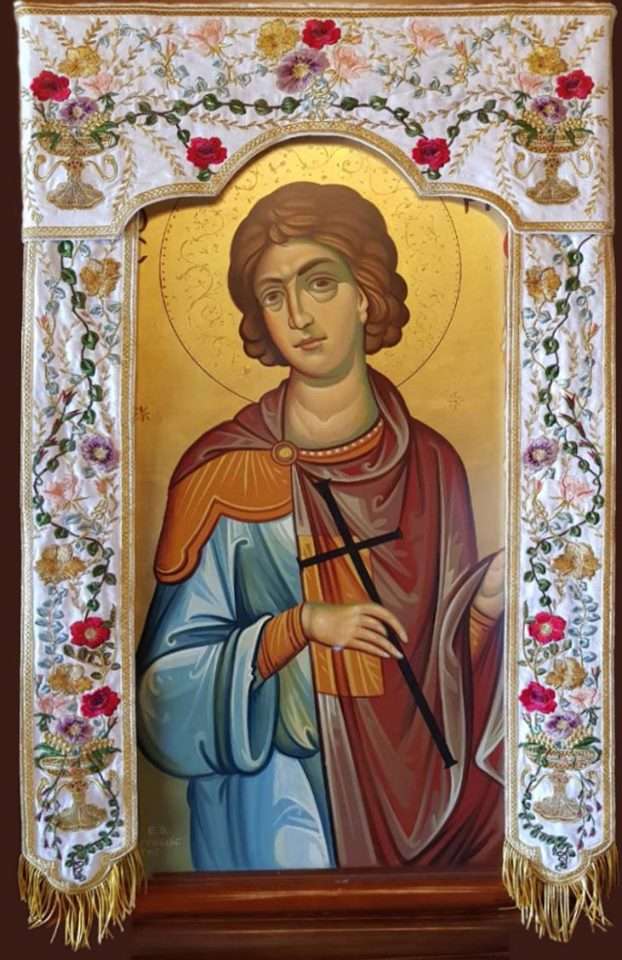
The Service of Supplication was celebrated in honour of Saint Phanourios the Great Martyr and Wonderworker. During the service, the slipper of Saint Spyridon the Wonderworker was displayed for the faithful to venerate and receive its blessing. This is a cloth covering the incorrupt foot of Saint Spyridon's holy body in Corfu; it is changed every year and given as a blessing. The holy slipper is one of our church's sacred treasures.
APOLYTIKION. Tone 4. To the melody "Come quickly to our aid"
A heavenly hymn of praise is splendidly celebrated on earth, while the community of Angels now joyfully celebrates an earthly festival. From above, with hymns they acclaim your struggles; below, the Church acclaims the heavenly glory you attained through your labours and contests, O glorious Phanourios.
SUBJECT OF THE 8TH TALK:
“The worldly spirit in our time.”
Guided by Saint Paisios the Athonite’s Spiritual Counsels, vol. I, With Pain and Love for Contemporary Man, page 69 onwards, and Saint Nikodimos the Athonite’s Christian Conduct, E.P.E., vol. 1, p. 16.
Saint Paisios, Spiritual Counsels, Volume 1
With Pain and Love for Contemporary Man, page 69 onwards.
Chapter 3: The worldly spirit.
Whoever is possessed by vanity is under the devil's dominion. A heart captured by the vain world keeps the soul atrophied and the mind darkened. Then, while a person appears to be human, in reality he is a spiritual monstrosity… The worldly spirit is the greatest enemy of our soul, even greater than the devil, for it draws us in sweetly and ultimately embitters us eternally… The worldly spirit enters gradually, just as the hedgehog entered the hare's den.
Evil advances little by little. Had it come suddenly, we would not have been deceived… When the heart is drawn by worldly beauties which are not sinful yet remain vain, it feels a worldly joy of the moment, which has no divine consolation, no inner flight with spiritual exultation…
What is needed is to direct all one's care towards spiritual purity, towards inner beauty and not towards outer appearance… Those who do not restrain their hearts from material desires… await a double misfortune… The desire of the heart is not evil in itself. But when things, even if not sinful, take away a part of my heart, they diminish my love for Christ.
Every desire, however good it may appear, is not better than desiring Christ or the Theotokos.
God seeks the human heart. “Give Me, my son, thy heart”[1]
We must avoid worldly things so that they do not take our hearts, and use simple things only for our needs.
Then they ask: “Why am I not moved by spiritual things?” How can you be moved when your heart is scattered in cupboards and on plates? You have no heart; you have only flesh, within which something ticks mechanically, like a clock, just enough for you to walk!
These desires, even if not sinful, are worse than sinful ones. For a sinful desire will sometimes shake a person and prick his conscience; then he will make an effort, repent and say, “I have sinned, O my God.” But these “good” desires do not trouble him.
Before the heart is purified, it has worldly desires and rejoices in them. But when it is purified, it is grieved by worldly desires, it loathes worldly desires, and then its joys are spiritual. Thus the heart is purified when it loathes worldly desires. Before it loathes them, it is drawn to them. But… to acquire divine Grace, desires must be cut off, even good ones; the will must be cut off.
[1]. Prov. 23:26.
Saint Nicodemus the Hagiorite. “Upright Conduct”.
(E.P.E., vol. 1, p. 16)
How, then, did evils prevail? Sin and evil are upheld by no natural, divine or human law; rather, all laws overthrow them. How, then, did evil prevail in the world and gain dominion over wretched people? I shall tell you, my brethren. Something else caused evil and sin to become established. They increased in the world solely through the bad habits of foolish and corrupt people, through all the superstitious reasoning of certain senseless people, and through the lawless and unthinking traditions invented by people of old, which later generations then blindly followed and preserved.
For example, a person's great-grandfather discovered an evil and practised it. His grandfather imitated it; his father then followed; afterwards the son imitated them. Thus, receiving evil from one another in succession and following it as though it were something fine, they confirmed it through continual and long-standing custom. Custom then became an ingrained habit, and habit became like law and nature. The wise Solomon says that "when an ungodly custom becomes established over time, it becomes law" (Wisdom of Solomon 14:16). Basil the Great likewise says, "A custom that has prevailed for a long time acquires the force of nature." And the wise Nilus says, "What is done from habit becomes nature through habit, and nature can neither be changed nor moved." Thus people regarded the unlawful as lawful, the unreasonable as reasonable, the impersonal as proper, the harmful as desirable; and, generally speaking, evil as good and sin as virtue.