UPRIGHT CONDUCT – Let us simplify our lives –
30 Απριλίου 2020 · ΧΡΗΣΤΟΗΘΕΙΑ
Βίντεο
CHURCH OF SAINT GEORGE THE GREAT MARTYR, LARISSA
30 April 2020. UPRIGHT CONDUCT — Let us simplify our lives — Fr Nikiforos.
A talk by Archimandrite Nikiforos Kontogiannis on “UPRIGHT CONDUCT,” guided by Saint Paisios the Athonite's book “With Pain and Love for Contemporary Man” and Saint Nikodemos the Athonite's “Upright Conduct”.
The talks take place every Thursday at a quarter to seven in the evening, immediately after the Service of Supplication, and for the time being are broadcast ONLY live, with audio and video, on our website: galilea.gr/new/webtv/live/.
On Thursday 30 April 2020, the evening talk by our spiritual father, Fr Nikiforos Kontogiannis, entitled “CHRISTIAN CONDUCT,” was held online. Drawing on Saint Paisios the Athonite's book “With Pain and Love for Contemporary Man,” it draws various conclusions concerning spiritual life, living together, cooperation and, in general, the approach to God, with the aim of salvation, sanctification, imitation of Holy Christ and, finally, the theosis of the human person through the incarnate Holy Jesus Christ. The talks take place every Thursday at 6:45 p.m., immediately after the Service of Supplication, which is celebrated at 6:00 p.m., temporarily behind closed doors, and are broadcast live on radio and television through our website: galilea.gr/new/webtv/live/ .
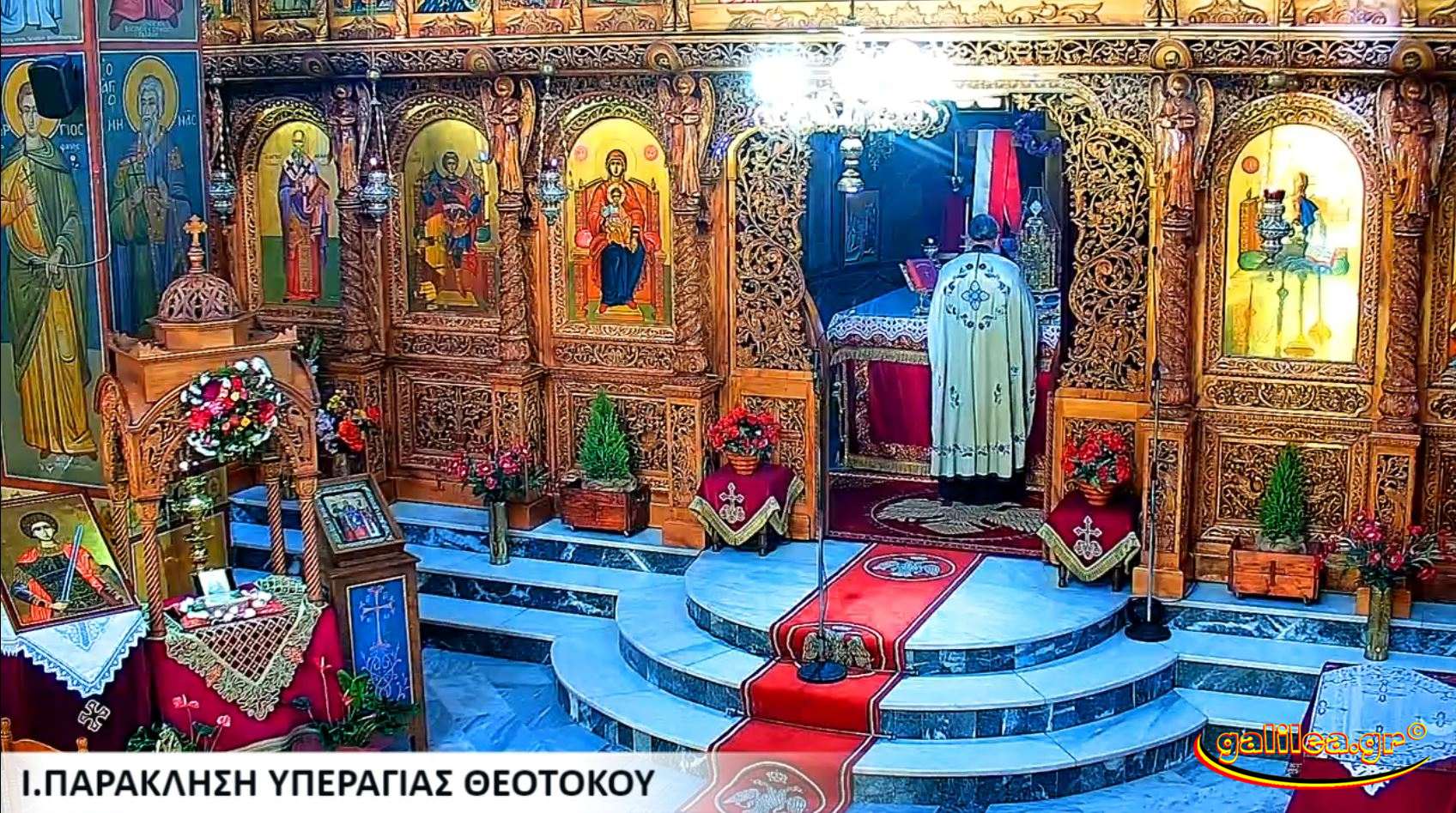
The Service of Supplication was offered in honour of the Most Holy Theotokos, so that our lives may remain under God's shelter and protection,
“παροικήσω ἐν τῷ σκηνώματί σου εἰς τούς αἰῶνας, σκεπασθήσομαι ἐν σκέπει τῶν πτερύγων σου”
(Ψαλμός 60 ος Στιχ.5)
THEME OF THE 22nd TALK:
“ Let us simplify our lives. “
(Guided by Saint Paisios the Athonite's book “With Pain and Love for Contemporary Man” and Saint Nikodemos the Athonite's “Upright Conduct.”
Saint Paisios the Athonite.
With Pain and Love for Contemporary Man
A. All the conveniences people have enslave them… Cleanliness is one thing; luxury another. To reduce one’s demands, it helps greatly to do many jobs with one thing… In general, simple things help greatly. Have simple, sturdy things. The humble and simple are appreciated even by people in the world, and help monks too…
You have not understood the sweetness of simplicity. Simplicity gives rest.
Instead of simplifying things so as not to waste time, you enter into… a “many-years” process. You want perfection and wear yourselves out. It is in spiritual things that you should desire perfection. Do not devote all your energy to outward artistry, but to the artistry of the soul. Day and night, attend to the perfection of the soul. If you apply your artistic talent to cultivating the soul, you will rejoice in your little spiritual palace… That is also why patronal celebrations were held at monasteries on a saint's feast: so that poor people might find a little fish to eat, enjoy themselves a little and at the same time receive spiritual help. What reason is there now for holding these celebrations? What is the point of people eating fish when today they do not go without?…
Just as someone who sets out in pursuit of spiritual things can never have enough, so someone who sets out in pursuit of beautiful things can never have enough. Do you know what must be done now? Do not concern yourself with finely constructed buildings. Build what is necessary and turn towards the world's suffering: with prayer when you have nothing to give, and with almsgiving when you do. Pray and do only the most necessary work. All these things we make do not last very long. Is it worth giving our lives to them while other lives are made difficult and others die of hunger? Simple buildings and humble objects transport monks in their minds to the caves and austere hermitages of our holy Fathers, and thus benefit them spiritually. Worldly things, however, remind them of the world and make their souls worldly. Recently[1] excavations uncovered the earliest monks' ascetic “Cells” at Nitria. Then slightly later ones were found, which were a little worldly, and finally the latest, resembling the drawing rooms of the wealthy of that time, with framed pictures and paintings on the walls and so on. These brought God's wrath: criminals plundered and destroyed them…
Christ was born in the Manger. If we find our comfort in worldly things, Christ, who spat upon no one, will spit us out. “I had nothing,” He will say. “Did you find all these things written in the Gospel? Did you see them in Me?”
Beautiful and perfect outward things are worldly and do not give spiritual people rest. All the walls will fall. The soul… One soul is worth more than the whole world. What do we do for the soul? Let us begin spiritual work. Let a healthy spiritual concern awaken. Christ will ask us how we helped people spiritually and what spiritual work we did, not what walls we built. He will not even mention those. We will be called to account for our spiritual progress. I want you to understand my spirit: I am not saying that these things, buildings and so on, should not be done or done well. But spiritual matters come first, and then everything else, with spiritual discernment.
Worldly people say, “How fortunate are those who live in palaces and have every convenience.” Yet blessed are those who have managed to simplify their lives, freed themselves from the noose of this worldly development with its many conveniences—which amount to many difficulties—and rid themselves of the terrible anxiety of our present age. Unless a person simplifies his life, he suffers. But if he simplifies it, he will not have this anxiety.
Once, in Sinai, a German said to a very bright little Bedouin boy, “You are intelligent; you can get an education.” “And then?” the boy asked. “Then you will become a mechanic.” “And then?” “Then you will open a car repair workshop.” “And then?” “Then you will expand it.” “And then?” “Then you will employ others and have a large staff.” “In other words,” the boy said, “I should have one headache, add another headache, and then add yet another? Am I not better off now, with peace of mind?” Most headaches come from these thoughts: to do this, to do that. If the thoughts were spiritual, a person would feel spiritual consolation and have no headache.
Nowadays I also stress simplicity very much to people living in the world, because much of what they do is unnecessary, and anxiety eats away at them. I speak to them about simplicity and ascetic discipline. I constantly call out, “Simplify your life so that anxiety may leave.” Most divorces begin there too. People have so much work, so many things to do, that they become overwhelmed. Both father and mother work, leaving the children neglected. Exhaustion, irritability—a small issue, a great quarrel—and then automatically divorce: that is where they end up. But if they simplified their lives, they would be rested and joyful. This anxiety is destructive!
Once I found myself in a house full of luxury, and as we were talking, they said to me, “We live in Paradise, while other people go without.” “You live in hell,” I told them. «Fool, this very night»[1], God said to the rich man. If Christ asked me, “Where do you want us to put you: in a prison or in a house like this?” I would say, “In a dark prison.” For prison would help me. It would remind me of Christ, of the holy martyrs, of the ascetics who lived in holes in the earth; it would remind me of monastic life. Prison would also resemble my cell a little, and I would rejoice. What would this house of yours remind me of, and how would it help me? That is why prisons give me greater spiritual rest not only than a worldly drawing room, but even than a beautiful monk's cell. A thousand times better prison than a house like this.
Once, while I was staying with a friend in Athens, he asked me to receive a family man before dawn, because he was not free at any other time. The man came joyfully and constantly glorified God. He was also very humble and simple, and begged me to pray for his family. This brother was about thirty-eight and had seven children. Counting the couple and his two parents, there were eleven souls in all, and they all lived in one room. In his simplicity he told me, “The room holds us when we stand up, but when we lie down it doesn't fit us; it is a little cramped. Glory to God, we have now built a lean-to for a kitchen and managed to make things comfortable. We have a roof over our heads too, Father, while others live out in the open.” He worked as a clothes presser. He lived in Athens and left before dawn to arrive on time in Piraeus, where he worked. Standing for so long and working so much overtime had given him painful varicose veins, but his great love for his family made him forget the pain and discomfort. He constantly reproached himself, saying that he had no love because he did not perform good deeds as a Christian should. He praised his wife for her good deeds: besides caring for the children and her parents-in-law, she collected clothes from elderly neighbours and washed them, tidied their homes and made them some soup. One could see divine grace written on this good family man's face. He had Christ within him and was full of joy, and his room was filled with the joy of Paradise. Yet those who do not have Christ within them are full of anxiety: even two people cannot fit into eleven rooms. These eleven people, however, with Christ, fitted into one room.
[1]. It was said in 1986.
.
Saint Paisios the Athonite.
With Pain and Love for Contemporary Man
B. Even spiritual people, however much space they have, you see finding it insufficient, because they have not made room within themselves for Christ in His entirety. If the women who lived in Farasa saw the luxury that exists today, even in many monasteries, they would say, “God will send down fire to burn us! God has abandoned us!” They finished their chores in no time. Early in the morning they had to take out the goats, then tidy the house. Afterwards they went to the country chapels or gathered in caves, and one who could read a little would read the life of the saint of the day from the Synaxarion. Then they would make prostration after prostration and say the Jesus Prayer. And they worked; they grew tired. A woman had to know how to sew all the household's clothes. They sewed them by hand. A few women in towns had hand-operated sewing machines; there were none in the villages. In all of Farasa there might have been just one hand-operated machine. They even sewed their husbands' clothes, which were more comfortable, and knitted socks by hand. They had taste and loving care, yet also had time to spare, because everything was simple. The people of Farasa did not fuss over details. They lived the joy of monastic life. If, for example, a blanket was not spread properly and hung a little to one side, and you said, “Straighten the blanket,” they would say, “Does it hinder your prayer?”
People today do not know this joy of monastic life. They think they must never go without anything or endure hardship. If people thought a little more like monks and lived more simply, they would be at peace. Now they torment themselves: anxiety and despair in the soul. “So-and-so has succeeded: he has built two blocks of flats or learned five languages, and so on! I do not even have one flat; I do not know a single foreign language. Oh, I am lost!” Someone has a car and begins, “The other fellow has a better one. I must get one too.” He buys the better one, then learns that others have private aeroplanes, and again he is tormented. There is no end to it. Yet someone else who has no car rejoices when he glorifies God. “Glory to God,” he says, “even if I have no car, I have strong legs and can walk. How many people have lost their legs, cannot look after themselves or go for a walk, and need someone to care for them, while I have my legs!” And someone with a lame leg who says, “What about others who have neither leg?” rejoices too.
Ingratitude and greed are a great evil. Anyone in the grip of material possessions is always in the grip of distress and anxiety: at one moment he trembles for fear that someone will take his possessions, and at another that someone will take his life. One day a wealthy man from Athens came and said to me, “Father, I have lost touch with my children; I have lost my children.” “How many children do you have?” I asked him. “Two,” he replied. “I brought them up with every imaginable luxury. Whatever they wanted, they had! I even bought them cars.” As we talked, it emerged that he had his own car, his wife had hers, and the children had theirs. “My dear man,” I said to him, “instead of solving your problems, you have made them worse. Now you need a large garage for the cars, a mechanic whom you have to pay four times as much to repair them, quite apart from the fact that all four of you are in danger of being killed at any moment. If you had simplified your life, your family would have been united, you would have understood one another, and you would not have had these problems. Your children are not to blame now; you are to blame for not taking care to bring them up differently.” One family, four cars, a garage, a mechanic, and so on! Let someone go a little later. All this convenience creates difficulties.
Another time, a different family man came to my hut—there were five people in his family—and said to me, “Father, we have one car, and I am thinking of getting another two. It will make things easier for us.” “And have you thought about how much harder it will make things?” I asked him. “You can tuck one car away in some little space; where will you put three? You will need a garage and a fuel store. You will face three risks. It is better to have one and limit your outings. You will have time to see your children. You will have peace of mind. Simplifying is everything.” “I had not thought of that,” he said.
“Elder, someone told us that twice he could not stop his car alarm. The first time it was because a fly had got inside, and the second because he himself had entered the car improperly.”
– Their life is a martyrdom because they do not simplify things. Most conveniences cause difficulties. People in the world are drowning in excess. They have filled their lives with conveniences, conveniences, and made life difficult. Unless a person simplifies things, one convenience gives rise to a host of difficulties.
When we were little, we would cut the edges of a spool, put a wedge inside and make a lovely toy, and enjoy it. Little children enjoy a toy car more than their father does when he buys a Mercedes. If you ask a little girl, “What do you want, a little doll or a block of flats?” you will see—she will say, “A little doll.” And in the end little children understand the vanity of the world.
“Elder, what helps a person most to understand this joy of simplicity?”
– One must grasp the deeper meaning of life. "Seek first the Kingdom of God…"[2]. From there simplicity and every sound approach begin.
[1]. Luke 12:20.
[2]. Matt. 6:33.