CHRISTIAN CONDUCT—The great achievement of our age “turns conveniences into difficulties.”
5 Μαρτίου 2020 · ΧΡΗΣΤΟΗΘΕΙΑ
Βίντεο
CHURCH OF SAINT GEORGE THE GREAT MARTYR, LARISSA
20 February 2020. UPRIGHT CONDUCT — The great achievement of our age: “Turning conveniences into difficulties”.
A talk by Archimandrite Nikiforos Kontogiannis on “UPRIGHT CONDUCT,” guided by Saint Paisios the Athonite's book “With Pain and Love for Contemporary Man,” p. 144 ff., and Saint Nikodemos the Athonite's “Upright Conduct” (Discourse VII, 130–134).
The talks take place at the Church of Saint George the Great Martyr in Larissa every Thursday at a quarter to seven in the evening, immediately after the Service of Supplication, and are also streamed live through our website: galilea.gr/new/webtv/live/.
On Thursday 5 March 2020, the evening talk by our spiritual father, Fr Nikiforos Kontogiannis, entitled “CHRISTIAN CONDUCT,” took place at our Church of Saint George the Great Martyr in Larissa. Drawing on Saint Paisios the Athonite's book “With Pain and Love for Contemporary Man,” it explores various conclusions concerning spiritual life, living and working together, and approaching God generally, with the aim of salvation, sanctification, imitation of Jesus Christ and, ultimately, the human person's theosis through the incarnate Jesus Christ. The talks take place every Thursday at 6:45 p.m., immediately after the Service of Supplication, which begins at 6:00 p.m. They are also broadcast live through our website: galilea.gr/new/webtv/live/ .
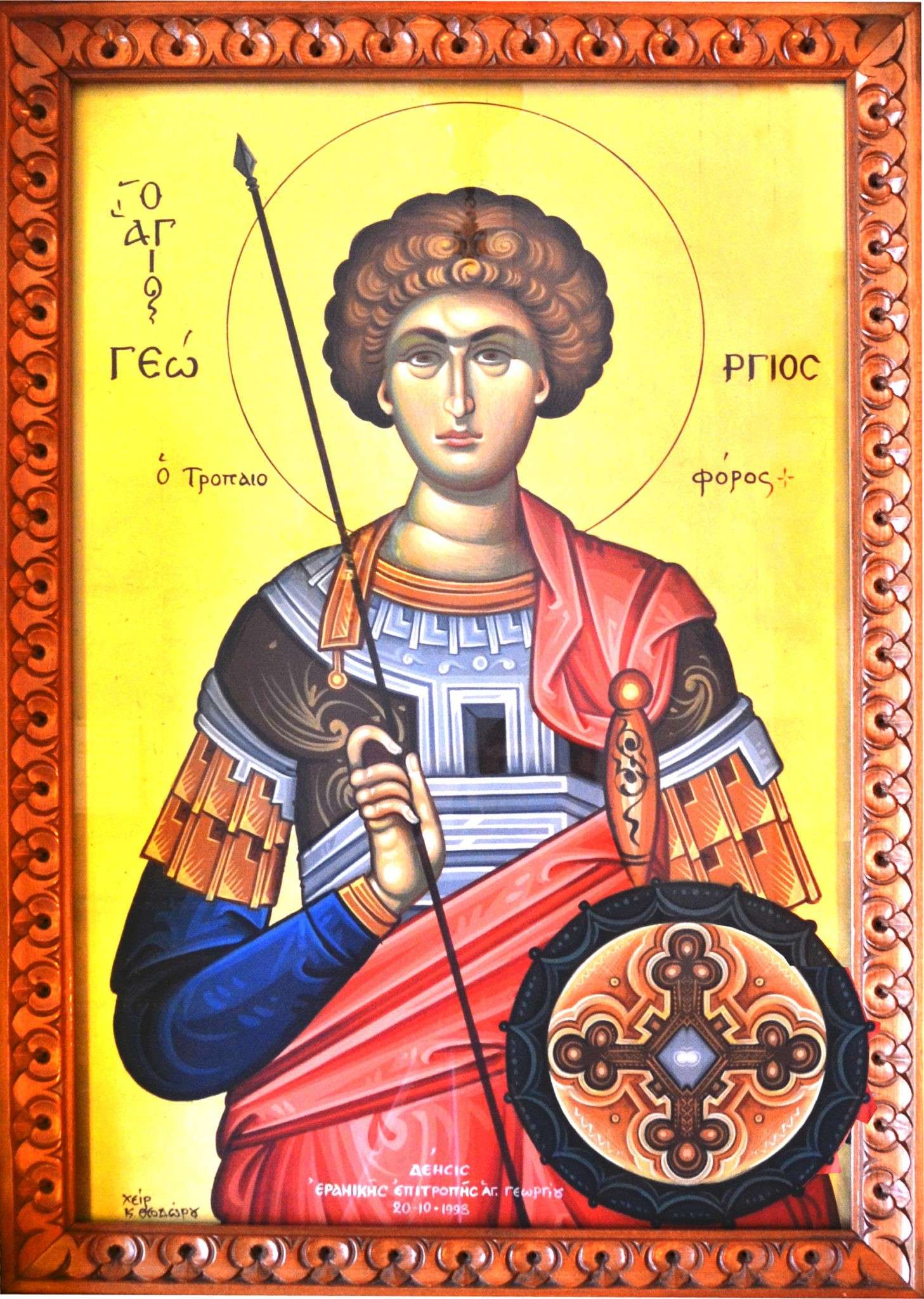
The Service of Supplication was offered in honour of Saint George the Great Martyr and Trophy-bearer. During it, the holy relics of Saint Luke the Physician and Saint Nektarios, Bishop of Pentapolis, were displayed for the faithful's veneration and blessing, together with two handcrafted objects made by Saint Paisios the Athonite containing wood from the Precious Cross.
APOLYTIKION. Tone 4. As liberator of captives, defender of the poor, physician of the sick and champion of kings, O Trophy-bearing Great Martyr George, intercede with Christ our God that our souls may be saved.
TOPIC OF THE 16th TALK:
“ The great achievement of our age turns conveniences into difficulties “
Guided by Saint Paisios the Athonite’s book With Pain and Love for Contemporary Man, page 144 onwards, and Saint Nikodimos the Athonite’s Christian Conduct, Discourse VII, pp. 130–134.
Saint Paisios, Spiritual Counsels, Volume 1
With Pain and Love for Contemporary Man, p. 144 onwards
Chapter 2 – The age of many conveniences = difficulties
Because the conveniences of human life have gone beyond all limits, they have become difficulties… That is why people’s hearts too have become iron… In the past, people worked with animals and were compassionate… If you loaded an animal a little too heavily and the poor creature sank to its knees, you felt sorry for it. If it was hungry and looked at you plaintively, it broke your heart. I remember that when our cow became ill, we suffered too, because we regarded her as a member of our family. Today people have machines of iron, and their hearts are iron too…
People today do not think of others. In the old days, if food was left until the next day, it would spoil, and people would think of a poor person. “Rather than let it spoil,” they said, “let me give it to someone poor.” A spiritually mature person would say, “Let the poor person eat first, and then I shall eat.” Now they put it in the refrigerator and forget the other person in need. I remember that when we had a good harvest of vegetables and so on, we gave some to our neighbours, shared them out. What would we do with so much? Besides, it would spoil. Now people have refrigerators. “Why give to others?” they say. “We put it in the refrigerator and keep it for ourselves.” Not to mention the whole tonnes they throw away or bury in landfill, while millions elsewhere go hungry…
People have gone mad over machines
There is no end to modern devices. They run faster than the human mind, because the devil helps too. In the past, people who did not have these devices—telephones, fax machines, all those machines—had their peace and simplicity.
– They were enjoying their lives, Elder!
—Yes, people have now gone mad with machines! Their many conveniences torment them; anxiety suffocates them. I remember how joyful the Bedouins were when I was in Sinai[1]. They had a tent and lived simply. They could not live in Alexandria or Cairo; they found rest in their tents in the wilderness. If they had a little tea, they were full of joy and glorified God. But now, with civilisation, they too have begun to forget God. They too have adopted the European spirit! First the Jews built huts for them. Then they sold them all Israel's old cars[2]. Ah, those Jews! Now every Bedouin has a hut with a broken-down car outside, and they have anxiety too. The car breaks down, and they struggle to repair it… And if one examines what they gain from all this, what is it? Nothing but a headache.
In the old days, at least they made sturdy things that lasted. Now you pay a fortune for something and it breaks down straight away. So the factories keep turning out new things and collecting people's money. People work themselves to death to make ends meet. Machinery is the science of the Europeans who busy themselves with screwdrivers. First they make, let us say, a lid; then they make it screw on, then they give it a button: more advanced, more advanced… In other words, continually new, more advanced machines, and poor people want to buy the most advanced one. Before they have paid off the first, they buy a second, leaving themselves in debt and exhausted. A poor man goes to buy one of the cheapest cars. He sells everything he has, his oxen, his horses—at this rate, before long they will put little donkeys on display and charge people to look at them!—and buys the car. Then it breaks down. “There are no spare parts,” they tell him. The poor man is forced to buy another. But he cannot afford the best. He buys one better than the previous one, and the old one is set aside, and so on. We need to be careful! We must not get drawn into this course ourselves: yet another fashion, even more advanced.
[1]. 1962-1964
[2]. Sinai, which now belongs to Egypt, belonged to Israel at that time.
CHRISTIAN CONDUCT
SAINT NIKODEMOS
(Discourse VII:130–134)
The holy counsels of Saint Nikodimos are most useful for us to escape the temptations of the modern age. He says: “What profit is there, my brethren, if on the one hand we are called Christians, yet on the other we speak and perform diabolical and anti-Christian deeds? How can we be both Christians and slanderers, and fools, and carnival revellers? These things are not in harmony with one another, just as water is contrary to fire, light to darkness, and good to evil. Therefore, strive to become worthy of the name ‘Christian’, and you shall become worthy by performing Christian and virtuous deeds and speaking words of virtue, as the holy Ignatius the God-bearer commands us: ‘It is fitting, therefore, not only to be called Christians, but also to be so’ (that is, one should not merely be called a Christian, but actually be one). E.P.E., Apostolic Fathers, Epistle to the Magnesians, vol. 4, p. 183. And elsewhere he says: ‘For I do not wish you to be pleasing to men, but to God, as indeed you are… Only ask me for strength, both inward and outward, that I may not only speak, but also will; that I may not only be called a Christian, but also be found to be one… The work is not one of persuasion, but Christianity is a matter of greatness when it is hated by the world’ (that is, I do not wish you to please men but God; pray that I may be and appear a Christian. The greatness of Christianity is when it is persecuted, not when it is proved). E.P.E., Apostolic Fathers, Epistle to the Romans, vol. 4, p. 114.
Let us, my brethren, make good use of this present life, for it is not intended for our comfort, but for us to mourn our sins. And Saint John Chrysostom says: “The present time is not for merriment, but for mourning, affliction and lamentation. Yet you jest?” (Homily 17 on Ephesians).
And again: “The present time is one of mourning, affliction, self-denial, servitude, struggles and sweat. Yet you laugh?” (Discourse 15 on Hebrews).
And continuing, Saint Nikodimos says: Since this is a time of struggle and warfare against sin and the devil, do you sit idle and live this life in comfort, with joy, laughter and entertainment? What soldier remains carefree while at war? Do you not see how the devil runs to and fro, roaring like a lion, gnashing his teeth and breathing fire from his mouth, seeking whom he may seize and cast into destruction?
“What athlete, having entered the stadium…. (What athlete enters the stadium and, having abandoned the contests, becomes friends with his opponent and begins to jest with him? The devil has not departed from our side. He prowls about, roaring to seize us, stirring up all things and turning them against us, gnashing his teeth, roaring and breathing fire to destroy our Salvation. Yet you sit idle, occupied with jokes and the modern culture, doing those things which do not save you?) (Discourse 15 on Hebrews).
This life, my beloved ones, is not for us to pass our days in comfort; it is not for us to reap and enjoy, but rather it is a time to sow. Therefore, like good and prudent farmers, with toil, with labour, with sweat and tears, let us sow in this season of autumn, so that when summer comes, we may rejoice by harvesting the fruits we have sown within our hearts. As the Prophet David says, “They went weeping and casting their seed, but afterward they came rejoicing, for they reaped the fruits” (Psalm 120:5-6). Thus, good Christians in this life mourn and weep over their sins and labour to plant in their hearts the good seeds of the virtues, so that then, in the time of the Resurrection, they may rejoice and laugh eternally and enjoy the blessedness which the good God will grant them. And Saint Basil the Great says: “Those who labour and weep over their sins in this time shall, on that morning which is to come, rejoice together with the Lord who was raised” (Interpretation of Psalm 29). Yet again, let us not become like foolish farmers who, in the season of sowing, do nothing, but leave the sowing and wander here and there, enjoying ourselves and making merry; then summer arrives, and they have nothing to offer, and so they shall have no reward to receive from the good God. Let us not, therefore, become foolish Christians like the foolish virgins, seeking oil at the last moment. For if you do not sow and do not water, how is it possible for the plant of the virtues to bear fruit, that you may gather it and offer it to God when He asks of you?