UPRIGHT CONDUCT – Sin causes disasters –
13 Φεβρουαρίου 2020 · ΧΡΗΣΤΟΗΘΕΙΑ
Βίντεο
CHURCH OF SAINT GEORGE THE GREAT MARTYR, LARISSA
13 February 2020. UPRIGHT CONDUCT — Sin causes destruction.
A talk by Archimandrite Nikiforos Kontogiannis on “UPRIGHT CONDUCT,” guided by Saint Paisios the Athonite's book “With Pain and Love for Contemporary Man,” p. 113 ff., and the Epistle of Saint James the Apostle (chapter 3:1–18).
The talks take place at the Church of Saint George the Great Martyr in Larissa every Thursday at a quarter to seven in the evening, immediately after the Service of Supplication, and are also broadcast live on our website: galilea.gr/new/webtv/live/.
On Thursday 13 February 2020, the evening talk by our spiritual father, Fr Nikiforos Kontogiannis, entitled “VIRTUOUS CONDUCT”, was held at our Church of Saint George the Great Martyr in Larissa. Drawing on Saint Paisios the Athonite's book “With Pain and Love for Contemporary Man”, the talk draws out various lessons concerning spiritual life, living together, cooperation and, more generally, drawing near to God, with the aim of salvation, sanctification, imitation of Jesus Christ and, ultimately, the deification of the human person through Jesus Christ, who became man. The talks take place every Thursday at 6:45 p.m., immediately after the Service of Supplication, which is celebrated at 6:00 p.m., and are also broadcast live on our website: galilea.gr/new/webtv/live/ .
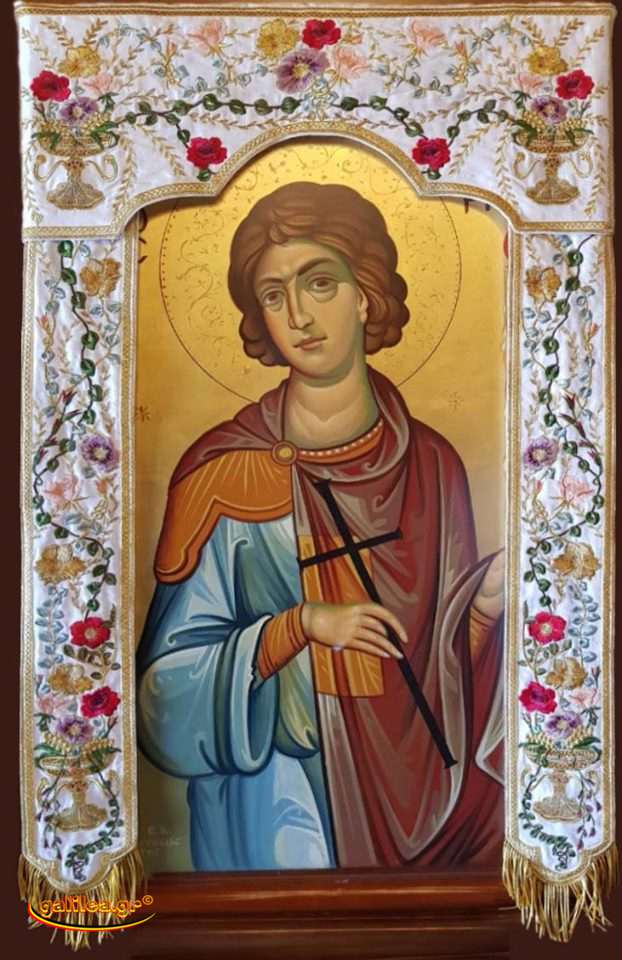
The Service of Supplication was celebrated in honour of Saint Phanourios the Great Martyr and Wonderworker. During the service, the holy relics of Saint Luke the Physician and Saint Nektarios, Bishop of Pentapolis, as well as two objects handmade by Saint Paisios the Athonite incorporating wood from the Precious Cross, were displayed for the faithful to venerate and receive a blessing.
APOLYTIKION. Tone 4. To the melody "Come quickly to our aid"
A heavenly hymn of praise is splendidly celebrated on earth, while the community of Angels now joyfully celebrates an earthly festival. From above, with hymns they acclaim your struggles; below, the Church acclaims the heavenly glory you attained through your labours and contests, O glorious Phanourios.
TOPIC OF THE 10TH TALK:
“Sin brings destruction.”
Guided by Saint Paisios the Athonite’s book With Pain and Love for Contemporary Man, page 113 onwards, and the Epistle of Saint James the Apostle, chapter 3:1–18.
Saint Paisios, Words, Volume 1
With Pain and Love for Contemporary Man, page 113 onwards.
Sin brings destruction
Locusts, wars, drought and illnesses are a scourge. It is not that God wants to discipline people in this way; they are consequences of people's estrangement from God. All these things happen because people depart from God. God's wrath comes so that people may remember God and ask for help. It is not that God arranges things this way and issues an order for some calamity to befall a person. Rather, God sees how far people's wickedness will go and that they will not change, and therefore permits a calamity to occur so that they may come to their senses. It is not that God planned things this way…
We must know that the faithful who keep God's commandments receive His grace, and God—how should one put it?—is obliged to help them in these difficult years…
…Even if a cure for cancer is found, another illness will arise. There was tuberculosis; they found a remedy for tuberculosis, and now this has appeared. Even if a remedy helps with this, another illness will arise. People themselves will cause another to appear afterwards, and there is no end to it! …
Why does God allow a calamity to happen?
Sometimes He permits something so that something better may result; at other times, He permits it for discipline. Some receive a reward and others pay their debts; nothing is wasted.
Saint James the Apostle—“Epistle”.
(Chapter III:1–18)
The Greatest Harm and Destruction Come from the Tongue The Tongue and the Need to Bridle It
1 Not many of you should become teachers, my brothers, for you should know that we will be judged more strictly, 2 since we all stumble in many ways. If anyone does not stumble in speech, that person is perfect, able to govern his whole body as well.
3 Take, for example, horses: we place bits in their mouths to make them obey us, and thus direct their whole bodies. 4 Consider ships too. Although so large and driven by fierce winds, they are steered by a comparatively tiny rudder wherever the person handling it wishes, according to his intention.
5 So it is with the tongue: it is a small member, yet it can express great arrogance. See how a little fire burns down such a great forest! 6 The tongue too is a fire, a world of unrighteousness. Among our members, the tongue thus becomes the instrument that defiles our whole body and sets the course of life ablaze, itself drawing its fire from hell. 7 Indeed, every kind of beast and bird, reptile and sea creature can be tamed and has been tamed by human beings. 8 But no human being can tame the tongue. It is an uncontrollable evil, full of deadly poison. 9 With it we bless God the Father, and with it we curse human beings who have been created in the likeness of God! 10 Blessing and cursing come from the same mouth! My brothers and sisters, these things ought not to happen this way. 11 Can a spring pour forth both fresh and bitter water from the same opening? 12 Can a fig tree, my brothers and sisters, produce olives, or a grapevine figs? In the same way, no spring can produce both salt and fresh water.
Heavenly and earthly wisdom
13 Who among you is wise and understands matters well? Let him show his deeds through good conduct, with the gentleness that is the mark of wisdom. 14 But if you have bitter jealousy and factional ambitions in your hearts, do not boast about yourselves or lie against the truth. 15 This is not true wisdom coming from above, but earthly, materialistic, demonic wisdom! 16 For where there are jealousy and factionalism, there are disorder and every kind of wretchedness. 17 But the wisdom from above is first of all pure, then peaceable, considerate, obedient, full of mercy and good fruits, impartial and sincere. 18 The fruit of righteousness is sown in peace by those who put peace into practice.