UPRIGHT CONDUCT – Injustice stores up God’s wrath –
16 Ιανουαρίου 2020 · ΧΡΗΣΤΟΗΘΕΙΑ
Βίντεο
CHURCH OF SAINT GEORGE THE GREAT MARTYR, LARISSA
16 January 2020. UPRIGHT CONDUCT — Injustice stores up God's wrath.
A talk by Archimandrite Nikiforos Kontogiannis on “UPRIGHT CONDUCT,” guided by Saint Paisios the Athonite's book “With Pain and Love for Contemporary Man,” p. 85 ff., and Saint Nikodemos the Athonite's “Upright Conduct” (Discourse Eight, Preface, p. 144).
The talks take place at the Church of Saint George the Great Martyr in Larissa every Thursday at a quarter to seven in the evening, immediately after the Service of Supplication.
On Thursday 16 January 2020, the evening talk by our spiritual father, Fr Nikiforos Kontogiannis, entitled “VIRTUOUS CONDUCT”, was held at our Church of Saint George the Great Martyr in Larissa. Drawing on Saint Paisios the Athonite’s book “With Pain and Love for Contemporary Man”, the talk draws various conclusions concerning spiritual life, coexistence, cooperation and, in general, drawing near to God, with the aim of salvation, sanctification, imitation of Jesus Christ and, ultimately, the deification of the human person through the incarnate Jesus Christ. The talks take place every Thursday at 6:45 p.m., immediately after the Service of Supplication, which is celebrated at 6:00 p.m., and are also broadcast live on our website: galilea.gr/new/webtv/live/ .
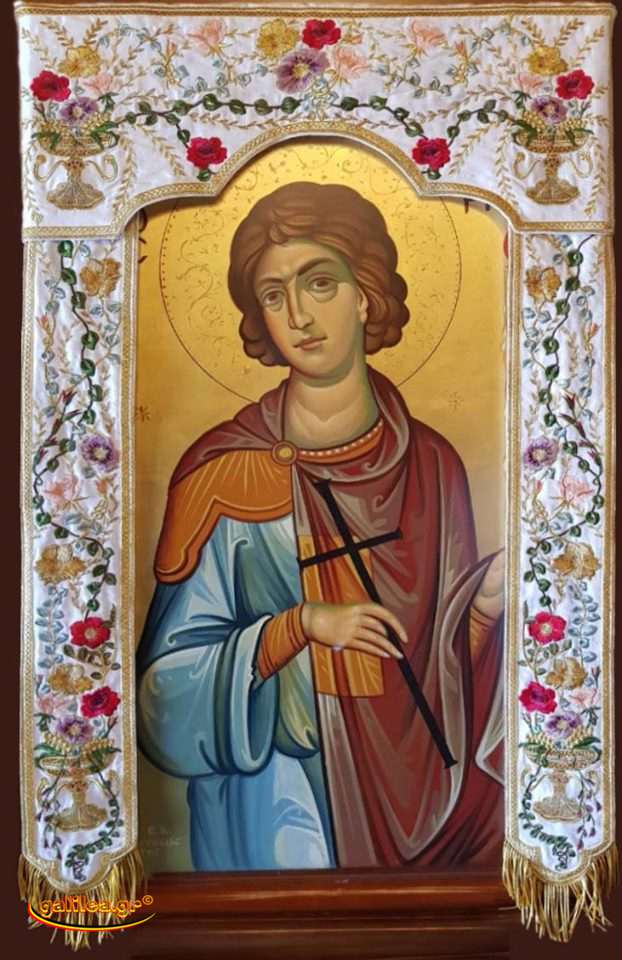
The Service of Supplication was celebrated in honour of Saint Phanourios the Great Martyr and Wonderworker. During the service, the holy relics of Saint Luke the Physician and Saint Nektarios, Bishop of Pentapolis, were set out for the faithful’s veneration and blessing.
APOLYTIKION. Tone 4. To the melody "Come quickly to our aid"
A heavenly hymn of praise is splendidly celebrated on earth, while the community of Angels now joyfully celebrates an earthly festival. From above, with hymns they acclaim your struggles; below, the Church acclaims the heavenly glory you attained through your labours and contests, O glorious Phanourios.
TOPIC OF THE 10TH TALK:
“Injustice stores up God's wrath”
Guided by Saint Paisios the Athonite’s book With Pain and Love for Contemporary Man, page 85 onwards, and Saint Nikodimos’s Christian Conduct, Discourse VIII, Preface, p. 144.
Saint Paisios, Spiritual Counsels, Volume 1
With Pain and Love for Contemporary Man, page 85 onwards.
CHAPTER 4. It is a great matter for a person to have God’s blessing! It is wealth! Whatever has blessing stands firm and does not collapse. Whatever has no blessing does not stand. Injustice is a great sin. All sins have mitigating circumstances, but injustice has none; it gathers up God’s wrath. Terrible! Those who commit injustice kindle fire upon their own heads. On the one hand, you see them committing an injustice, and on the other, their own people are dying, yet they pay no heed. How can people prosper with so much injustice? By doing what they do, they give rights even to the devil; that is why they later undergo trials, are struck by illnesses and so forth, and then they say to you: “Pray for me to be healed.”
The unjust, and indeed every guilty person, when they do not ask for forgiveness, are troubled by their conscience and, moreover, by the indignation of the one they have wronged. For when the wronged person does not forgive and grumbles, then the unjust person is greatly troubled and tormented. They cannot sleep. It is as if waves strike them and whirl them round.
The senseless can at most take refuge in some entertainment to forget themselves. It may be that the wronged person has forgiven the guilty one, yet some indignation remains within them. In that case, the wronged person is troubled to some degree, but the guilty person is greatly troubled by the other’s indignation. If, however, the guilty one asks for forgiveness and the wronged person does not grant it, then the latter is troubled. There is no greater fire than the inner burning of the soul by conscience. It torments and devours it continually with the worm in this life, and, of course, will devour it all the more in the other life, the eternal, “the worm that dieth not”, if a person does not repent in this life and does not restore their injustices to their neighbours, even if only through good intention, in cases where they cannot do so in any other way.
– If a person has repentance and confesses his sins, spells cannot take hold. For spells to take hold, a person must have given some right. He must have wronged someone, or mocked a young lady, and so on. Then he must repent, ask for forgiveness, make his confession, set matters right, and restore what he has done. For otherwise, even if all the priests were to read exorcisms over him, the spells would not be broken. And even if no one had cast spells upon him, the very sigh of the wronged soul is enough to torment him.
There are two forms of injustice: material and moral. Material injustice occurs when someone wrongs another in material matters. Moral injustice is, for example, when someone deceives a young lady; and if she is an orphan, it weighs upon his soul with fivefold burden. Do you know how the bullet hunts down the unrighteous in war? There you see divine justice and the protection of God made manifest. War will not tolerate shame. The bullet will find the unrighteous man.
We should regard someone who wrongs us as a great benefactor, making deposits for us in God’s savings bank. He makes us rich for eternity. Is that a small thing? Do we not love our benefactor and express our gratitude to him? Likewise, we should love and thank the person who wrongs us, because he benefits us eternally. The unjust suffer eternal loss, while those who joyfully accept injustice are justified eternally. You see, Joseph[1] did not speak when his brothers sold him as a slave. He could have said, “I am their brother.” But he remained silent; then God spoke and made him a king.
If someone suffers injustice in this life from people or demons, God is not troubled, because the soul gains from it. Often, however, we say we are being wronged when in fact we are the ones doing wrong. Here we must be careful and catch ourselves out.
Blessing brings blessing, and injustice brings destruction. Pay very close attention to this. Do not even haggle with tradesmen.
And how people deceive others! Someone brought me a large box of sweets. “I shall open it when a large group comes,” I said. “Let me not open it now and let ants get in.” One day quite a few people gathered. I reckoned there would be enough, with some left over. When I opened it, I saw polystyrene on this side, polystyrene on that side… The space actually holding the sweets was so-o-o small!
Sin has become fashionable now, and injustice is considered cleverness. Sadly, the worldly spirit sharpens the mind for deceit, and someone who wrongs his neighbour regards it as an achievement.
There is nothing worse than injustice. Whatever you do, make sure you have God’s blessing.
[1]. See Gen. 37:20 ff.
Saint Nikodemos the Hagiorite. "Christian Conduct".
(Discourse 8, Preface, p. 144)
It is also unjust to exploit one's parents financially: that is, to live on their money without working oneself. In Discourse 8 of Christian Conduct, Saint Nikodemos the Athonite says the following: the devil has many ways of fighting Christians, of which three are the principal ones. The first is to fight Christians so that they do no good at all. The second is to prevent them from doing the good they have begun in accordance with God and in the proper manner. The third is to make them proud of whatever good they may have done. Saint John Climacus says the same in Discourse 26, on discernment. Now that we know how the devil hinders us, we should at least begin working and living by the labour of our own hands. This is good and beneficial, because it gathers the mind and prevents a person from doing evil. The wise Solomon says that God gives the sinner occupation, adding work to distract him from evil (Ecclesiastes 2:26). Human labour is something ordained both by God and by the Apostles. Even before the disobedience, God told Adam to work (Genesis 2:15), and after the disobedience He said that we must eat our bread by the sweat of our brow (Genesis 3:19). All the Apostles together likewise tell Christians to occupy themselves very decorously with work at every time and place, so that they may provide both for themselves and for those in need, without burdening the Church of God (Apostolic Constitutions, book 2, “kx”). The Apostle Paul also writes to the Thessalonians, “I beg you, my brethren, to work with your hands, as I commanded you.” I say this because the devil has cast many Christians, particularly rulers and the wealthy, into idleness and negligence, so that they concern themselves with nothing but going to theatres, games and contests of chance. The Wisdom of Sirach says that “idleness has taught much evil” (33:32). As for those whom the devil could not overcome through idleness, he leads some into lying, others into injustice, others into pride, and others into greed. In this way he causes all Christians to sin. Therefore I too have resolved to dismantle the devil's machinery and expose the error of Christians who think they are doing useful work while actually committing injustice. They must work honestly, by the sweat of their brow.