
Saint Ahmed, formerly a Muslim
26 Δεκεμβρίου 2021 · ΟΙ ΑΓΙΟΙ ΜΑΣ ΟΜΙΛΟΥΝ
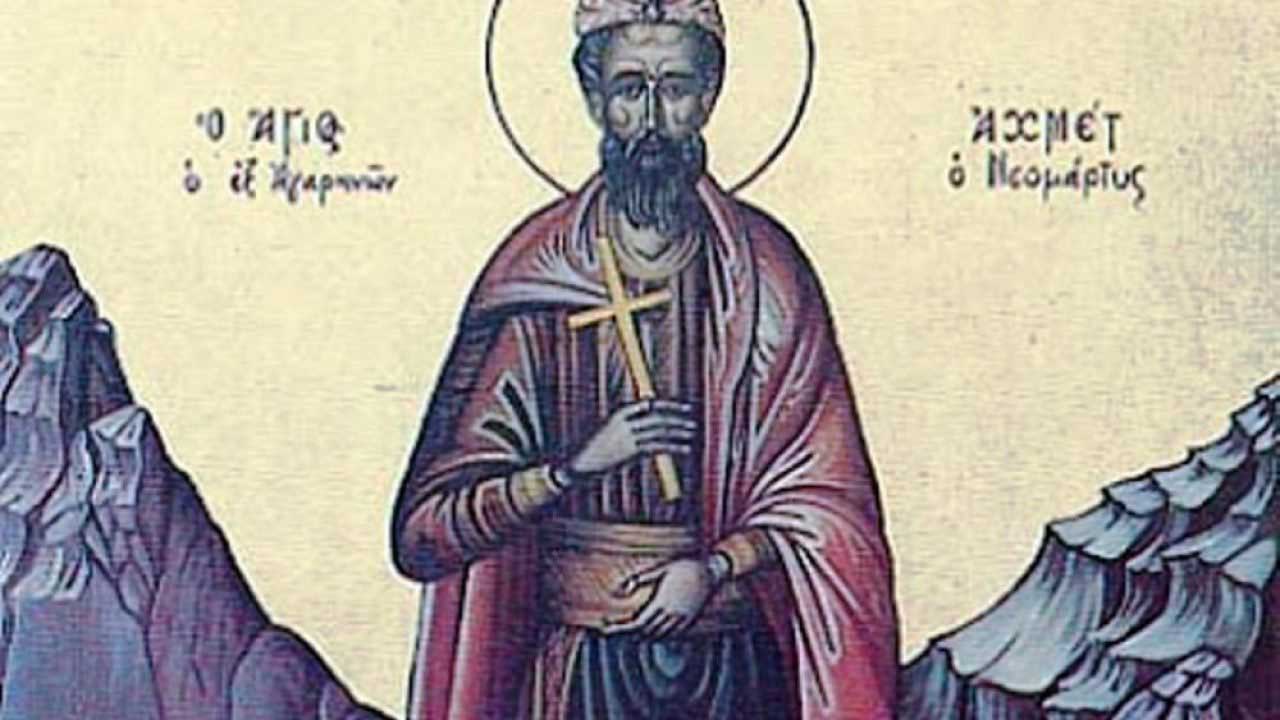
Among the saints of our Church are many in whose souls the light of the Holy Spirit shone, leading them to salvation and deification through their entry into the Church of Christ. Many of them were Muslims. A classic example is Saint Ahmed the former Hagarene, who was miraculously converted to Christ and suffered martyrdom for his conversion, taking his place among the New Martyrs.
Ahmed lived in Constantinople in the 17th century and held high state office. He served as second calligrapher in the Sultan's secretariat. His office gave him a highly privileged position, placing him among the noble and prominent inhabitants of the Ottoman capital. He enjoyed honours and wealth, respect and esteem. He was a faithful Muslim who observed all the religious requirements of Islam.
He was unmarried, but lived with a beautiful and faithful Russian Orthodox Christian concubine, one of his many enslaved women, who had been taken captive during the first Russo-Turkish war (1682–1725) and distributed among Ottoman officials. Muslim law permits this, as the Quran provides for enemy women to be enslaved and confined as sexual and other kinds of slaves in the harems of the victorious Muslims. It is regarded as a kind of gift from Allah for their participation in war against the “infidels”. An elderly woman among his slaves, also Russian, used to go to church on major feasts. Evidently because of her age, he did not deny her this wish. His concubine did not express her faith out of fear, and therefore did not ask him to allow her to attend church and openly identify herself as a Christian. Despite all this, however, he treated his enslaved women and his concubine relatively well.
The elderly Christian slave woman secretly brought antidoron from church to the Christian concubine, who took it in her hands and ate it with great reverence. She also often brought her holy water. One day Ahmed approached the concubine and sensed a wonderfully sweet fragrance coming from her mouth. Astonished, he asked what fragrant food she had eaten to make her breath smell so sweet. Afraid, she refused to reveal that she secretly ate the antidoron the old woman brought from church. He persisted with great curiosity, and she was compelled to admit that all she had eaten was the blessed bread the elderly Christian slave woman had given her.
Ahmed was puzzled, and at the same time various questions began turning over in his mind. How could believers in a false, idolatrous religion, as Muslims consider Christianity, bring about this wondrous and inexplicable phenomenon? He asked the elderly woman to explain what this blessed bread was.
The elderly woman gave him some explanations, but he himself wanted to go and see the worship in the church with his own eyes. Evidently it was here that divine grace began to visit him, leading him towards his conversion. One Sunday he decided to go to one of the churches of Constantinople. He cast aside his Turkish clothes, dressed as a Greek Orthodox Christian and went to the Patriarchate's church to attend the Divine Liturgy secretly.
As soon as he entered the church, he felt an inexplicable joy. He followed every moment of the divine service attentively. But at the Great Entrance, an unexpected and wondrous thing happened. He saw that the priest carrying the Precious Gifts was not touching the ground, and his whole being was shining! Then, when the Patriarch blessed the people, he could see rays of light springing from his hands and falling upon the heads of the faithful. Yet not a single ray came to his own head! He understood that this light was divine and that he himself was deprived of it, evidently because of his faith.
This experience shook him to the core. At that very moment he understood that the Christians' faith was the true faith and that he himself was in error. He immediately burst into tears and made the great decision to become a Christian. He returned home a changed man. He shone with joy and exultation. The same was true at his workplace in the palace. He began speaking openly before his colleagues in praise of the Christians and extolling their faith. He often made comparisons with Islam, praising Christianity and denouncing the weaknesses of the Muslim religion.
His colleagues were astonished by the strange things they heard from Ahmet's mouth and began to suspect him of apostasy. The third calligrapher, who coveted his position, hurried to report to the chief secretary that he was blaspheming Islam. The secretary immediately denounced him to the investigating authorities, who ordered his arrest and appearance before the court. Brought in chains before the Turkish judge, he confessed his conversion to the Christian faith. He also described the miraculous manner of his conversion, praying that the judges and those in the courtroom might themselves be granted such a miraculous conversion to the true faith: that they might renounce the deceptive Muslim religion and believe in Christ, the true God and Saviour of the world.
As was natural, this courageous confession of his aroused the judge’s anger. He ordered him to be imprisoned with the common criminals and left without food or water for a week. Ahmed gladly accepted his imprisonment and the torment of hunger and thirst. In prison, day and night, he prayed to Christ to enlighten him and strengthen him for the sufferings that awaited him.
They then brought him before the court again, where the judge expected him to have changed his mind and returned to Islam. Once more he began confessing his faith in Christ with all the strength of his soul. When the judge asked whether hunger and thirst had brought him to his senses, he answered that fasting in prison had helped purify him and reveal to him the mysteries of the Christian faith; that this hardship had strengthened his faith in Christ still further; and that it would be easier for him to knead stones and iron with his hands than to change his new faith!
The judge, filled with fury and anger, sent him to the sultan for judgement. But there too the martyr maintained the same stance. He confessed Christ despite the threats of the great and fearsome ruler. The sultan then ordered his execution by beheading. Christ's heroic champion heard the sentence with extraordinary serenity, without the slightest disturbance. A gentle cheerfulness appeared on his afflicted face. The executioners led him to the place of execution. He followed them, full of joy and gladness, proclaiming at the top of his voice that he was going to his baptism in his own blood, which would be shed for Christ, and that his name was now Christodoulos, not Ahmed! He was now being deemed worthy to become a humble servant of Christ the Master. He was beheaded on 3 May 1682, amid savage shouts, anathemas and curses from the crowd of fanatical Muslims who had come to witness the “apostate's” execution. The executioners threw his body onto the shore and ordered that it not be buried. An otherworldly light bathed it for many days!
He is commemorated on 24 December each year.
Source (text – photograph): vimaorthodoxias.gr