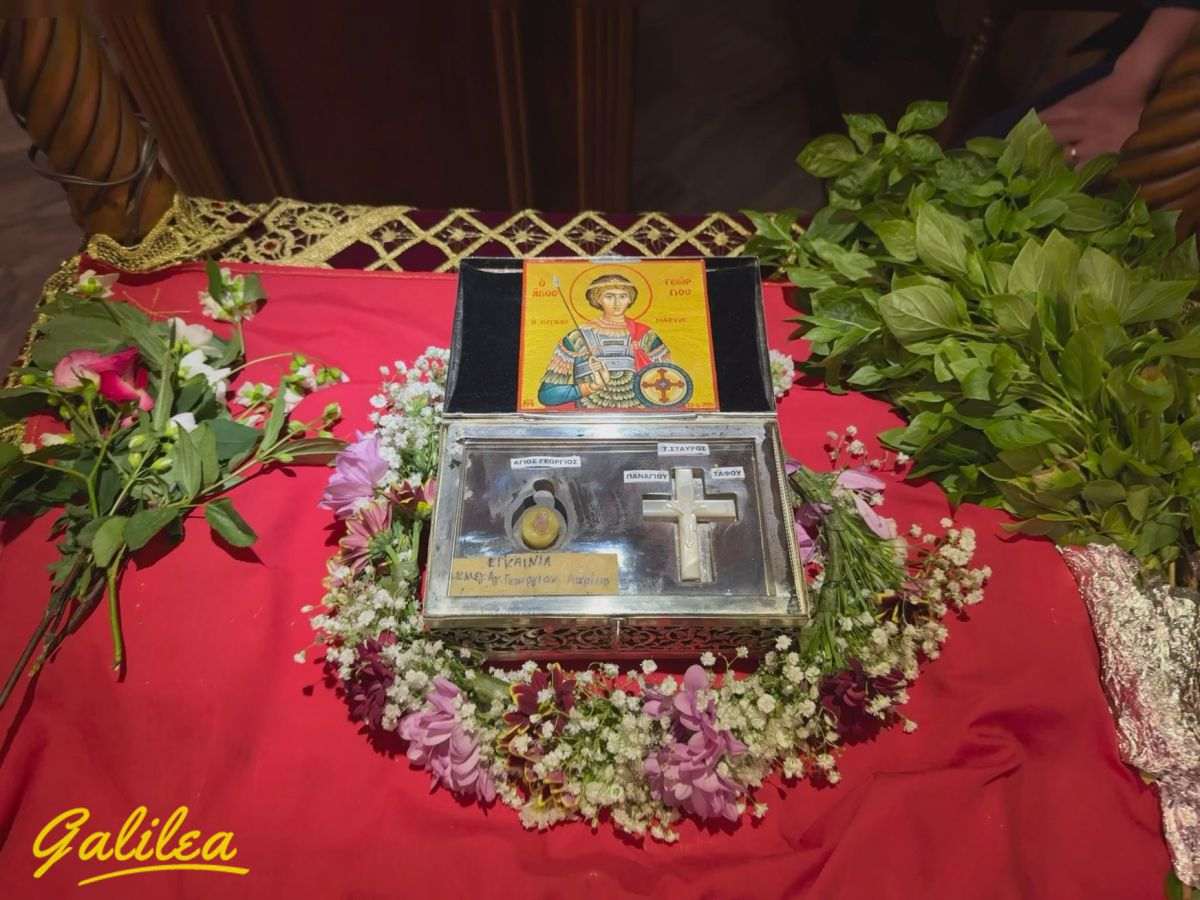
What is the relationship between the sacrifice of the Lord and that of the Saint? FESTAL VESPERS OF SAINT GEORGE, Fr Nikiforos Kontogiannis.
22 Απριλίου 2025 · ΓΕΝΙΚΕΣ ΕΚΔΗΛΩΣΕΙΣ
Βίντεο
“FESTAL VESPERS OF THE GREAT SAINT GEORGE”
Topicof the Liturgical Sermon: “What is the relationship between the Lord’s sacrifice and the saint’s?”
Tuesday, 22 April 2025
FESTAL VESPERS FOR THE FEAST OF THE GREAT MARTYR SAINT GEORGE
What is the relationship between the Lord's sacrifice and the Saint's?
With God’s help, we celebrated Holy Week, our Lord’s Crucifixion, the sacrifice, the blood that was shed, the spear that pierced the Lord.
Indeed, let me ask you something: which side did the centurion pierce with his spear? Holy Scripture does not say which side he pierced. You will tell me the left, because that is where the heart is. Yet all icon painters place the pierced heart, the wound from the spear, here on the right, distinctly on the right, not on the left. Why?
For now, something metaphysical begins, something beyond the human realm, in this blood: “He pierced,” it says, “the heart, and immediately blood and water came out.”
Medicine does not say much. It says that if you pierce the heart with a lance, water comes out too. They suppose there is pericardial fluid, there are a thousand explanations. No, this came from the heart. Medicine cannot answer us. How did the heart contain water? How?
My beloved, when we perform the Proskomedia, the Preparation of the Holy Gifts, and put the sacramental wine into the Holy Chalice—and let me say this for others too: do not buy just any sacramental wine; these are Mavrodaphne wines. Check which sacramental wines you buy. They are Mavrodaphne wines. They contain roses, cloves, cinnamon and a thousand other things. Whatever they may say on the label, whatever ecclesiastical title they may bear. Forgive me for saying this, of course; I have said it here in church too. In any case).
So we put in sacramental wine, wine from grapes, and add a little water. And we say, “One of the soldiers pierced His side with a spear, and immediately blood and water came out.” And we bless it. And we say, “Blessed is the union of Your holy things.” What holy things? We put in wine and water. Why do we not say, “Bless these products, the wine and the water”?
Now, when we offered the blessing here, we said, “Bless these loaves.” The wheat, the wine, the oil. Specifically.
“Bless,” it says, “the union of Your Holy Gifts.” And afterwards, to receive Communion, just before we receive, we pour zeon into the Holy Chalice. Hot water! Not lukewarm. “Zeon”! Hot water, steaming. And we say, “The fervour of faith, full of the Holy Spirit. Amen.”
“Fervour”: boiling, faith that seethes. Faith that is dynamic, not passive. Not passive.
So this blood is our Lord's. The little water that comes out is our own blood, adulterated after the Fall. That is our blood: adulterated. What do we say? “You have put too much water in the wine.” Yes, this water is our own blood, which after the Fall has no value. Our blood has no value, except to be drawn and given to the sick in transfusions. Nothing else. It does not save us. It does not save us.
So, speaking of the Most Holy Theotokos, Saint John of Damascus says, “Jesus Christ was conceived from the virginal blood of the Most Holy Theotokos.” So, then, is there virginal blood? Yes, there is.
A troparion we sang today says of Saint George, “From blood you clothed yourself in a beautiful, joyful purple robe of blood.” Of blood, a purple robe of blood. We too dress ourselves, but in what, eh?
The blood of Stephen the Protomartyr is mentioned again in Holy Scripture: “The blood of Stephen the Protomartyr was shed.”
The blood was shed of which Judas said—pay attention—“Take the silver coins, for I have betrayed innocent blood.” Innocent blood?
The blood of the righteous. There is the blood of prophets. There is the blood of martyrs.
This blood, my dear ones, is what expresses our life. It expresses our life. And we struggle and strive to make this watered-down blood, watered-down blood, adulterated blood, as true as possible, so that it may enter into Christ’s blood and become one. One. As we receive Holy Communion, we become Christ’s Body and Blood. One. We become one.
So if I put a great deal of water into the blood, what happens? I have spoiled it. That blood does not save me. Pay attention: the Lord says, “He who eats My body and drinks My blood has life within him.” He has life. He has it. It is not that he will receive it. He has it. “And when I come, I will raise him up.” I will lift him up. I will raise him from the dead. If you do not have the blood of life that Christ offers you, how will He raise you? How will He raise you? You are dead.
So have you considered what blood we offer the Lord in our lives? We ourselves. He offered us the blood of life and salvation. What do we offer Him?
Look a little and see what it is that adulterates our blood. And there is much adulteration in our time. Much adulteration. What does it mean to adulterate the Lord’s blood? It means that I do not obey His will. How will we be united? How will my blood become Christ’s blood if I do not do His will? How? How can two people cooperate when each does whatever comes into his head? Whatever he wants.
Let us ask ourselves: how much do we put God's will into practice in our time? Not when we go to church, light our little candle and make the sign of the cross. One day a gentleman came and said to me:
“You gave me nothing for Pascha.”
“Let me give you something,” I tell him. “Come to church.” He did not come. He came later.
“Tell me,” I say to him, “why did you not come to church? The Lord gives to you. What do you have to give to the Lord?”
“I come, he says, and light a candle.”
The Lord does not want your little candle. That is secondary. What comes first is that He wants you. The candle within you. Have you kept it alight? Have you kept it alight? Have we kept it alight? Have we perhaps put it out?
Do you keep an oil lamp burning at home? Perhaps you also have another little lamp called a television that never goes out? That is the devil's lamp. Perhaps you carry another little lamp called a mobile phone, and we are always in front of a phone looking at all the world's filth? Do we dress as we please? You know what we used to say: “Do not wear trousers. Do not wear trousers.” People wore them because fashion said so. All right. We put skirts outside monasteries, skirts so that we might be more modest. And because now we do not… everything became the same, the skirts disappeared and everything else too. We say nothing. We enter the church. Yes, the Lord receives us. But He will say, “Companion, friend, why did you enter here without a wedding garment?” Where are you going? Where are you heading?
The children grow up. The children grow up. To what age? 15, 16, 17. And they appear with a little earring here. Why? Who said so? Does the Lord say this? Does Holy Scripture say it? Does the Word of God say it? Young girls come, and grown women… What young girls? With artificial, painted nails.
“I do not have time to come to church. I have work to do.” Of course.
“I have no money. You must give me money.”
How much does it cost to have your nails done? I asked and found out—better not say it. How much?
“We have no money.” Yet the cafés out there are full. Take note: the cafés are full. Workplaces are empty. There are no hands to do the work.
“Go, man, and work.”
“There are no jobs.”
“Where do you want to work? Where are you looking for work? Where are you looking?”
What have we done? What does it mean? We have adulterated our life.
Saint George sacrificed glory. He sacrificed riches. He was led to endure hardship.
Which of us welcomes hardship? Just think: how many of your children have learnt, at least now during Holy Week, to eat lentils, bean soup, food prepared without oil? How many of your children? Our pride and joy, our precious darlings. This and that, and we must make sure nothing happens to them. And not this either: the child is little and will grow up. Well, when will the child learn to struggle while still young? They will struggle when they are grown up. As a teenager, though, forget it. Life flows on; it slips away. The years do not come back.
My dear friends, we adults are to blame first. We adults are to blame first, dressing and living as we please. We have no law in our lives. None. Do we have any law in our lives? If you tell someone:
“Don't do that.”
“Why, what does it matter?”
“Do not walk like that.”
“Why, what does it matter?”
“Don't go there.”
“Why, what does it matter?”
“What is wrong if I have a relationship before marriage? What is wrong?”
Of course, nothing matters; no one troubles you. Christ is still crucified, and we crucify Him. But at some point He says, “The sign will appear” (the sign of the Son of Man, the Cross) “and all people will see Him whom they pierced. Him whom they struck with a spear. Him whom they wounded.” That is why the Lord remains there crucified, waiting to see what I will give Him. Will I give Him wounds? Will I pierce Him with a spear? With what?
My dear ones, let us reconsider our lives a little. As the saying goes, “I bring them in while the sun is out, I take them out while the sun is out. What is wrong with the poor creatures that they keep dying?” We go through life without God's blessing, without prayer in the morning, without prayer at night, without attending church on Sunday, without any obedience to God's will. And then we ask what is wrong. Why illness, why this, why that?
“Where are You, God? Where are You? You took my child.” And who told you that God took your child? Did you understand and perceive it so clearly?
“Why am I ill?” I! Let other people be ill so that I am not ill, eh? And we do not bow our heads and say, “I deserve this, I deserve this.” “Why, what did I do? Did I do anything?”
My dear ones, let us consider for a moment how much we have adulterated our blood. How much have we adulterated it? We have adulterated it greatly. Let us return to ascetic discipline, to self-restraint. Self-restraint.
We have become full of sins against nature. Whoever heard of such a thing, my friends? Whoever heard of it? Can we not refrain from sins against nature? Why? “Man with man,” the Apostle Paul says, “woman with woman.” And then? Animals do not do this.
Indeed, the Lord says to the Prophet Isaiah: “Listen, my friend,” He says, “the ox knows its manger, and the donkey its master.” Shall I put it in everyday language? The ox knows its manger, and the donkey knows its master. “You do not know Me,” He says. So we are worse than oxen, worse than donkeys! What have we come to? And I am not the one saying it. The Lord says it in Holy Scripture.
That is where we have ended up, my beloved. Sodom and Gomorrah are far more tolerable than our own age. Far more tolerable. Those people knew what they were doing. We do not know where we are going, what we are doing, why we are doing it or how we live. We have become possessed. It is demonic possession; all these things are demonic possession.
When you come to church to be married or attend a wedding, and dress… undress. You do not dress; you undress. Why? To whom does your body belong? Does it not belong to your husband? Does it belong to other people's eyes? We go to the beaches. How do we appear on the beaches? Each competes with the other in nakedness. And what do we do? What do we do? How do the blind go to Hades? One behind the other.
My beloved, Saint George was young; he had authority, he had power. He struggled. Why was he able to struggle? He had determination, faith, heroism, courage and boldness. Which of all these do we have? Let us ask ourselves.
I have said these things now, yes, I have said them. Let me see into whose hearts these words will enter. I rejoice because there are people who listen, obey and change. Many have come and told me, “I am giving up smoking, because you said that whoever smokes will not see Paradise.” Did those of you who smoke think you would see Paradise? Because we have grown used to it, with people wandering around outside, here and there, puff, puff… and no one saying anything? You will enter Paradise, God will take you and place you there, and you will look for a kiosk to find cigarettes because you cannot go without smoking. Could you remain there like that? “Outside,” the Lord will tell you. “Outside you will find plenty, as many as you wish.” Outside.
These are no laughing matters. Life does not turn back. And do not hope that, “Well, he was a good person, so he should go to Paradise.” The issue is not being a good person; the issue is having a garment. That is why the Lord will say, “Outside.”
And at some point you will knock at the door outside Paradise and say, “Lord, open to us. Open to us. I went to parish feasts, offered loaves for blessing, went on religious excursions, and so on.”
“Leave, he says to him, leave.”
“Why, Lord?”
“I do not know you, workers of lawlessness.” Lawlessness. Do we have a law in our lives? By law I mean God's will, yes? Not our own law. Not the state's law. Do we have law, God's will, in our lives? If you have it, put it into practice, and you will see that life will be very, very blessed, because it will give us the joy of journeying towards the Resurrection.
Text correction: Th. and Ch. S.
Subtitle correction, adaptation and formatting, and insertion of references, by the speaker.
Φωτογραφίες