79TH EVENING TALK: "CHRISTIAN CONDUCT (PART III)—FAMILY LIFE"
19 Μαΐου 2022 · ΧΡΗΣΤΟΗΘΕΙΑ
Βίντεο
On Thursday 19 May 2022, the evening talk of the third series by our spiritual father, Fr Nikiforos Kontogiannis, was held at our Church of Saint George the Great Martyr in Larissa. Entitled “VIRTUOUS CONDUCT (Part III) – FAMILY LIFE”, it draws on Saint Paisios the Athonite's book “Family Life”, from which various conclusions are drawn concerning spiritual life, living together, cooperation and, in general, drawing near to God, with the aim of salvation, sanctification, imitation of Holy Christ and, ultimately, the deification of the human person through the Incarnate Holy Christ. The talks take place every Thursday at 7:00 p.m., immediately after the Service of Vespers and the Service of Supplication, which are celebrated at 6:00 p.m., and are broadcast live on our website: galilea.gr/new/webtv/live/ .
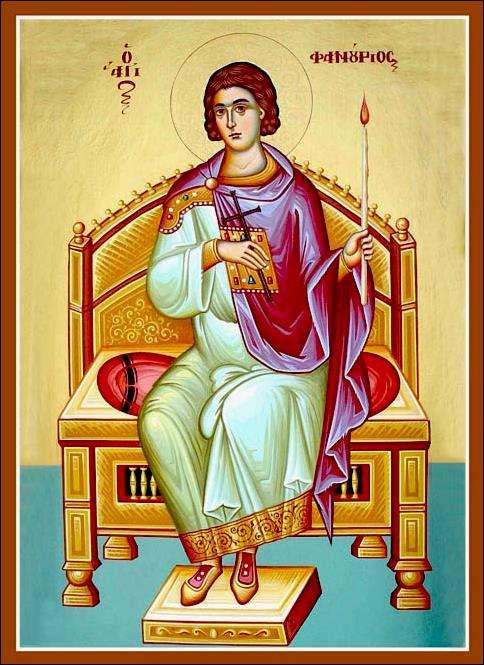
The Service of Supplication (Paraklesis) was celebrated in honour of the Holy Great Martyr Phanourios the Wonderworker. During it, the holy relics of Saint Luke the Physician and Saint Nektarios, Bishop of Pentapolis, were set out for the faithful’s veneration and blessing, as were two handmade works by Saint Paisios the Athonite containing wood of the Precious Cross.
APOLYTIKION. Tone 4. To the melody “Come Quickly.” A heavenly hymn of praise is splendidly celebrated on earth, while the community of Angels now joyfully celebrates an earthly festival. From above, with hymns they acclaim your struggles; below, the Church acclaims the heavenly glory you attained through your labours and contests, O glorious Phanourios.
THEME OF THE 79TH TALK:
“Children and the environment “
Excerpts from Saint Paisios's book Family Life, Spiritual Counsels, Volume Four, EPE, Chapter 3, p. 102.
The love between brothers and sisters
Parents must cultivate love between their children and, when they wish to strengthen the weaker one, they should prepare the ground by obtaining the consent of the stronger sibling. That is, they should help him to understand that the other child truly has a need. Justice belongs to God and must be accorded equally to both the elder and the younger. To the elder with respect, to the younger with love, without causing harm. This is also mentioned in Deuteronomy 6. If, for example, the elder is at fault, we shall vindicate the younger without affronting the elder before the younger; rather, we shall speak with him privately, so that he may understand his mistake.
– Elder, how is the jealousy that often arises in older siblings towards younger ones dealt with?
– Jealousy is a passion. However, when a small child is three years old and his mother is nursing his newborn sibling, it is somewhat understandable that he should be jealous, for he himself was nursing not long ago. Now he sees his little sibling in his mother's arms and says: “Until yesterday my mother had me in her arms; now she has put me aside!” And if there is also a grandmother, something happens. But when he becomes four years old, he should be less jealous. When he becomes six, his mother should tell him: “You are a whole child now. What mother holds such a large child in her arms?” If she helps him to face it in this way, then he will remember his mother only when there is a reason. If he wishes to hold his mother's skirt continually, this is something unhealthy.
Peer groups greatly influence children
– Elder, how does it happen that a young man, although he lived spiritually as a child and had a sense of honour, should reach a point of going completely astray?
– Let no one judge. There are many factors at work. Children who live worldly, careless lives are challenged when they see others living purely and spiritually, and they wish to draw them into their ways. Once, two children were walking along a road. At one point, one of them stumbled and fell into a pit of muddy water, so that his clothes became all covered in mud. As soon as they went a little further, he pushed his friend and threw him into a pit, so that he too might get muddy, because he felt uncomfortable being the only one covered in mud while the other was clean.
Peer groups greatly influence children. When I was young, I had love in my nature by instinct. Whenever I set out somewhere with the animals, I would try to put one child on the animal, another on the animal, and I would take my little brother on my shoulder. Once, one of my brothers killed a little bird, and I was very distressed and scolded him. Afterwards, I took the bird and buried it with tears. During that period, I kept company with children of my own age. We would go to the forest, pray, read the Synaxarion and fast. Later, their mothers began to prevent them from coming with me. “Do not keep company with him,” they would tell them, “he will infect you with his piety.” So they left me, and I felt alone. They even mocked me, calling me “a monk from here, a monk from there”; they had made my life a martyrdom. At one point I reached a stage where I could no longer endure the mockery. Then I said to myself: “I shall go with the older children and pretend.” So I began to keep company with older children. I took rubber bands and made a sling. At first, I would merely pretend to aim with the sling. Then I took pellets and became the best shot. Once, as soon as I killed a little bird and saw it lying dead, I came to my senses. I threw away both the rubber bands and the pellets. “You cried,” I said, “when your brother killed a little bird, and you scolded him for killing it; and now where have you come to? You kill birds, and little by little you will come to kill animals too.” Indeed, if I had continued in this way, I would have progressed to hunting animals and then skinning them as well. From a certain sensitivity, to what wickedness can a person fall, if he is not careful and is led astray by bad company! Whereas good companionship is very helpful. God has filled people with various gifts. Just as a person sees the depravity of others, so too can he see their virtue and imitate it.
Help for wayward children
In the home, it is essential that there be an atmosphere of love and peace. If a child receives a little love from the home and strays away at some point, he will see that he finds no love elsewhere, only hypocrisy, and he will return. If, however, he recalls unpleasant scenes in the home, quarrels and disputes, how can his heart be moved to return?
– Elder, when a child leaves home, what should parents do?
– They should try to maintain contact with him, so that, when he comes to his senses, he may be able to return home. They should speak to him kindly, raise questions in his mind and help him. For example, if a child stays out all night, the mother might say: “Come here, my child. If you were in my place and your children were late returning home in the evening, could you not worry?” Nor should the gravest fall of children drive parents to despair, for in our times sin has become fashionable. Parents should also always bear in mind the following: The children of our times have extenuating circumstances for the misdeeds they commit. A grade of seven—the conduct grade of today—has the value of ten, of excellence, in our own time. Of course, parents will try to help their children, but they should not worry excessively. The children will come to their senses later. Now they may not understand what is good, because their minds have not yet matured. They are clouded and lack the clarity to discern the danger they face and the irreparable harm they may suffer.
It is good for parents to show the child that they are grieved by his misdeeds, but they should not pressure him and should pray. Prayer offered with pain brings positive results. If, however, the child commits a very serious fault, then the parents should intervene in a fitting way. If it is not serious, let them overlook it a little, so as not to provoke the child and worsen his condition, with the result that he distances himself from them. Let them only pray to Christ and the Theotokos to protect him. The prayer of parents, especially of the mother, because it is heartfelt and full of pain, is heard very readily. When I was at the Skete of Iveron, a young man happened to come and find me. He was returning to Chalkidiki, met a group of pilgrims coming to Mount Athos, and he came with them to the cell. Pa-pa, he was an atheist, blasphemous, utterly shameless! He had a demonic cleverness and believed nothing. He insulted everyone, young and old. From here and from there I brought him round; he reached an understanding. I even cut his hair, for he had long hair!… “Look,” I said to him, “be grateful to your mother. Her prayers carried you here.” “Yes, Father,” he said to me. “I was returning to Chalkidiki, and I myself do not know how I came here.” “If your mother learns that you have come to Mount Athos,” I said to him, “and sees you with your hair cut, what joy she will have!” “How did you know, Father?” he said to me. “Indeed, what joy it would be for my mother to see me so changed!” God guided him from here and from there and brought him to the… master! How much prayer the poor mother must have offered for him!
The distribution of property
Parents who have the financial means have the responsibility to care for the future of their children. Naturally, the most important thing is to give them a good upbringing; then to educate them or send them to learn a trade, so that they may be able to earn their living; and afterwards to provide them with a small house, and so on. When our family came to Greece from Pharasa in Cappadocia in 1924, during the Exchange, my father, as president of the village, took care to settle all our fellow villagers. He left our family for last. Later, my elder siblings complained to him. “You looked after everyone, Father,” they said, “but you did not think of us.” If a person is alone, he may give everything and be indifferent to himself, out of self-denial and nobility; but if he has a family, he must also think of his family. Of course, parents should not become overconfident and give their children everything they have, all at once, for children are inexperienced and may venture into modern life, which has no limits. Afterwards they will grieve, having nothing left to help them. They should also take care to support the weaker child more materially, and even more morally, so that he is not swept away by the panic of failure; but they should also, with discernment and love, arrange matters for all the children, so that they do not grow cold toward one another. Rarely do you find loving families that live spiritually, where the siblings do not quarrel over plots of land and property, nor rush to the courts.
I once knew a seven-member family. The parents had some gold jewellery. After their death, the children said that the brother who had cared for them in their old age should take it. However, he thought that their sister had a large family and was in greater need, so he gave it to her. She gave it to the other brother, he to another, and in the end it returned to the first! Exactly what those Fathers did that we read about in the Gerontikon. In the end, since he too did not wish to keep it, they gave it to a church.