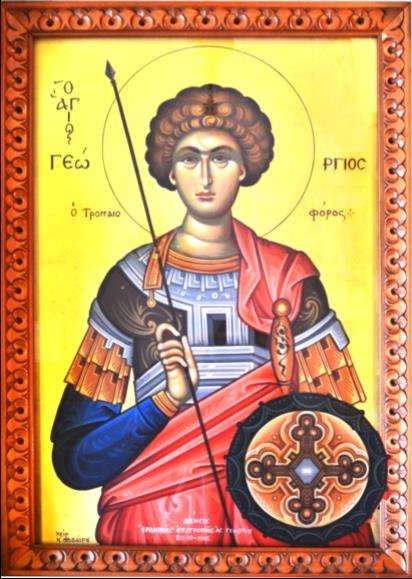
82ND EVENING TALK: "CHRISTIAN CONDUCT (PART III)—FAMILY LIFE"
16 Ιουνίου 2022 · ΧΡΗΣΤΟΗΘΕΙΑ
Βίντεο
On Thursday, 16 June 2022, an evening talk in the third series of talks by our spiritual father, Fr Nikiforos Kontogiannis, was held in our Church of Saint George the Great Martyr in Larissa. Entitled “UPRIGHT CONDUCT (Part III) – FAMILY LIFE”, it took as its starting point Saint Paisios the Athonite's book “Family Life”. It drew various lessons about spiritual life, living and working together, and, more generally, drawing near to God for salvation, sanctification, the imitation of Jesus Christ and, ultimately, human deification through Jesus Christ, who became man. The talks take place every Thursday at 7:00 p.m., immediately after Vespers and the Service of Supplication, which begin at 6:00 p.m. They are streamed live through our website: galilea.gr/new/webtv/live/ .
The supplication was offered in honour of the Great Martyr Saint George the Trophy-bearer. During it, the holy relics of Saint Luke the Physician and Saint Nektarios, Bishop of Pentapolis, were set out for the faithful to venerate and receive their blessing, as well as two handcrafted items made by Saint Paisios the Athonite containing wood of the Precious Cross.
APOLYTIKION. Tone 4. As liberator of captives, defender of the poor, physician of the sick and champion of kings, O Trophy-bearing Great Martyr George, intercede with Christ our God that our souls may be saved.
THEME OF THE 82nd TALK:
“Respect of children towards their parents ”
Excerpts from Saint Paisios’s book Family Life, Spiritual Counsels, volume IV, E.P.E., part 3, chapter 2.
Respect of children towards their parents and elders
When a child is small, it does nothing, and its parents care for its food, its clothing, and so on. They help it out of love, without it having to labour. It only does a little job now and then. Does that repay the effort or the expenses that the parents incur for it? But when the child grows up and does not understand what its parents offered it, this is very heavy!
In the past, parents would beat a child, and the child accepted it without question. Often it did not even understand why it was being beaten. Today, children are full of “why and why?” and argument. They lack simplicity. They put everything through the sieve. But divine Grace does not come in this way. When a child does not feel its father as a father and does not accept the father's discipline, it is a bastard child. Some children, if their parents make a small remark, immediately say, “I will cut my veins”. What can the parents do then? They give in, and in the end the children are ruined. The child must understand that, if the parents sometimes give it a little slap, they do not do it out of malice, but out of love, so that it may be corrected, become better, and rejoice later. When we were small, whether our parents caressed us, beat us, or kissed us, we accepted it all.
We understood that they did everything for our good. We had great trust. Sometimes, in fact, my mother would scold one child when another was at fault, because she did not have time to hold a …court. However, the guilty one, when he saw that the other, who was not at fault, had been scolded, because his conscience troubled him, would say, “I was at fault”, and the other was vindicated.
In the family, the younger ones must have respect both for their parents and for the elders. They must feel respect, submission and gratitude towards the elder as a necessity. The elders, in turn, must have love for the younger ones, helping and protecting them. When the younger respects the elder and the elder loves the younger, a beautiful family atmosphere is created. My father used to say: “Obedience to your elder brother”. We knew that our father loved us all, and we had more courage with our father. With the elder brother, whom we did not find with our father's love, we showed greater obedience. When spouses have respect for each other and children have respect for their parents, life in the family is peaceful, it runs like clockwork. Never in such a family does the elder son say to his mother, “Look here, mother, do not do that again”, or “Why did you do this like that and that differently?”, nor does the father speak to the mother in such a way. The elder may joke with the younger, to make him rejoice, but the younger must not acquire boldness from the joy he feels at the elder's teasing. When I was at the Monastery of Stomion
and would sometimes go down to buy various supplies, a little child, whose house was on the road, as soon as he saw me, would come close to me, and I would kiss his hand. Afterwards he got used to it and would run and give me his hand himself to kiss! I would kiss it. Then his parents told me: “Do not kiss his hand, Father, because he runs to the priests and gives his little hand to be kissed, and if they do not kiss it, he bursts into tears”.