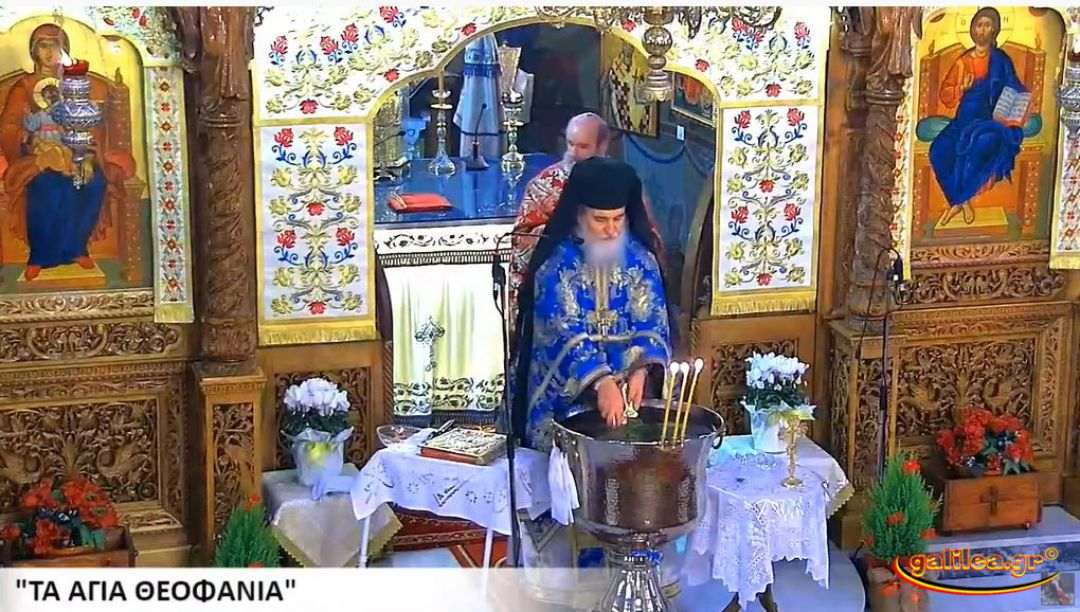
HOLY THEOPHANY AT OUR CHURCH
6 Ιανουαρίου 2021 · ΑΝΑΚΟΙΝΩΣΕΙΣ
Βίντεο
Holy Theophany was celebrated with particular splendour and magnificence today, Wednesday, 6 January 2021, in our Church of Saint George the Great Martyr in Larissa, with the prescribed protective measures observed. Our parish priests celebrated the Festal Divine Liturgy, followed by the Great Blessing of Waters and the blessing of the faithful. The faithful may reverently take today's holy water from the Great Blessing of Waters for Theophany from the fountain in our church courtyard between 10:00 a.m. and 18:00. They may drink it throughout the day and sprinkle and sanctify everything with it, but may not keep it. TODAY ONLY THE CHURCH KEEPS IT. At home we keep ONLY the holy water from the Great Blessing of Waters on Theophany Eve for exceptional circumstances, such as suspected sorcery, illness, weather disasters and so on; whenever we use it, we should receive our spiritual father's blessing.
On the Greater Blessing of Water and its use, so that the devil may not have his way. (Church Diptychs for 1999, pp. 78–80.)
The Greater Blessing of Water is celebrated every year on 5 and 6 January.
Many ask whether this holy water is drunk, used for sprinkling, kept in homes, and whether it replaces Holy Communion.
The following text, translated into modern Greek, is a "special opinion on the subject of the Greater Blessing of Water, that is, how it is received by Christians, whether it is kept, and whether the faithful partake of it", compiled by the late Metropolitan of Patras, Nikodimos.
It was originally published in the Church Diptychs for 1999 (pp. 78–80), for the instruction of the most reverend parish priests and the information of the faithful.
1. Is there a difference between the Greater Blessing of Water celebrated on the eve of Theophany and that of the principal day of the feast?
The Greater Blessing of Water celebrated on the eve of Theophany and on the day of the feast itself is exactly the same. Some mistakenly believe that the "lesser Blessing" is performed on the eve and the "Greater" on the following day. In both cases, the Greater Blessing of Water is performed.
The Lesser Blessing of Water is performed on the first day of every month, as well as exceptionally when Christians request it for various occasions (consecration of homes, shops and institutions, laying of foundations for buildings, etc.). The Greater Blessing of Water is performed only twice a year (on 5 and 6 January) in the Church.
2. Where is the Greater Blessing of Water kept, and for what reason? It is kept throughout the year in the Church. It is kept not without reason. The reason is none other than that it may be "partaken of" by the faithful under certain conditions and prerequisites. A common case concerns those under ecclesiastical penalty imposed by their spiritual father, which prevents their participation in Holy Communion for a certain period; it is customary to give them the Greater Blessing of Water for their blessing and consolation. There is no impediment to this, especially since they are "in repentance and confession."
However, they must necessarily realise that the Greater Blessing of Water neither substitutes nor replaces Holy Communion of the Body and Blood of Christ, for which they ought to prepare through repentance, so as to be freed from the impediments of sin, in order to be deemed worthy to receive Communion as soon as possible.
3. Can the Greater Blessing of Water be kept in the home and drunk in times of illness or to ward off the evil eye and every satanic activity?
The answer is affirmative. (Naturally, the Greater Blessing of Water is kept throughout the year in the Church, but the Blessing of the eve alone is also kept in our homes. On the day of the feast, only the Church keeps it.) This is provided by the sacred text of the Service of the Greater Blessing of Water, which stipulates “that all who draw and partake may have it (the sanctified water…) for the healing of passions, for the sanctification of houses, for every benefit,” and indeed “destructive to demons, inaccessible to hostile powers” (cf. also the accompanying prayer against the evil eye: “drive away and banish every diabolical activity, every satanic assault and every plot… and the evil eye of wicked men”).
Undoubtedly, in this way the faithful are guided to avoid other avenues (“charms,” sorceries and other devices of the evil one), and to have recourse to the authentic “sanctified things” of the Church, such as the Greater Blessing of Water, as well as the so-called “lesser” Blessing, as a conscious member of the Church, the treasury of divine grace, and a partaker of her sanctifying means.
It is presupposed, of course, that in homes where the Greater Blessing of Water is kept, the vigil lamp shall be lit and burn diligently, and piety shall be present in the members of the family, the spouses and the children, and every cause that drives away divine grace (such as blasphemies or other indecencies) shall be avoided.
4. What is the relationship between fasting and the Greater Blessing of Water?
The historical origin of the Greater Blessing of Water is as follows: In the ancient Church, on the eve of Theophany—as on the eve of Pascha and of Pentecost—the baptism of the Catechumens, that is, of new Christians, took place. At midnight, the blessing of the water was performed for the rite of Baptism; then the custom was introduced—as Saint John Chrysostom informs us—that Christians should take of the sanctified water and drink it or carry it to their homes for blessing and keep it throughout the whole year: "Wherefore also at midnight on this feast all draw water, lay it up in their houses, and keep it for the whole year" (Homily on the Holy Baptism of the Saviour; PG 49, 366).
Later, however, in times of liturgical decline, the service of the Blessing was separated from that of Baptism, although it retained many of its elements. The custom remained that the faithful should take of the sanctified water "for the sanctification of houses," as the consecratory prayer of the Greater Blessing of Water states.
An ancient custom also arose to fast before the feast of Theophany for two reasons. First, in the ancient Church the two great feasts of the Nativity of Christ and of Theophany were united into one, that of Theophany or Epiphany, celebrated on 6 January (a practice preserved in the Armenian Church to this day). However, Saint John Chrysostom (4th century) separated the two feasts, decreeing that the Birth of Christ be celebrated on 25 December, while the Baptism and manifestation of the Holy Trinity be celebrated on 6 January. Before every Lord's feast a fast preceded it for the spiritual and bodily purification of the faithful. Let us recall that within fasting there lies the element of mourning for our sins. Thus, when the two feasts were separated, the fast that preceded them followed the feast of the Nativity of Christ. Therefore, the Church has ordained that we fast only on the eve of Theophany as preparation for the feast, and not for more days, since we are in a festive period, the Holy Twelve Days.
Secondly, it was also an ancient custom that those who were to be baptised should fast, and with them their godparents, relatives, and other Christians who voluntarily kept a fast "on behalf of those being baptised". It was therefore not difficult for the conscience of Christians to connect the drinking of the holy water and fasting, even though there is no causal relationship between them.
Thus, applying this to our present day, we can say that those who regularly receive Holy Communion and observe the fasts of our Church, including that of 5 January, are already prepared to drink from the Great Blessing of the Waters on 5 and 6 January. In other cases, it is advisable to observe a related fast, as their Spiritual Father may direct.
Finally, those who occasionally drink from the Great Blessing of the Waters kept in their homes, in times of illness or danger and the like, whether after fasting or without it, let them not fall short in spiritual fasting, abstaining "from every defilement of flesh and spirit, perfecting holiness in the fear of God" (2 Cor. 7:1).
BLESSED THEOPHANIES. =