43RD EVENING TALK. “UPRIGHT CONDUCT (PART B) — WITH PAIN AND LOVE”
4 Μαρτίου 2021 · ΧΡΗΣΤΟΗΘΕΙΑ
Βίντεο
At our Church of Saint George the Great Martyr in Larissa, the evening talk of the second series by our spiritual father, Fr Nikiforos Kontogiannis, entitled “CHRISTIAN CONDUCT (Part Two)—WITH PAIN AND LOVE,” took place on Thursday 4 March 2021. Drawing on Saint Paisios the Athonite's book “With Pain and Love for Contemporary Man,” it draws various conclusions concerning spiritual life, coexistence, cooperation and, in general, the approach to God, with the aim of salvation, sanctification, imitation of Jesus Christ and, ultimately, the theosis of the human person through the incarnate Jesus Christ. The talks take place every Thursday at 6:00 p.m., immediately after the Service of Vespers and the Service of Supplication, which begin at 5:00 p.m. They are broadcast live through our website: galilea.gr/new/webtv/live/ .
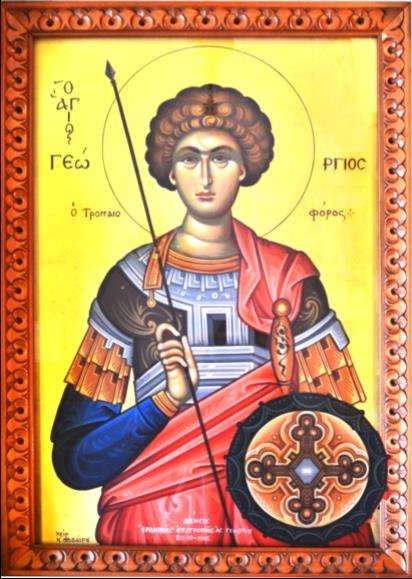
The supplication was offered in honour of the Great Martyr Saint George the Trophy-bearer. During it, the holy relics of Saint Luke the Physician and Saint Nektarios, Bishop of Pentapolis, were set out for the faithful to venerate and receive their blessing, as well as two handcrafted items made by Saint Paisios the Athonite containing wood of the Precious Cross.
APOLYTIKION. Tone 4. As liberator of captives, defender of the poor, physician of the sick and champion of kings, O Trophy-bearing Great Martyr George, intercede with Christ our God that our souls may be saved.
TOPIC OF THE 43rd TALK:
“The priest and us in the Divine Liturgy “
Excerpts from Saint Paisios the Athonite’s book: SPIRITUAL COUNSELS, VOLUME I, “With Pain and Love for Contemporary Man,” Part 4, chapter 2.
Governance in the Church
The Orthodox Church has always functioned through Synods. The Orthodox spirit is that the Synod should function in the Church and the Elderly Assembly in the Monasteries. The Archbishop and the Synod must decide together. The Abbot or Abbess and the Abbatial Council must decide together. The Archbishop is first among equals. And the Patriarch is not a Pope; he holds the same rank as the other hierarchs. Whereas the Pope has a different rank—he sits high and people kiss his foot!—the Patriarch sits with the other hierarchs and coordinates. Likewise, an Abbot or Abbess in relation to the superiors is again first among equals.
The Archbishop or an Abbot cannot do whatever he wishes. God enlightens one hierarch or superior for one matter and another for a different matter. You see, the four Evangelists complement one another. So too here, each expresses his opinion, and when there is a contrary opinion, it is recorded in the minutes. For, when a decision is contrary to the commandments of the Gospel and one person disagrees, if he does not request that his opinion be recorded, he will appear to agree. If he disagrees and signs without having his opinion recorded, he does harm and bears responsibility; he is guilty. Whereas, if he states his opinion, even if the majority is opposed, he is in good standing before God. If the Synod does not function properly in the Church, or the Assembly in the Monasteries, then, while we speak of the Orthodox spirit, we have a Papal one. The Orthodox spirit is for each to state and have his opinion recorded, not to remain silent because he is afraid, or to flatter in order to be on good terms with the Archbishop or the Abbot.
But even clergy who enter administration at a young age, even if they have qualifications, are harmed and wasted. They become caught in the gears of administration, secretariats, etc., and are not helped spiritually, despite having the prerequisites. Had some not been wasted and had they worked on themselves, they would later have become great assets for the Church. When a person does not, in the good sense, attend to himself—that is, does not work on himself—he is like a merchant who buys and sells but does not know what debts he has, and in the end is thrown into prison.
I am very sorry when I hear young priests in the office. If they remained outside of administration a little longer, they would help much more later. Unfortunately, however, young priests often become superiors instead of experienced ones who could do spiritual work among their flock, and thus a double harm is done. That is, the young assume responsibilities before doing spiritual work on themselves, and find themselves in positions where they must give, before having acquired spiritual wealth. The older ones, on the other hand, not having responsible positions, lack the opportunity to offer their precious experience and divine illumination.
The Divine Liturgy
– Elder, when the Divine Liturgy is celebrated, must there always be someone who receives Holy Communion?
– Yes, because the main purpose of the Divine Liturgy is for Christians to receive Holy Communion, even if only a few are ready. All the prayers refer to the faithful who will receive Communion. Therefore, even one person must receive. Of course, it may happen that on occasion not even one is ready; that is another matter. It is good, however, even for a small child, an infant, to receive Communion. And when no one is found, then it is only for the priest to receive and for names to be commemorated. But let this be done as an exception and not as a rule.
The events of the New Testament are made present by each person at every Divine Liturgy. The Holy Prothesis is Bethlehem; the Holy Altar is the All-Holy Sepulchre; and the Crucified One is the Holy Golgotha. The entire creation is sanctified by the Divine Liturgy, by the presence of Christ. The Divine Liturgies uphold the world! It is awe-inspiring what God has given us! We are not worthy of this! There are priests who, at every Divine Liturgy, live this awesome Holy Mystery. A certain cleric told me that a very simple and good priest used to say to him: “I find it very difficult to perform the prothesis. My foul tears fall into the Holy Chalice; I cannot hold them back, and for this reason I am greatly distressed.” And he wept! The cleric said to him: “Tell Christ to grant me a few of those foul tears as well.”
– Elder, why do you step down from your stall when the priest takes time?
– I step down because at that moment, when the priest is praying, God sends His divine Grace to the priest to deliver him from his weaknesses, so that he may be able to celebrate the divine Mystagogy. At that time, the faithful too must pray with reverence in order to receive Grace.
The Divine Liturgy begins with the Proskomedia. How wonderfully God sometimes arranges for us to understand and to experience the Holy Mysteries ourselves! When I was an ecclesiastical officer, a certain event happened to me. Once, while the priest was performing the Proskomedia, at the moment he said, “He was led as a sheep to the slaughter,” I heard the bleating of a lamb upon the Holy Diskos. When he then said, “The Lamb of God and Son of God is sacrificed,” I heard a bleat from the Holy Prothesis. It was awe-inspiring! For this reason I tell priests not to prepare the Proskomedia beforehand and then perform the other actions in a merely symbolic manner. That is to say, they should not cut the prosphoron beforehand and then, at that moment, simply place the Lamb upon the Holy Diskos and say, “The Lamb of God is sacrificed” and “He was led as a sheep to the slaughter,” even though they have already removed the Lamb. When they speak these words, they must then take the Holy Lance and cut the prosphoron. That is to say, when they say, “The Lamb of God is sacrificed,” then they must “sacrifice” Him.
When the priest rings the little bell during the Proskomedia, and you are also mentally commemorating names, let your heart participate in the sorrow of each soul you remember, whether living or departed. Bring to mind people in general and anyone specific you have in view, and say: “Mary, Nicholas… You know, O God, their problems; help them.” For names given to you for commemoration, commemorate them in a few Divine Liturgies—some for three, others for five—and then commemorate others. Why should you have some whom you commemorate continually and others who need not be commemorated at all? I do not understand this. The names of Catholics, Jehovah’s Witnesses, and the like should not be commemorated on the Holy Table. No portion may be taken out for them, nor may a memorial service be held for them. We may pray for their health and enlightenment, and even hold a Paraklesis service for them.
– Elder, some priests say they do not wish to serve frequently, so that they do not become accustomed to it.
– It is not right for a priest to say this. It is as if he were saying: “I do not visit my relatives regularly, so that they may receive me more warmly when I do come.” Preparation is indeed required. Holy Communion heals and sanctifies the one who strives. How can it help someone who does not strive? What can Christ change, if the person himself does not change? Once, in the cave of Saint Athanasios, there was an Elder with two disciples. One was a Hieromonk and the other an Ierodeacon. One day, therefore, the disciples went to a chapel to serve the Divine Liturgy. However, the priest was very envious of the deacon and jealous of him, because the deacon was more intelligent and capable in all things; yet the deacon did not help in his own egoistic manner. The priest had prepared outwardly, reading the prayers for Holy Communion and performing all the required rites. Unfortunately, however, he did not do the most important thing: inner preparation; that is, to confess humbly, so as to drive out envy and jealousy from his heart, which do not depart merely by changing our clothes and washing our heads. Thus, with this outward preparation, he proceeded to the fearful Altar to serve. But as soon as he began the Proskomedia, what happened? Suddenly a great noise was heard, and the holy Diskos was seen to fly away from the Proskomedia and disappear. It was inevitable that they could no longer serve. If the Good God had not hindered them in this way, and if the priest had served in the state of soul in which he was, I tell you, he would have suffered great harm.
– Elder, if something happens during the Divine Liturgy, can the Divine Liturgy be interrupted?
– When the Divine Liturgy is being celebrated, the priest cannot leave it unfinished, whatever may happen. Even if war were declared, he would complete it. Even if enemies were approaching outside the Church, he would at most hasten a little to finish. God will help it to be completed. But one must have trust in God and not be afraid.
The servant of the Most High must have great attention, purity, and accuracy. Priests are higher than the Angels. The holy Angels cover their faces at the hour when the Holy Mystery of the Divine Eucharist is celebrated, whereas the priest celebrates it.