56TH EVENING TALK: “UPRIGHT CONDUCT (PART III) — FAMILY LIFE”
21 Οκτωβρίου 2021 · ΧΡΗΣΤΟΗΘΕΙΑ
Βίντεο
On Thursday, 21 October 2021, an evening talk in the third series of talks by our spiritual father, Fr Nikiforos Kontogiannis, was held in our Church of Saint George the Great Martyr in Larissa. Entitled “UPRIGHT CONDUCT (Part III) – FAMILY LIFE”, it took as its starting point Saint Paisios the Athonite's book “Family Life”. It drew various lessons about spiritual life, living and working together, and, more generally, drawing near to God for salvation, sanctification, the imitation of Jesus Christ and, ultimately, human deification through Jesus Christ, who became man. The talks take place every Thursday at 7:00 p.m., immediately after Vespers and the Service of Supplication, which begin at 6:00 p.m. They are streamed live through our website: galilea.gr/new/webtv/live/ .
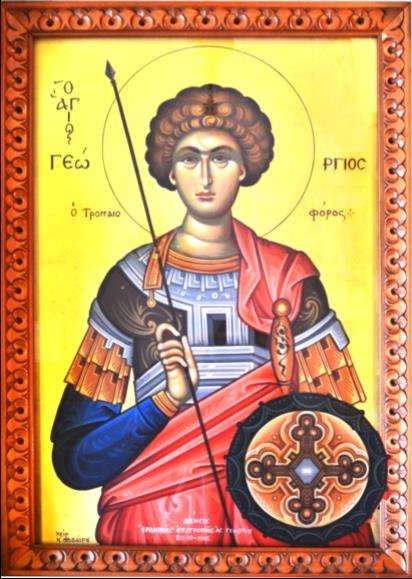
The supplication was offered in honour of the Great Martyr Saint George the Trophy-bearer. During it, the holy relics of Saint Luke the Physician and Saint Nektarios, Bishop of Pentapolis, were set out for the faithful to venerate and receive their blessing, as well as two handcrafted items made by Saint Paisios the Athonite containing wood of the Precious Cross.
APOLYTIKION. Tone 4. As liberator of captives, defender of the poor, physician of the sick and champion of kings, O Trophy-bearing Great Martyr George, intercede with Christ our God that our souls may be saved.
THEME OF THE 57th TALK:
“Preparation for entering family life. ”
Excerpts from the book by Saint Paisios the Athonite: SPIRITUAL COUNSELS, VOLUME IV, “Family Life.”
PREFACE
With this volume, we continue the publication of the discourses of the late Elder Paisios on themes concerning the family and the trials that man endures due to the crisis of the institution of the family in our times. The Elder said that most of the letters he received came from people with family problems. He attributed these problems to humanity's separation from God and to their self-love. "In the past," he would say, "life was calmer, and people exercised patience. Today, everyone is a matchstick. They cannot bear a single word. And then, automatic divorce."
The Elder, from a very early stage, actively positioned himself within the great family of the Church and felt that he no longer belonged to his small family. He acquired divine love and became a child of God. Therefore, he felt all people to be his brothers and loved each one "in the bowels of Jesus Christ" (Phil. 1:8). "When I see an elderly person," he would tell us, "I say that he is my father. When I see a grandmother, I say that she is my mother. When I see a small child, I see him as my nephew. I love them all. Some I rejoice in, others I grieve for. Do you know what this is?"
Yet he also became, for each person according to the case, a child, a brother, a father, or a grandfather. And this sincere love helped whoever approached him to undergo good change, to accept the word of God, and to live according to it. As a member of the Body of Christ, he not only prayed with pain for those facing problems within the family, but also helped them with his words when they asked him, even on the most specific matters of family life, although he himself lived as an ascetic.
Having himself been tested in the “fiery trials” and in the furnace of illness, which visited him in various forms from 1947 until his repose in 1994, he shared in the suffering of every afflicted person and prayed with pain for the sick. He cared for his own health only to the extent that he could look after himself and serve those who visited him. He believed that if he were to disregard his own pain, this would move God and He would hear his prayers for the other sick. Nevertheless, he advised them to do everything humanly possible to be healed, and to leave whatever is humanly impossible to God. At the same time, he strengthened their faith, so that they might face their illness with hope in God, yet not forget that in this life we are all “strangers and pilgrims” (1 Peter 2:11) and prepare for eternal life.
This volume—which is published with the blessing of our Shepherd, His Eminence Metropolitan Nikodimos of Kassandra—consists of an introductory chapter and six parts. Many of its themes arose from conversations the Gerontissa and certain Sisters had with the Elder. Although, following the Elder’s encouragement and principle, we refer those who seek spiritual help to their spiritual father, it often happened—and still happens—that people, in their contact with the Gerontissa or with a senior Sister, under the pressure of a problem, express their pain and ask for advice. On some occasions, to be certain that the answer we gave to a serious or difficult matter was correct, we turned to the Elder, who told us what was the God-pleasing approach in each case. Likewise, in the gatherings of the Brotherhood and in private conversations with the Sisters, taking occasion from some event of communal life or from one of our questions, he would usually mention difficulties faced by lay people. He did this so that we might pray with pain for the world. He also cited examples from heads of households or from mothers who, though they did not have the spiritual opportunities of monks, lived a holy life. In this way he encouraged us to struggle with greater zeal.
Some of these themes were supplemented with excerpts from the Elder’s letters, which were given to us by clergy and devout lay people.
To help young people troubled about the path they ought to follow in life, the introductory chapter “Young People Before the Two Paths of Life” was placed at the beginning of this fourth volume. In it, it is emphasised that both paths marked out by our Church—the married life and the monastic life—are blessed. Young people, according to their vocation, their strengths and their zeal, must, uninfluenced and with trust in God, choose one of the two paths. The basic condition for their progress, whichever path they follow, is to live purely and spiritually.
In the first of the six parts of this book, noble love and mutual respect between spouses are set forth as the foundations of the family. Patience in the difficulties of family life, when accompanied by prayer, saves the family from dissolution.
The second part, which concerns the obligations and responsibility of parents for the proper upbringing of children, especially highlights the importance of example, the “silent exhortation” of parents towards their children, and the role of the mother. It is also emphasised that affection and love for children are basic conditions for their normal development.
The third part refers to children, to their joys and difficulties from infancy until adulthood, as well as to their duties towards their parents. Respect and love for parents, not only in childhood but also in mature age, secure for them the blessing of God.
In the fourth part, simple and practical advice is given for spiritual life within the family. Thus, children and parents are helped to live out the Gospel daily, whether at home or at work, which ought, as far as possible, to contribute to their perfection according to God, rather than overwhelm them with constant anxiety.
In the fifth part, which refers to the various trials people face in life, emphasis is placed on the comfort and strength God gives to those who face them not only with patience but also with doxology. Illness, disability and slander are a blessing for the person who has grasped the deepest meaning of life. Through the hardships they endure, they either pay off sins or store up a heavenly reward.
Finally, the sixth part contains topics concerning the proper handling of death and preparation for it. The Elder clarifies what is the true comfort for those mourning the death of loved ones, and highlights how much memorial services, prayers and almsgiving for the departed help. In a simple and vivid manner, he also presents a picture of the Future Judgment and of eternal life.
The themes of this volume can, on the one hand, help those struggling in the world to continue “the good fight” (1 Tim. 6:12) with greater zeal, and, on the other, awaken the consciences of people who are troubled far from God, so that they may wish to become conscious members of the Church and enjoy within the small community of their family the peace and rest which spiritual life gives. At the same time, they underline that within marriage it is essential to keep all the commandments of God, which are “not burdensome” (1 John 5:3). If, for example, each of the spouses sacrifices his or her own will and practises obedience, he or she does not feel oppressed, because it is done out of love and there is felt within a sweet comfort. Perhaps the modern person, accustomed to the “lax laws” of today’s society, may regard certain positions of the Elder as absolute and impracticable; but, if judged in the light of the Gospel, it will be found that they are an exact expression of it. The Elder always aims at perfection in Christ. Yet, with his enlightened pastoral care, He is patient before human weakness and makes use of “oikonomia”*1, without, of course, consenting to sin.
Through examples and references to the life of earlier times and so forth, it seeks to help the modern person understand that God is living and “working all things in all” (1 Cor. 12:6). He does not respond only as a rewarder in the life to come, but also as a loving Father in the present. Yet man must show his good will through his small struggle. A little labour will bring much reward. But this small labour must be undertaken, so as to give God the “right” to intervene with abundant help in his life. We thank those who read the manuscripts of this volume and, with great reverence, offered certain reflections which helped to bring it to a more complete form. We pray that the words of the Elder may help the family, which today is especially troubled by forgetfulness or contempt for God's commandments, to find within the bosom of the Church its true purpose, so that parents and children may live Paradise even in this life.