41ST EVENING TALK. “UPRIGHT CONDUCT (PART B) — WITH PAIN AND LOVE”
18 Φεβρουαρίου 2021 · ΧΡΗΣΤΟΗΘΕΙΑ
Βίντεο
At our Church of Saint George the Great Martyr in Larissa, the evening talk of the second series by our spiritual father, Fr Nikiforos Kontogiannis, was held on Thursday 18 February 2021, entitled “VIRTUOUS CONDUCT (Part II) — WITH PAIN AND LOVE”, inspired by Saint Paisios the Athonite's book “With Pain and Love for Contemporary Man”, from which various conclusions are drawn concerning spiritual life, coexistence, cooperation and, in general, drawing near to God, with the aim of salvation, sanctification, imitation of Holy Christ and, ultimately, the deification of the human person through Holy Christ, who became man. The talks take place online every Thursday at 6:00 p.m., immediately after Vespers and the Service of Supplication, which are celebrated at 5:00 p.m., and are also broadcast live on our website: galilea.gr/new/webtv/live/.
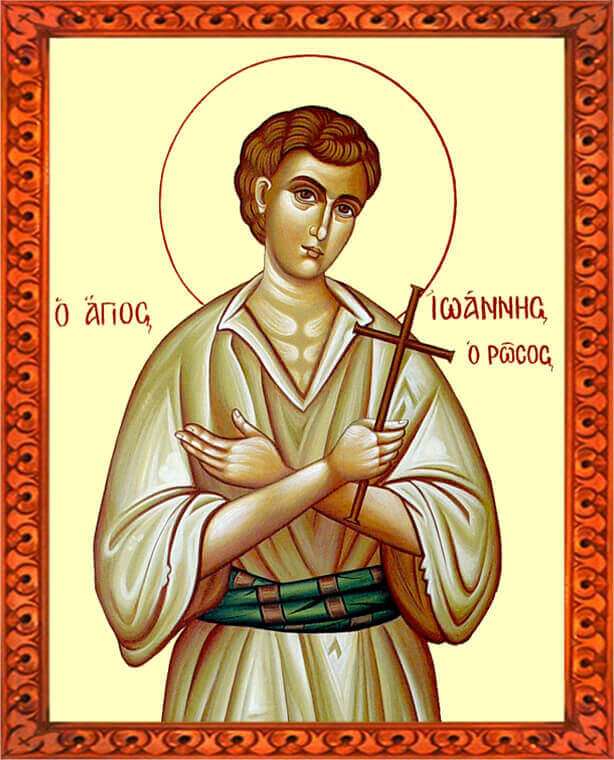
The Service of Supplication (Paraklesis) was celebrated in honour of Saint John the Russian. During it, the holy relics of Saint Luke the Physician and Saint Nektarios, Bishop of Pentapolis, were set out for the faithful’s veneration and blessing, as were two handmade works by Saint Paisios the Athonite containing wood of the Precious Cross.
ΑΠΟΛΥΤΙΚΙΟΝ ῏Ηχος δ’ Ταχὺ προκατάλαβε. Ἐκ γῆς ὁ καλέσας σε, πρὸς Οὐρανίους Μονάς, τηρεῖ καὶ μετὰ θάνατον ἀδιαλώβητον, τὸ Σκῆνός σου Ὅσιε. Σὺ γὰρ ἐν τῇ Ἀσίᾳ, ὡς αἰχμάλωτος ἤχθης, ἔνθα καὶ ᾠκειώθης, τῷ Χριστῷ, Ἰωάννη. Αὐτὸν οὖν ἱκέτευε, σωθῆναι τάς ψυχὰς ἡμῶν.
THEME OF THE 41ST TALK:
“The good educator “
Excerpts from the book by Saint Paisios the Athonite: SPIRITUAL COUNSELS, VOLUME I, “With Pain and Love for Contemporary Man,” part 4, chapter 1.
They burden the children with so much…
I see children who have completed not only high school but also university, yet they write letters with mistakes… We, even in primary school, did not make such errors. And if they are students of Philology or Law, something is amiss. If they are from other faculties, they do not know how to write. Whereas the School of Letters in the past was…
– Like a university, Elder!
– Here you see how much the children learned even in primary school back then; how much more so in the School of Letters! Today they burden them with a multitude of things and confuse them. They saturate them with letters without any spiritual counterweight. In schools, children must first learn the fear of God. Little children are sent to learn English, French, German – while they do not learn Ancient Greek – music, this and that… What should they learn first? Always letters and numbers, and the things they ought to learn for their Fatherland, etc., they do not learn. Neither patriotic songs nor anything else.
Take one of today's children now and ask him: “In which prefecture is your village? What is its population?” He does not know how to tell you. He says to you: “I will go to the travel agency, I will take the bus, and it will take me to the village. Since the conductor knows, I will tell him I wish to go to such-and-such a village, I will pay, and he will take me.” We, in primary school, knew the whole world by heart. For we had to know by heart the cities of all nations with populations of five hundred thousand and above. Then we had to know the largest rivers by width and length, and the next smaller ones, the highest mountains, etc. – how much more so those of Greece! I have seen this not only in little children but even in adults; a university student who does not know the population of the city in which he studies! I asked one what is the highest mountain in Greece, and he did not know. What is the largest river, nothing. The smallest, not even that. A university student who knows nothing about his Fatherland! Then our so-called “friends,” the neighbours, will come and say to him: “This is not your homeland; it is our homeland,” and he will reply: “You speak well; it is so!” Do you understand? That is where we are heading! If, however, you ask today's children about football or television, they know everything and everyone by heart.
And you see, children came from Albania and they knew letters. “Where did you learn your letters?”, you ask the Northern Epirotes. “In the prisons”, they tell you. They turned the prisons into schools. Our own children have turned the schools into prisons; they locked themselves in with the occupations… Today’s children, especially in adolescence, are dazed; more so in middle school and high school. At university they are more mature. After all, there, whenever they wish, they go.
And instead of taking certain measures for education, they make things worse. And I see how they distort everything spiritual. Listen now to a prayer in a primary school reader: “My Panagia, your baby is the most beautiful in the world”! Good heavens, what has happened to us! What children used to learn in school and what they learn now! “Little four-cornered goat, with twisted goat-horns, gather your little devils… to make goat’s milk, so that your grandchildren, your little crazy devils, may eat it”. Come now, let little children learn such things! But they do it to promote the devil, while on the other hand the Satanists do their work. May God lay His hand on it, because now the children are not being helped to be changed, in the good sense, but to be demonised.
And with the knowledge they receive, they do not learn to exercise their minds at all. That is why it does not turn. But a mind that does not turn has rust inside. Those who made inventions exercised their minds. They were in a need, they thought how to overcome it. Today most people look at what the books say, what the notes say. They remain in these; nothing more, and always numbers and figures; this screw at number 1, the other at number 2, and if by chance any screw gets damaged and the machine does not work, immediately: “Let us call the mechanic”. They do not think to take a file, to open the hole a little so that the screw may fit, or to take a little plastic, to wrap the screw so that it may tighten, but immediately: “Let us call the mechanic”, they say. What can I say? Both television and other media have today stupefied man. And even intelligent people eventually become cassettes. I mean to emphasise that man must exercise his mind. That is the whole foundation. For if the mind does not work, he learns, let us say, this now, and then he will be confused in that. That is why the aim is for the mind to give birth, to find solutions. If it does not give birth, then it is underdeveloped.
The work of the teacher is holy
– Elder, sometimes the difficulties teachers face at school stem more from their colleagues.
– In our times, great discernment and divine illumination are required for each person to move rightly among his colleagues. For every situation, much prudence and divine light are needed. At times, one should not even show that he believes. He should move quietly and, above all, speak to them through his true Orthodox way of life. In this way, he will help without provoking. Especially in education, some matters are like a mass: at times benign, at times malignant. If we take a stand based merely on human logic, we may do far more harm than good. If an intervention is made and the mass is malignant, it may spread. It requires careful cautery.
– Nevertheless, Elder, even teachers who wish to do their work find it difficult, because they are bound by restrictions.
– If someone truly wishes, he can find a way to do his work. They managed to find a way even under atheistic regimes; cannot we find one here? Someone from here went to Bulgaria and distributed small crosses to the children of a school. A member of the Communist Party standing nearby saw him. As soon as the teacher noticed him, she took the crosses from the children's hands and scolded them for having taken them. But when that atheist departed, the teacher herself distributed the crosses to the little ones. You see how the teacher was both in accord with the law and with God? You also see how much the teachers in Asia Minor gave during those difficult years! Because they worked with their hearts. They felt pain, they had piety, they made sacrifices. Behold, how wisely Saint Arsenios the Cappadocian acted in Phara! He had prepared a room for a school and, instead of desks, he placed goat or sheep skins, complete with their wool. Upon these, the children knelt to follow their lessons. In this wise manner, he did not provoke the Turks, even if they happened to see them, for they thought the children were praying. When Saint Arsenios wished to take the children on an outing, he led them to his own field, which resembled a garden, pretending they were doing work, and he told them: "If you happen to see a Turk, do something trivial. Cut a small branch, so that he thinks you are clearing the garden." And so the poor children did. For if the Turks had realised that he had taken them on an outing, there would have been trouble. You see, it was a secret school! When the Turk departed, the children would play again. And in summer, during the holidays, he would gather the children again in the same way, to help them, so that they would not become detached and forget what he had taught them.
– Elder, why did Saint Arsenios write the lessons in Turkish using Greek letters?
– So that the children would also know Turkish, enabling them to get by. And if the Turks, who were teaching the children letters, happened to catch him and saw the Greek letters, they would hear him reading them as Turkish and would not become enraged. Thus the children learned Turkish, and the Turks were not provoked. Everything that Saint Arsenios lived—the exactness of Orthodoxy, his devotion—he passed on to his pupils.
That is why I say: if someone truly wishes, he can do his work among children wherever he may be. A fine book has come into my hands, written by a teacher about Northern Epirus. She is worth five hundred men! How she spoke to the guides! She turned them round and round. Well done to her!
A true teacher is a matter of great importance, especially in our days! Children are blank cassettes: either they will be filled with filthy songs or with Byzantine music. The
teacher's work is sacred. He bears great responsibility and, if he is vigilant, may receive a great reward from God. He should strive to teach the children the fear of God. Teachers must find a way to convey certain messages to the children about God and about the Fatherland. Let them sow the seed, and let them not expect to see it sprout immediately. Nothing is lost; at some time it will take root.
And always, with kindness, forbearance and love, let them treat the children. Let them strive to awaken their sense of honour. The child needs love and warmth. Many children are utterly deprived of these at home. If teachers love the children, the children will love them in return, and then they will carry out their work more easily. In our day, the teacher would strike us with a rod when he saw disorder, yet he loved the children, and the children loved him. He had no children of his own, but he loved the children very much.
That is why I say: good are the parents who bear many children and become parents of many; but better are the true teachers who regenerate the world's children and become super-super-parents! They give regenerated people to society, and thus the world becomes better.