64TH EVENING TALK: "CHRISTIAN CONDUCT (PART III)—FAMILY LIFE"
16 Δεκεμβρίου 2021 · ΧΡΗΣΤΟΗΘΕΙΑ
Βίντεο
At our Church of Saint George the Great Martyr in Larissa, the evening talk of the third series by our spiritual father, Fr Nikiforos Kontogiannis, was held on Thursday 16 December 2021, entitled “VIRTUOUS CONDUCT (Part III) – FAMILY LIFE”, inspired by Saint Paisios the Athonite's book “Family Life”, from which various conclusions are drawn concerning spiritual life, living together, cooperation and, in general, drawing near to God with the aim of salvation, sanctification, imitation of Holy Christ and, ultimately, the deification of the human person through Holy Christ, who became man. The talks take place every Thursday at 7:00 p.m., immediately after the Service of Vespers and the Service of Supplication, which are celebrated at 6:00 p.m., and are also broadcast live on our website: galilea.gr/new/webtv/live/.
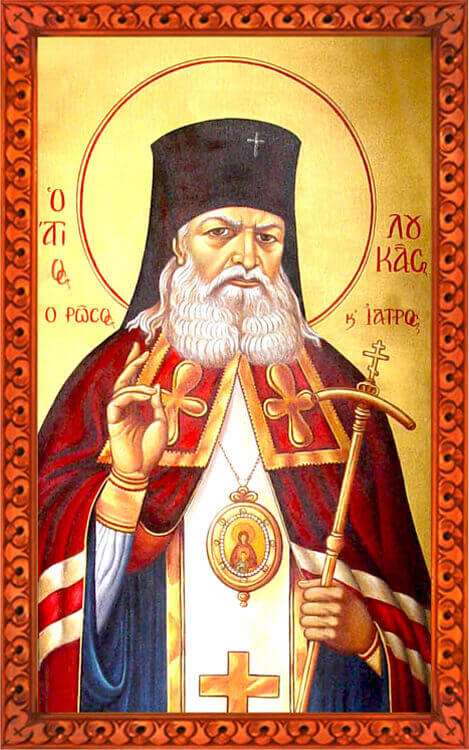
The Service of Supplication was celebrated in honour of Saint Luke the Russian, physician and Bishop of Simferopol. During the service, the holy relics of Saint Luke the Physician and Saint Nektarios, Bishop of Pentapolis, were displayed for the faithful to venerate and receive their blessing, together with two handcrafted works by Saint Paisios the Athonite containing wood from the Precious Cross.
ΑΠΟΛΥΤΙΚΙΟΝ ῏Ηχος πλ.α´. Τόν συνάναρχον Λόγον Ἰατρὸν καὶ ποιμένα, Λουκᾶ τιμήσωμεν, Συμφερουπόλεως ποίμνης, Ἀρχιερέα λαμπρόν, τὸν βαστάσαντα Χριστοῦ τὰ θεία στίγματα, τὰς ἐξορίας, τὰ δεινά, ἐγκλεισμοὺς ἐν φυλακαῖς, τὰς θλίψεις καὶ τὰ ὀνείδη, τὸν ἐπ΄ ἐσχάτων φανέντα, ἐν τῇ Ρωσίᾳ νέον Ἅγιον.
THEME OF THE 64TH TALK:
“Nurturing the gifts of children”
Excerpts from Saint Paisios’s book Family Life, Spiritual Counsels, volume IV, E.P.E., pp. 22–24.
We must help the young to follow their vocation
Every person has his own vocation. The Good God created man free. He is noble; He respects man's freedom and leaves each person free to follow the path that brings him rest. He does not place them all in the same line with military discipline. For this reason, let the young leave themselves free in the spiritual space of God's freedom. They are not helped if they examine what life someone or other followed or will follow. On this matter, they must not be influenced by anyone.
Parents, spiritual fathers and teachers, on the other hand, must help the young to choose whatever life suits them and to follow their true vocation, without influencing them or stifling their vocation. The decision for the life they will follow must be their own. All others can only express simple opinions, and the only right we have is to help souls to find their path.
Sometimes, when I speak with young people who are troubled on this matter, although I see which way the scale is tipping, I do not tell them, so as not to influence them. The only thing I try to do is to help them, as I can, to find the right path and inner peace; to remove from that which brings them rest whatever is harmful, so as to leave what is good and holy, that they may live happily in this life, near to God, and even more happily in the life to come. Sincerely, whatever life a young person I know follows, I shall rejoice and shall always have the same concern for the salvation of his soul, provided he is near to Christ, within our Church. I shall feel like his brother, because he will be a child of our Mother the Church.
Naturally, I rejoice especially in the young who follow the monastic life, for indeed he is wise who follows this angelic life, since he escapes the devil's hook, which has the world as its bait. Yet one cannot place all people in the same mould. You see, Christ did not give Monasticism as a commandment – although it is the path of perfection – because He did not wish to impose a heavy burden on all. For this reason, when the young man asked Him how he might be saved, Christ answered him: “Keep the commandments”. And when he said that he keeps them and asked, “What do I still lack?”, Christ said to him: “One thing you lack: if you wish to be perfect, go, sell what you have and come, follow Me”7. That is to say, if He found someone with noble spirit, then He spoke to him of perfection; He did not set a trap for the world. Nor did He teach Monasticism, for He would have kindled a fire and perhaps many would have rushed indiscriminately to become monks, and harm would have resulted. He cast only the spark, and when the right moment came, Monasticism emerged.
Thus we too have no right to force others – let them, if they wish, force themselves; we have the right only to force ourselves, and even that with discernment. Until now, I have not told any young person either to marry or to become a monk. If someone asks me, I say: “Do what brings you rest, provided you are near to Christ”. And if he tells me that he finds no rest in the world, then I speak to him of Monasticism, so as to help him to find his path.