48TH EVENING TALK: "CHRISTIAN CONDUCT (PART II)—WITH PAIN AND LOVE"
15 Απριλίου 2021 · ΧΡΗΣΤΟΗΘΕΙΑ
Βίντεο
At our Church of Saint George the Great Martyr in Larissa, the evening talk of the second series by our spiritual father, Fr Nikiforos Kontogiannis, entitled “CHRISTIAN CONDUCT (Part Two) – WITH PAIN AND LOVE,” took place on Thursday 15 April 2021. Drawing upon Saint Paisios the Athonite's book “With Pain and Love for Contemporary Man,” the series draws various conclusions concerning spiritual life, coexistence, cooperation and, in general, the approach to God, with the aim of salvation, sanctification, imitation of Jesus Christ and, ultimately, the theosis of the human person through the incarnate JESUS CHRIST. The talks take place every Thursday at 7:00 p.m. and are broadcast live on our website: galilea.gr/new/webtv/live/ .
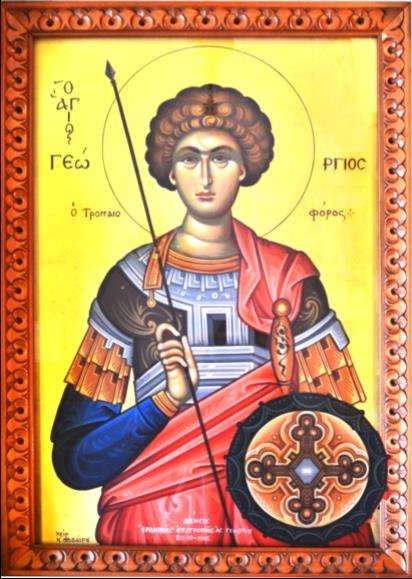
The supplication was offered in honour of the Great Martyr Saint George the Trophy-bearer. During it, the holy relics of Saint Luke the Physician and Saint Nektarios, Bishop of Pentapolis, were set out for the faithful to venerate and receive their blessing, as well as two handcrafted items made by Saint Paisios the Athonite containing wood of the Precious Cross.
APOLYTIKION. Tone 4. As liberator of captives, defender of the poor, physician of the sick and champion of kings, O Trophy-bearing Great Martyr George, intercede with Christ our God that our souls may be saved.
THEME OF THE 48TH TALK:
“ Spiritual operations “
Excerpts from Saint Paisios the Athonite’s book: SPIRITUAL COUNSELS, VOLUME I, “With Pain and Love for Contemporary Man,” Part 4, chapter 2.
Today people want two things from the priest: that he be free from the love of money, and that he have love.
Spiritual work on ourselves is silent work for our neighbour, because our example speaks; people then imitate the good they see and mend their ways. If we do not acquire spiritual wealth so that we can live on its spiritual interest while serving others freely, we shall be the most miserable and pitiable of all. We should therefore not regard the work we do on ourselves as a waste of time, whether it is for a short period, a long period, or continually throughout our lives. For hidden spiritual work has the power to preach the word of God secretly within people's souls. A person of God who is filled with grace imparts divine grace and transforms those who live according to the flesh. He frees them from slavery to the passions, thereby bringing them closer to God, and they are saved.
A priest can never close his door; he bears a great responsibility. One person is in despair, another is sick and in need, another is dying. Some he must receive, others he must visit. A priest cannot refuse. Souls are in danger; he must help them. If he does not help them, and God takes them before they have put their spiritual affairs in order, who will bear the responsibility?
We monks, and clergy too, spread atheism when we do not live according to the Gospel. The world needs our virtues, not our wretched behaviour. The example monks set for people in the world is particularly important! People in the world look for an excuse to justify their sins. That is why great care is needed. You see, we cannot say what Christ says, “Which of you convicts me of sin?”159 But “Who can accuse me of causing another to stumble?”—that is something we ought to be able to say. Christ said the former because he was perfect God and perfect man. We are human. We have imperfections, we fall, and so on, but we must not become a cause of stumbling for someone else.
There are also some who concern themselves with criticising one another rather than with the common good. Each watches the other more closely than himself. He looks to see what the other will say or write, so that he may then attack him mercilessly; yet if he himself said or wrote the same thing, he would support it with many testimonies from Holy Scripture and the Fathers. The harm he does is great, for he both wrongs his neighbour and tears him down in the eyes of the faithful. Often he even sows unbelief in the souls of the weak, because he causes them to stumble. Those who justify their malice through a supposed rebuking of others rather than themselves, or by publicising ecclesiastical matters—even things that ought not to be spoken of—using 'tell it to the Church' as their pretext, should first begin with their own little church, their family or brotherhood. If that seems good to them, then let them disgrace Mother Church too. Good children, I think, never accuse their mother.
Everyone is needed in the Church. Everyone offers their service to her, both gentle characters and strict ones. Just as the human body needs sweet and sour foods, and even bitter greens, because each has its own nutrients and vitamins, so everyone is needed in the Body of the Church. One person's character complements another's, and we are all obliged to bear with not only the other's spiritual character but even the weaknesses he has as a human being. Unfortunately, some make unreasonable demands of others. They want everyone to have the same spiritual character as themselves. When someone does not conform to their temperament—being, for example, a little lenient or a little sharp—they immediately conclude that he is not a spiritual person.
I wonder how some people attach such importance to human glory rather than to the glory of God that awaits us when we “flee the glory of men”. What will it benefit us if we acquire the highest office there is and the whole world praises us? Will the world's praises lead us to Paradise or push us into hell? What did Christ say? “I do not receive glory from men.” What would it benefit me if, from being a monk, I could become a hieromonk, a bishop or a patriarch? Would these offices help me to be saved, or would they be a great burden for a weak Paisios and cast me down into hell? If there were no other life, such foolishness might be excused. But someone who seeks the salvation of his soul regards everything as “refuse” and does not pursue high office.
Some people, although they ought to be full of joy both inwardly and outwardly because God has arranged for them to be free of every responsibility, instead seek responsibilities and positions of authority. When these are not given to them, they stew in their anguish and wear out both their soul and their body, which, according to the Apostle Paul, is the temple of God. While Christ is preparing heavenly glory for them, they want to enter Paradise by way of human glory.
Some may perhaps say to me, “Why are others honoured by people and afterwards glorified by God as well?” In truth, no one will be glorified by God while desiring human glory. No one should ever seek responsibilities for himself. When relieved of responsibilities, he should rejoice, because normally he ought to have felt concern over the responsibilities he held. If he does not rejoice, it means pride is lurking insidiously within him. Let us never seek offices in order to gain glory through them, for this reveals an advanced illness. It shows that we are following, in an unhealthy way, a path different from the path of humility walked by the Holy Fathers, who reached Paradise.
.