36TH EVENING TALK. “CHRISTIAN CONDUCT (PART TWO)—WITH PAIN AND LOVE.”
14 Ιανουαρίου 2021 · ΧΡΗΣΤΟΗΘΕΙΑ
Βίντεο
At our Holy Church of Saint George the Great Martyr in Larissa, the evening talk of the second series by our spiritual father, Fr Nikiforos Kontogiannis, entitled “CHRISTIAN CONDUCT (Part Two) – WITH PAIN AND LOVE,” was held on Thursday 14 January 2021. Drawing upon Saint Paisios the Athonite’s book “With Pain and Love for Contemporary Man,” it draws various conclusions concerning spiritual life, coexistence, cooperation and, in general, the approach to God, with the aim of salvation, sanctification, imitation of Holy Christ and, finally, the theosis of the human person through the incarnate Holy Christ. The talks take place every Thursday at 6:00 p.m., immediately after the Service of Vespers and the Service of Supplication, which begin at 5:00 p.m., and are also broadcast live on our website: galilea.gr/new/webtv/live/ .
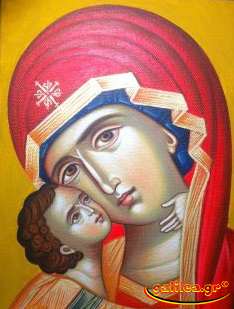
The Service of Supplication was offered in honour of the Most Holy Theotokos, so that our lives may remain under God’s shelter and protection. During it, the holy relics of Saint Luke the Physician and Saint Nektarios, Bishop of Pentapolis, were set out for the veneration and blessing of the faithful, together with two handcrafted works by Saint Paisios the Athonite containing wood from the Precious Cross.
“παροικήσω ἐν τῷ σκηνώματί σου εἰς τούς αἰῶνας, σκεπασθήσομαι ἐν σκέπει τῶν πτερύγων σου”
(Ψαλμός 60 ος Στιχ.5)
TOPIC OF THE 36th TALK:
“We used to say, ‘Either the shore is crooked or we are sailing crookedly.’ Today we will say, ‘Both the shore is crooked and we are sailing crookedly.’” “
Excerpts from the book by Saint Paisios the Athonite: SPIRITUAL COUNSELS, VOLUME I, “With Pain and Love for Contemporary Man,” part 3, chapter 4.
Shamelessness and lack of reverence
Boldness drives away reverence
– Elder, where does boldness come from?
– From Paris… Boldness is shamelessness and drives the fear of God far away, like the smoke we place among bees to make them leave the hive.
– Elder, how can I avoid boldness?
– Feel yourself beneath everyone. Great humility is required. As a younger sister, show respect and reverence to all the sisters. Speak your thoughts humbly, and do not show that you know everything. Then God will bless you and you will make progress. Boldness in a disciple is his greatest enemy, because it drives away reverence. Usually, rebellion follows boldness, and then insensitivity and indifference toward small sins at first, which one gradually grows accustomed to and later regards as normal; yet there is no peace in the depths of the soul, only anxiety. Nor can a person understand what is wrong with him, for the heart is outwardly smooth and does not feel the stumbles it makes.
– Elder, what is the relationship between simplicity and boldness?
– Simplicity is one thing, boldness another. Simplicity contains reverence and something childlike within it. Boldness has audacity.
And often shamelessness can exist within straightforwardness. Within straightforwardness and within simplicity, much shamelessness is often hidden when a person is not careful. He says: “I am of a straightforward character” or “I am simple,” and speaks shamelessly without realizing it. But simplicity is one thing, shamelessness another.
– What is, Elder, spiritual modesty?
– Spiritual modesty is the fear of God, in the good sense. This fear, this tightening, brings joy; it drips honey into the heart—spiritual honey! You see, a little child who is modest respects his father, pulls himself together, and out of great modesty does not look at his father. He tries to ask something and turns red! This is something to place in the icon corner. Another child thinks: “He is my father,” and stretches out before him carelessly, with audacity. And when he wants something, he demands it be given to him, stamps his feet and threatens.
In a good family, the children move freely. There is respect, without the children being stifled; there is no military discipline. They rejoice in their father and mother, and the parents rejoice in them. “Love knows no shame,” says Abba Isaac135. It has courage, in the good sense. This love has reverence and respect within it; that is, it conquers fear. One person has modesty, hesitates, and is afraid, because he does not have true modesty. Another has modesty but is not afraid, because he has true, spiritual modesty. When modesty is spiritual, one feels joy. For example, a little child loves his father and mother with a certain boldness; he is not afraid of being struck. He takes his father’s hat, even if he is an officer, throws it about and rejoices. He has good simplicity; he does not have shamelessness. We must distinguish simplicity from shamelessness. If respect and modesty are lacking, we arrive at boldness and shamelessness. And then you hear the girl lying down and saying: “Mother, bring me a glass of water! It must be cold!… Oh, it is not cold. I told you to bring it cold.” Thus it begins, and later they say: “And why should a woman fear her husband?”136. Within fear, however, there is respect, and within respect there is love. What I respect, I also love; and what I love, I also respect. The woman should respect the man. The man should love the woman. But now everything is flattened out, and families are dissolved, because they take the Gospel upside down. “The woman must obey,” says the man. But if you do not have love, you cannot even subdue a cat. If you do not have love, the other person is not informed, and you cannot even ask him to bring you a glass of water. When one respects another, he respects even himself, but he does not count himself. Respect for the other has honour. Whereas, when a person pays attention to himself, that has no honour.