59TH EVENING TALK: “CHRISTIAN CONDUCT (PART III)—FAMILY LIFE.”
11 Νοεμβρίου 2021 · ΧΡΗΣΤΟΗΘΕΙΑ
Βίντεο
On Thursday 11 November 2021, the evening talk of the third series of talks by our spiritual father, Fr Nikiforos Kontogiannis, was held at our Church of Saint George the Great Martyr in Larissa. Entitled “VIRTUOUS CONDUCT (Part III) – FAMILY LIFE”, it draws on Saint Paisios the Athonite's book “Family Life”, from which various conclusions are drawn concerning spiritual life, living together, cooperation and, in general, drawing near to God, with the aim of salvation, sanctification, imitation of Holy Christ and, ultimately, the deification of the human person through the Incarnate Lord Jesus Christ. The talks take place every Thursday at 7:00 p.m., immediately after the Service of Vespers and the Service of Supplication, which are celebrated at 6:00 p.m., and are also broadcast live on our website: galilea.gr/new/webtv/live/.
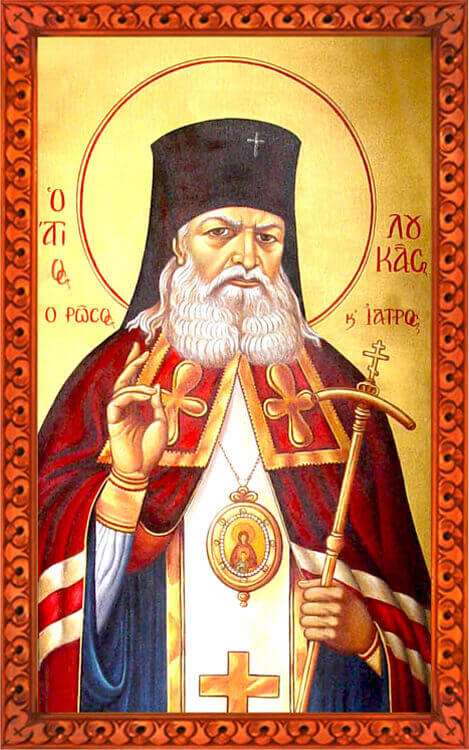
The Service of Supplication was celebrated in honour of Saint Luke the Russian, physician and Bishop of Simferopol. During the service, the holy relics of Saint Luke the Physician and Saint Nektarios, Bishop of Pentapolis, were displayed for the faithful to venerate and receive their blessing, together with two handcrafted works by Saint Paisios the Athonite containing wood from the Precious Cross.
ΑΠΟΛΥΤΙΚΙΟΝ ῏Ηχος πλ.α´. Τόν συνάναρχον Λόγον Ἰατρὸν καὶ ποιμένα, Λουκᾶ τιμήσωμεν, Συμφερουπόλεως ποίμνης, Ἀρχιερέα λαμπρόν, τὸν βαστάσαντα Χριστοῦ τὰ θεία στίγματα, τὰς ἐξορίας, τὰ δεινά, ἐγκλεισμοὺς ἐν φυλακαῖς, τὰς θλίψεις καὶ τὰ ὀνείδη, τὸν ἐπ΄ ἐσχάτων φανέντα, ἐν τῇ Ρωσίᾳ νέον Ἅγιον.
TOPIC OF THE 59th TALK:
“Whoever walks honestly walks securely” “
Excerpts from the book by Saint Paisios the Athonite: WORDS, VOLUME IV, “Family Life.”
pp. 11–12
To help young people who are considering which path to follow in their lives, the introductory chapter "Young People Facing the Two Paths of Life" has been placed at the beginning of this fourth volume. It emphasises that both paths laid out by our Church—married life and monastic life—are blessed. According to their inclination, abilities and philotimo, their generous sense of loving duty, young people should choose one of the two paths freely, without outside pressure, and with trust in God. A fundamental condition for their progress on whichever path they follow is to live purely and spiritually.
In the first of this book's six parts, noble love and mutual respect between spouses are identified as the foundations of the family. Patience amid the difficulties of family life, when accompanied by prayer, saves the family from breaking apart.
Excerpts from a book by Saint John Chrysostom, volume 21, E.P.E., pp. 83–89.
Do you not see that wickedness is blind? Have you not heard that whoever digs a pit for his neighbour digs it for himself? How, then, could you fail to fear a soul full of turmoil? If you mean that bitter people should be feared in the same way as demons, mad people or fools—since such people act without restraint—I agree. But if you regard them as formidable in the management of affairs, I do not accept that. For nothing is so well suited to managing affairs as sound judgment, and nothing hinders sound judgment so much as wickedness, malice and deceit. Do you not see how bodies afflicted by bile are unsightly, how all their bloom has withered, how weak, emaciated and unfit for anything they are? Such souls are the same. For wickedness is nothing other than jaundice of the soul. Wickedness is therefore not something strong; indeed, it is not. Would you like me to make my meaning clear through an example, showing scenes from the lives of a wicked man and an upright one? Absalom was wicked and sought to win everyone over. Observe how great his cunning was. He went about, we are told, saying, ‘Do you have a case requiring judgment?’ in his wish to win each person to himself. David, by contrast, was upright. What then? Observe the end of them both, and how foolish the former was. Since his only concern was how to harm his father, he was blind to everything else. David, however, did not behave in this way, for ‘He who walks uprightly walks securely.’ That is, one who does not meddle contrives no evil.
Therefore let us obey the blessed Paul, show mercy to the wicked and weep for them, doing everything we can to drive wickedness from their souls. Is it not absurd that, though bile exists within us—and this substance is useful, since a person cannot live without bile; I mean the body's natural bile—we strive with all our strength to remove it, despite its great benefit, yet do nothing and make no effort to remove the bile in our soul, which is useful for nothing and indeed causes enormous harm? “Let anyone among you who desires to be wise,” he says, “become a fool, so that he may become truly wise.” Listen also to Luke, who says, “They shared the food set before them and ate with hearts full of rejoicing and childlike sincerity and simplicity, praising God and enjoying the esteem of all the people.” Do we not see even now that the simple and sincere enjoy the common esteem of everyone? No one envies such a person when he prospers, and no one reproaches him when he suffers misfortune. Everyone congratulates him when he does well and feels compassion when he falls into error. But if a wicked person happens to prosper, everyone groans as though some evil had occurred; and when he suffers misfortune, everyone rejoices.
Let us therefore show compassion towards them, for they have common enemies roaming everywhere. Jacob was sincere, yet he overcame the evildoer Esau, “for wisdom will not enter a deceitful soul.” “Let all malice disappear from you”: let not the slightest remnant remain. For he knows that, if it is stirred, it will kindle an entire fire within, as though from a spark. We shall understand precisely what malice is: for example, the character of the underhanded person, the deceitful person, the one ready to do evil, the suspicious person. From this, then, rage and anger continually arise. Certainly such a person cannot be at peace, since malice is the root of rage and anger. This person is also ill-tempered and never allows his soul to be free: he is always sunk in brooding thoughts, always gloomy. =