44TH EVENING TALK. “UPRIGHT CONDUCT (PART B) — WITH PAIN AND LOVE”
11 Μαρτίου 2021 · ΧΡΗΣΤΟΗΘΕΙΑ
Βίντεο
At our Church of Saint George the Great Martyr in Larissa, the evening talk of the second series by our spiritual father, Fr Nikiforos Kontogiannis, entitled “CHRISTIAN CONDUCT (Part Two) – WITH PAIN AND LOVE”, took place on Thursday 11 March 2021. Drawing on Saint Paisios the Athonite's book “With Pain and Love for Contemporary Man”, it draws various conclusions concerning spiritual life, coexistence, cooperation and, in general, the approach to God, with the aim of salvation, sanctification, imitation of Jesus Christ and, ultimately, the theosis of the human person through the incarnate Jesus Christ. The talks take place every Thursday at 6:00 p.m., immediately after the Service of Vespers and the Service of Supplication, which begin at 5:00 p.m. They are broadcast live through our website: galilea.gr/new/webtv/live/ .
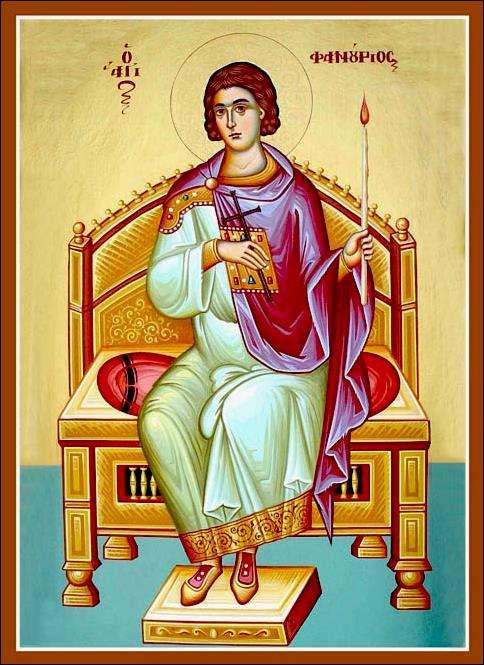
The Service of Supplication (Paraklesis) was celebrated in honour of the Holy Great Martyr Phanourios the Wonderworker. During it, the holy relics of Saint Luke the Physician and Saint Nektarios, Bishop of Pentapolis, were set out for the faithful’s veneration and blessing, as were two handmade works by Saint Paisios the Athonite containing wood of the Precious Cross.
APOLYTIKION. Tone 4. To the melody “Come Quickly.” A heavenly hymn of praise is splendidly celebrated on earth, while the community of Angels now joyfully celebrates an earthly festival. From above, with hymns they acclaim your struggles; below, the Church acclaims the heavenly glory you attained through your labours and contests, O glorious Phanourios.
THEME OF THE 44th TALK:
“How the Divine Liturgy begins “
Excerpts from Saint Paisios the Athonite’s book: SPIRITUAL COUNSELS, VOLUME I, “With Pain and Love for Contemporary Man,” Part 4, chapter 2.
The Divine Liturgy
– Elder, when the Divine Liturgy is celebrated, must there always be someone to receive Holy Communion?
– Yes, because the main purpose of the Divine Liturgy is for Christians to receive Holy Communion, even if only a few are prepared. All the prayers refer to the faithful who will receive Communion. Therefore, even if only one person is present, he or she must receive. Of course, it may happen that on some occasion no one is prepared; that is another matter. It is good, however, even for a small child or an infant to receive Communion. And when no one is present, then it is only for the priest to receive and for names to be commemorated. But let this be done as an exception and not as a rule.
The events of the New Testament are made present in every Divine Liturgy. The Holy Prothesis is Bethlehem, the Holy Altar is the All-Holy Tomb, and the Crucified One is the Holy Golgotha. The whole creation is sanctified by the Divine Liturgy, by the presence of Christ. The Divine Liturgies sustain the world! It is awe-inspiring what God has given us! We are not worthy of it! There are priests who, in every Divine Liturgy, live this awesome Holy Mystery. A cleric once told me that a very simple and good priest said to him: “I find it very difficult to make the dismissal. My tears of unworthiness fall into the Holy Chalice; I cannot hold them back, and for this reason I am greatly distressed.” And he wept! And the other said to him: “Tell Christ to give me a few of my own ‘tears of unworthiness’ as well.”
– Elder, why do you leave your stall when the priest takes time?
– I leave because at that moment, when the priest prays, God sends His divine Grace to the priest, to deliver him from his weaknesses so that he may be able to celebrate the divine Mystagogy. Then the faithful too must pray with reverence in order to receive Grace.
The Divine Liturgy begins with the Proskomedia. How God sometimes arranges for us to understand and experience the Holy Mysteries ourselves! When I was a churchwarden, something happened to me. Once, when the priest was performing the Proskomedia, at the moment he said, “He was led as a sheep to the slaughter”, I heard the bleating of a lamb upon the Holy Diskos. And when he said, “The Lamb of God and Son of God is sacrificed”, I heard a bleat from the Holy Prothesis. Awe-inspiring! This is why I tell priests not to prepare the Proskomedia beforehand and then perform the rest symbolically. That is, they should not cut the prosphoron in advance and merely place the Lamb upon the Holy Diskos at that moment, saying, “The Lamb of God is sacrificed” and “He was led as a sheep to the slaughter”, when they have already taken out the Lamb. When they say these words, then they must take the Holy Lance and cut the prosphoron. That is, when they say, “The Lamb of God is sacrificed”, then they must “sacrifice” Him.
When the priest rings the little bell during the Proskomedia, and you are also mentally commemorating names, let your heart participate in the sorrow of each soul you remember, whether living or departed. Bring to mind people in general and anyone specific you have in view, and say: “Mary, Nicholas… You know, O God, their problems; help them.” For names given to you for commemoration, commemorate them in a few Divine Liturgies—some for three, others for five—and then commemorate others. Why should you have some whom you commemorate continually and others who need not be commemorated at all? I do not understand this. The names of Catholics, Jehovah’s Witnesses, and the like should not be commemorated on the Holy Table. No portion may be taken out for them, nor may a memorial service be held for them. We may pray for their health and enlightenment, and even hold a Paraklesis service for them.
– Elder, some priests say they do not wish to serve frequently, so that they do not become accustomed to it.
– It is not right for a priest to say this. It is as if he were saying: “I do not visit my relatives regularly, so that they may receive me more warmly when I do come.” Preparation is indeed required. Holy Communion heals and sanctifies the one who strives. How can it help someone who does not strive? What can Christ change, if the person himself does not change? Once, in the cave of Saint Athanasios, there was an Elder with two disciples. One was a Hieromonk and the other an Ierodeacon. One day, therefore, the disciples went to a chapel to serve the Divine Liturgy. However, the priest was very envious of the deacon and jealous of him, because the deacon was more intelligent and capable in all things; yet the deacon did not help in his own egoistic manner. The priest had prepared outwardly, reading the prayers for Holy Communion and performing all the required rites. Unfortunately, however, he did not do the most important thing: inner preparation; that is, to confess humbly, so as to drive out envy and jealousy from his heart, which do not depart merely by changing our clothes and washing our heads. Thus, with this outward preparation, he proceeded to the fearful Altar to serve. But as soon as he began the Proskomedia, what happened? Suddenly a great noise was heard, and the holy Diskos was seen to fly away from the Proskomedia and disappear. It was inevitable that they could no longer serve. If the Good God had not hindered them in this way, and if the priest had served in the state of soul in which he was, I tell you, he would have suffered great harm.
– Elder, if something happens during the Divine Liturgy, can the Divine Liturgy be interrupted?
– When the Divine Liturgy is being celebrated, the priest cannot leave it unfinished, whatever may happen. Even if war were declared, he would complete it. Even if enemies were approaching outside the Church, he would at most hasten a little to finish. God will help it to be completed. But one must have trust in God and not be afraid.
The servant of the Most High must have great attention, purity, and accuracy. Priests are higher than the Angels. The holy Angels cover their faces at the hour when the Holy Mystery of the Divine Eucharist is celebrated, whereas the priest celebrates it.