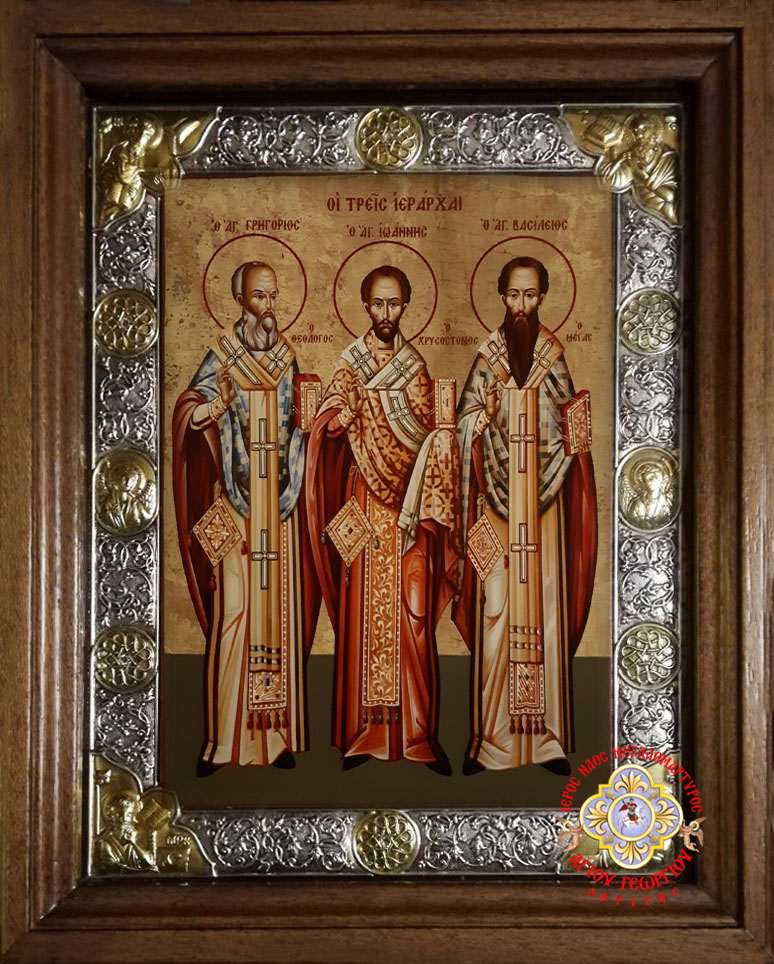
2020 30 JAN. THE THREE HIERARCHS
30 Ιανουαρίου 2020 · ΑΝΑΚΟΙΝΩΣΕΙΣ

Three great souls. Three brilliant minds, universal scholars. Three courageous, valiant hearts. These are the Three Holy Hierarchs, the patrons of letters, whom we celebrate together on 30 January. We honour three souls of wondrous holiness: Saint Basil the Great, Saint Gregory the Theologian, and Saint John Chrysostom.
Saint Basil the Great was born in Neocaesarea of Pontus in 330 AD. He grew up and was raised within a Christian environment, under the care of his mother, Saint Emmelia. When the renowned schools of Caesarea could offer him nothing more, Basil journeyed to the celebrated Athens. So great was his love of learning that he studied medicine, rhetoric, astronomy, geometry and theology. Yet he progressed most in virtue and the Christian life. Thus he renounced human glory and the reputation of a sage, and devoted himself to God. He became the well-known Archbishop of Caesarea, who remains in history as "the Great" and as the Bishop of love, through his famous Basiliada. To this work of philanthropy he dedicated all his wealth and his entire life, until his repose in 350.
Saint Gregory the Theologian was a friend and fellow-student of Basil, and his contemporary. He studied and became master of all the wisdom then known. Yet he quickly left all these things behind and devoted himself to Christ. As Bishop of Nazianzus and as Patriarch of Constantinople, he fought with eloquence and courage against all heresies and preserved our faith undefiled. For his contribution to Orthodoxy he was named "Theologian", and he is the second to bear this title after the Evangelist John. Less well known, yet of great worth, is his poetic work, which many study and admire today.
Saint John Chrysostom was born a little later, around the year 350, in Antioch of Syria. The renowned teacher Libanius destined him to be his successor in Antioch. But John preferred to devote himself to God. With fiery and powerful sermons he sowed the word of God in many places, and also in Constantinople as Patriarch. At every sermon vast crowds gathered. Because of his eloquence he received the name Chrysostom. Yet the enemies of the truth, among them the empress, whom he rebuked for her injustices, sent him into exile three times. On the third occasion he died from hardships, glorifying God.
The contribution of the Three Holy Hierarchs to humanity is unique. They laid the foundations of Orthodoxy; therefore we call them Fathers. They were educated in Greek and taught in Greek. The great sages of our own time draw from their inexhaustible wisdom. They possessed gifts and received careful upbringing from their homes, and especially from their mothers: Saint Emmelia, Saint Nonna and Saint Anthousa. Yet through their own diligence, labour and effort they became great. They struggled unceasingly, prayed without ceasing and practised themselves in the contest of virtue. Thus they became the champions of piety, virtue, holiness, and also of learning and wisdom. It is worth our while to imitate them. The reason for the institution of the feast of the Three Holy Hierarchs in the Church is the following event:
During the reign of Alexios Komnenos (1081–1118), who succeeded to imperial authority after Nikephoros III Botaneiates (1078–1081), a dispute arose in Constantinople among learned and virtuous men. Some regarded Saint Basil the Great (1 January) as superior, describing him as a genius and a magnificent figure. Others placed Saint John Chrysostom (13 November) on high and considered him superior to Saint Basil the Great and Saint Gregory. Finally, others, devoted to Saint Gregory the Theologian (25 January), held him to be superior to the other two, namely Basil and Chrysostom. This dispute resulted in the division of the Christian crowds, some being called “Ioannites”, others “Basiliites”, and still others “Gregorites”.
This strife was brought to an end by John Mauropous, Metropolitan of Euchaita. As the account in the Synaxarion relates, he saw in a vision these greatest Hierarchs, first each one separately and then all three together. They said to him: “As you see, we are one in God, and nothing exists that separates us or causes us to dispute. Yet, under the particular circumstances and times in which each of us found ourselves, moved and guided by the Holy Spirit, we wrote in our works, each in his own manner, teachings that help people to find the path of salvation. Likewise, the deeper divine truths into which we were able to penetrate by the illumination of the Holy Spirit, we included in the works we published. Among us there is neither first nor second; but if you name one, the other two accompany him. Rise, therefore, and give command to those who are disputing to cease their quarrels and to stop dividing themselves over us. For we, both in the earthly life we lived and in the heavenly life to which we have passed, have cared and continue to care to bring peace and lead the world to harmony. And appoint one day on which our memory shall be celebrated together; and, as it is your duty, see to it that this feast is introduced into the Church and that the sacred service is composed. Yet another duty of yours is to hand down to future generations that we are one in God. Certainly we too will cooperate for the salvation of those who will celebrate our memory, for we too have boldness before God.”
Thus, Bishop John of Euchaita undertook the reconciliation of the warring factions, established the feast on 30 January and composed a common service worthy of the Three Great Fathers.
The feast of this Synaxis of Saint Basil the Great, Saint Gregory the Theologian and Saint John Chrysostom is the visible symbol of the equality and unity of these Great Teachers, who taught the Gospel of Christ through their holy lives. They are those who, because of their humility before the truth, have received the grace to express the universal conscience of the Church; what they teach is not merely their own thought or personal conviction, but is furthermore the very testimony of the Church, for they speak from the depths of her catholic fullness.
Around the beginning of the 14th century, a church of the Three Holy Hierarchs was built near Hagia Sophia in Constantinople, almost next to the monastery of Panachranto.
Source: www.pemptousia.gr
www.saint.gr
Apolytikion. Tone 1.
Let all who love their words gather together to honour in hymns the three greatest luminaries of the three-sunned Godhead, who set the world ablaze with the rays of divine teachings; the honey-flowing rivers of wisdom, who watered all creation with the streams of the knowledge of God: Basil the Great, Gregory the Theologian, and the renowned John of the golden tongue. For they ever intercede with the Trinity on your behalf.
Φωτογραφίες