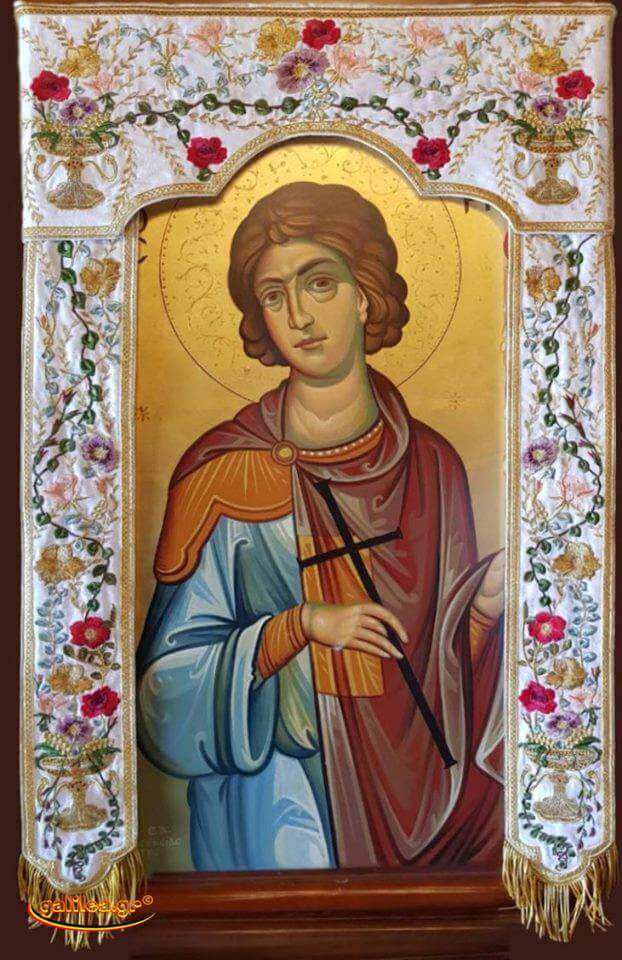
Our only hope: God. SAINT PHANOURIOS THE GREAT MARTYR –
27 Αυγούστου 2020 · ΛΕΙΤΟΥΡΓΙΚΑ ΚΗΡΥΓΜΑΤΑ
Βίντεο
FEAST
“SAINT FANOURIOS, THE GREAT MARTYR”
Topic of the Liturgical Sermons: “God, our only hope. ”
This evening, God willing, at 19:30, the Saint’s Service of Supplication (Paraklesis), afterfeast Vespers, the Blessing of Loaves and the Saint’s hypsoma, the blessed loaf, will take place before the old miraculous holy icon of Saint Phanourios, a treasured possession of our church.
THE GREAT MARTYR SAINT PHANOURIOS
THE LIFE OF THE SAINT:
Introduction:
Saint Fanourios is among the most beloved saints of the entire Greek people and can undoubtedly be described as a gift from God, for he remained unknown for many centuries.
The discovery of the icon:
Unfortunately, no written accounts of the life of Saint Fanourios have survived. Everything we know consists of inferences drawn from an icon of his that was found in Rhodes during the 14th or 15th century AD, when the island was under Hagarene rule. The Hagarenes decided to rebuild the city walls they had savagely destroyed and demolished in the war a few years earlier. So they began sending workers outside the southern part of the fortress to collect stones from the inhabitants' half-ruined houses, to rebuild their city's strong new walls. During the restoration work on the city walls, a half-destroyed church filled with ancient icons was discovered in the ruins of the southern section of the fortress. Most of these icons were so deteriorated that neither the faces of the Saints nor the inscriptions upon them could be distinguished.
Only one remarkable icon stood out from the rest, untouched by time, depicting a young man dressed in Roman military attire, holding a cross in his left hand and a candle in his right. Besides the figure of the Saint, the icon also contained twelve scenes illustrating the martyrdoms he endured at the hands of the Romans. Thus we learned that the Saint was martyred at a young age. From the severity of the martyrdoms he suffered, as depicted in the twelve scenes, we infer that he must have lived and been martyred around the 2nd or 3rd century AD, during a period when the persecution of Christians was relentless. Furthermore, from the scenes on the Holy Icon, we conclude that the Saint is a Great Martyr, having endured many cruel and inhuman tortures. Another conclusion arises from the Saint's attire, which appears to be a Roman military uniform. This indicates he was educated enough to hold such a position. Moreover, Saint Fanourios must have been of Greek origin, as evidenced by his name. The then Metropolitan of Rhodes, Neilos, because the Saint's name on the Holy Icon was worn away, gave this unknown Saint the name Fanourios. Bishop Neilos eventually restored the church where the icon was found and placed it there.
The building of the church.
The Metropolitan of Rhodes, Neilos, immediately sent a delegation to the ruler of the island, pleading for permission to restore the church. When the ruler refused, the Metropolitan personally traveled to Constantinople and succeeded in obtaining the requested permission from the Sultan. He soon returned to Rhodes and restored the church exactly in its original location, outside the walls. The church has survived to this day and has since become a holy shrine for all Christians.
The miracle of the three priests:
Saint Fanourios performs many miracles for the faithful who invoke his name, and one of these is the following:
During the historical period when the Latins held Crete under their rule (1204–1669 AD), they had established their own Archbishop and were trying by every means to lure the island's inhabitants into Catholicism (Papism).
Among the oppressive measures against Orthodoxy, the Latins had forbidden the ordination of priests in Crete; thus, the Cretans were forced to travel to the island of Tsigri (Kythera) to be ordained as priests by an Orthodox Hierarch residing there.
At one time, therefore, three deacons set out from Crete for Tsigri. Having been ordained there as priests, they were returning, filled with joy, to their much-suffering island, then enslaved. However, on their return journey, they were captured by Hagarene pirates, who took them to Rhodes and sold them to three different Hagarene masters.
And while the plight of the three priests was pitiable, a sweet hope came to sweeten their bitter lament. They learned that in Rhodes, Saint Fanourios worked miracles, and upon him they placed their hopes, continually praying and invoking him, each one separately, to deliver them from the harsh captivity of the Hagarenes. Therefore, each one, without having consulted the others, asked his master for permission to visit the church and venerate the icon of Saint Fanourios. Having obtained permission with relative ease, all three hastened to the Saint and venerated his icon with great devotion. Kneeling in prayer with all the strength of their souls, and wetting the ground with their tears, they implored Saint Fanourios to intercede so that they might finally be delivered from the hands of the Hagarenes.
After the priests departed, relieved of their pain, Saint Fanourios appeared at night to all three of their masters and commanded them to set their slave priests free. However, the Hagarene rulers regarded the Saint's intervention as some form of sorcery; consequently, they chained their slaves and began to torture them even more severely. But on the following night, Saint Fanourios, intervening effectively, loosed the three priests from their bonds and promised that He would deliver them from the Hagarenes the next day. Thereupon, He appeared again to the Hagarenes and threatened them this time, saying that if they did not release the priests in the morning, they would meet with great harm.
The next morning, the Hagarenes, disobeying the saint's command, lost their sight and their bodies were left paralysed. They were then forced to consult their relatives to discuss the affliction that had befallen them. All the rulers decided to summon the three priests, hoping they might be able to help. The priests replied that they would pray and beseech God, and He would decide.
On the third night, Saint Phanourios appeared once more to the three Hagarene rulers and announced that unless they sent written consent to his church for the liberation of the priests, they would never regain their health. The Hagarenes then submitted in writing what Saint Phanourios had requested, declaring unequivocally that they granted the three priests their freedom. Even before the delegation of Hagarenes returned from the church, the blind and paralysed unbelievers were completely healed according to the will of the Saint. The wealthy Hagarenes gave the three priests all their travelling expenses, and before departing, they went to the church; after thanking the Saint for their liberation, they faithfully copied the icon of Saint Phanourios and took it to Crete, where they honoured it every year with services of thanksgiving and processions.
The Saint is one of our greatest wonderworking Saints and is honoured as a Great Martyr. When Christians wish to ask the Saint for something, they customarily make a special cake, phanouropita, and take it to church for the priest to bless.
The Saint's memory is celebrated on 27 August.
APOLYTIKION OF SAINT PHANOURIOS THE GREAT MARTYR. Tone 4. To the melody “Come Quickly.”
“A heavenly refrain is splendidly celebrated on earth; the company of angels now joyfully celebrates an earthly feast. From above they praise your struggles in hymns; from below the Church praises the heavenly glory you attained through your labours and contests, O glorious Phanourios.”
LISTEN TO No. 02 HERE:
APOLYTIKION OF THE ENTHRONED HOLY ICON OF SAINT PHANOURIOS THE GREAT MARTYR Tone 4. To the melody “A royal diadem.”
Our parish possesses You as guardian and protector, a gift offered by the faithful for our souls. Your venerable icon, from Makri in Asia Minor, has found a new home in this church. And now, O Phanourios, victorious martyr, intercede that we may be saved.
LISTEN TO No. 03 HERE:
Φωτογραφίες